


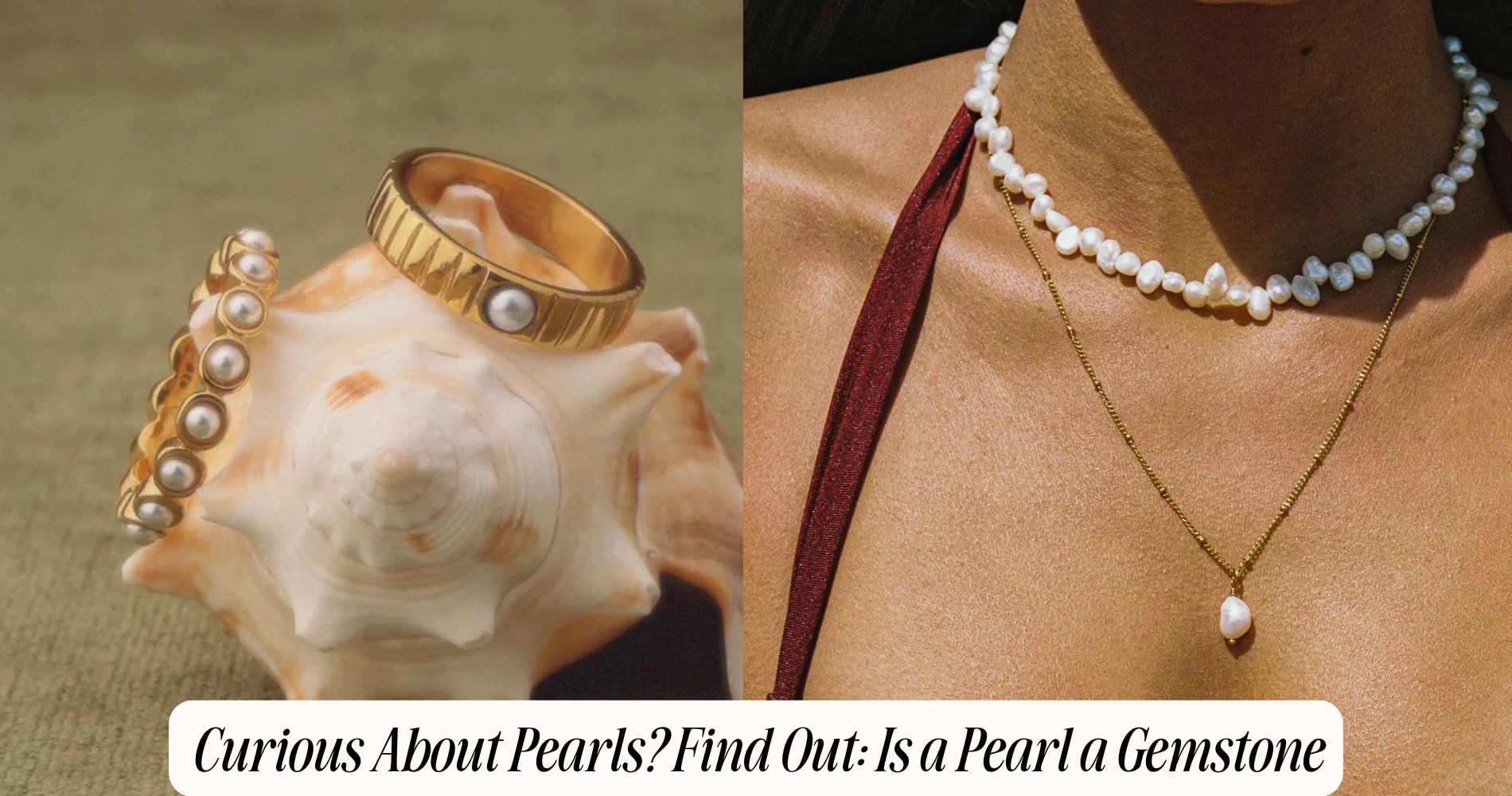
Curious About Pearls? Find Out: Is a Pearl a Gemstone
Is a pearl a gemstone? The answer is yes. A pearl meets the core criteria used to define gemstones—rarity, beauty, and sufficient durability—even though it’s organic and forms inside mollusks rather than in rock. Its signature luster, color, and orient come from layers of nacre (calcium carbonate and conchiolin), which gemologists evaluate much like the optical properties of mineral-based gems. That same nacre is what gives mother-of-pearl jewelry its soft glow and depth. As part of the “organic gemstone” category, pearls fully earn their place in the world of fine gems.
What Makes Something a Gemstone, Anyway?
Although the term “gemstone” is often used loosely, it has a precise meaning in mineralogy and gemology: a material—typically mineral, but sometimes organic—that is sufficiently rare, durable, and aesthetically appealing to be cut, polished, and used in jewelry or decorative objects.
When you evaluate the gemstone definition, you’re really examining a strict set of gemstone characteristics.

You look first at hardness and toughness, which determine resistance to scratching and breakage. You then consider chemical stability, so the material won’t degrade under light, heat, or common chemicals.
Rarity matters because abundant materials rarely achieve gem status. Finally, you inspect optical properties—refractive index, dispersion, luster, and color saturation. Only when these parameters reach distinct thresholds do you classify a material as a true gemstone.
How Pearls Form Inside Oysters and Other Mollusks
Pearl formation begins as a defensive biogenic process inside a mollusk’s soft tissue when an irritant—often a parasite or tissue fragment, not just a “grain of sand”—penetrates the mantle.
You can think of pearl creation as the mantle epithelium’s controlled reaction to isolate this foreign body.
In oyster biology, the mantle secretes successive microscopic layers of calcium carbonate (primarily aragonite) in an organic matrix of conchiolin, collectively termed nacre.
You’re seeing a highly ordered biomineralization sequence: crystalline platelets align in stacked lamellae, producing interference effects responsible for luster.
Over time, concentric nacre layers thicken around the nucleus, yielding a spheroidal or irregular concretion.
Variations in mantle physiology, secretion rate, and microenvironmental chemistry dictate pearl size, symmetry, surface quality, and optical properties.
Natural vs. Cultured Pearls: Does It Change Their Status?
Understanding the same biomineralization mechanism operates whether humans intervene or not sets up the key distinction between natural and cultured pearls.
You’re dealing with identical calcium carbonate phases (primarily aragonite) and conchiolin arranged in nacreous layers, so the fundamental material remains the same.
Natural pearl characteristics arise from a random irritant and uncontrolled deposition, producing irregular internal growth patterns and often complex, radiating structures.
Organic Gemstones: Where Pearls Fit in Gemology
While most gemstones originate from geological processes in the Earth’s crust, pearls belong to a distinct class that gemologists term “organic gemstones,” materials produced by biological organisms rather than inorganic mineral crystallization alone.
When you evaluate pearls, you’re examining biomineralization products secreted by mollusks, composed primarily of aragonite platelets and conchiolin arranged in a nacreous microstructure.
You categorize pearls with other organic gemstones such as coral, amber, and jet, all sharing organic origins and complex, non-crystalline internal architectures.
Within this framework, you analyze pearl varieties—Akoya, South Sea, Tahitian, and freshwater—by growth environment, mollusk species, and nacre deposition dynamics rather than solely by chemical formula.

This classification affects how you interpret durability, optical behavior, and appropriate testing protocols in gemological practice.
Comparing Pearls to Traditional Gems Like Diamonds and Rubies
Recognizing pearls as organic gemstones sets up a clear contrast with classic mineral gems such as diamonds and rubies, which crystallize from purely geological processes.
When you make a gemstone comparison, you’re really comparing two different formation pathways: biomineralization versus high-pressure crystallization. Diamonds and rubies possess fixed crystal lattices (cubic and trigonal corundum), while pearls consist of aragonite platelets and conchiolin arranged in nacreous layers.
You evaluate pearl rarity differently, too. Diamonds and rubies are constrained by mantle or crustal chemistry and tectonic setting; pearls depend on viable mollusk species, clean marine environments, and low mortality during cultivation.
Their mechanical properties differ: diamonds show extreme hardness (Mohs 10), rubies high durability (Mohs 9), whereas pearls are softer, anisotropic, and more vulnerable to abrasion and acids.
The Role of Luster, Color, and Shape in Pearl Value
Although pearl classification often starts with size and origin, luster, color, and shape drive most of a pearl’s market and gemological value.
When you perform luster evaluation, you’re analyzing nacre thickness, surface smoothness, and specular reflection intensity. High luster shows sharp, high-contrast reflections, indicating dense, well-ordered aragonite platelets.
Color variety involves bodycolor, overtone, and orient. You assess how microscopic interference and diffraction generate secondary hues and iridescence, then correlate those optical effects with rarity and demand.
Shape significance arises because perfectly spherical pearls require highly symmetrical nacre deposition. You’ll observe how deviations—baroque, drop, button—affect symmetry and design versatility.
During value determination, you integrate these three parameters, weighting luster most, then color and shape, to quantify a pearl’s overall quality.
How Jewelers and Gemologists Classify Pearls Today
In contemporary practice, jewelers and gemologists classify pearls using standardized systems that integrate origin, cultivation method, and a suite of measurable quality factors.
You’ll see pearls first separated by origin—saltwater vs. freshwater—and by natural vs. cultured formation. Within these categories, experts apply classification methods that quantify nacre thickness, luster intensity, surface cleanliness, shape regularity, and size.
When you encounter professional pearl grading, you’re usually dealing with tiered scales (such as A–AAA or A–AAAA) or proprietary laboratory criteria.
These systems rely on magnification, calibrated lighting, and comparative master sets. You can also expect documentation specifying species (e.g., Akoya, South Sea, Tahitian), treatment status, and matching consistency for strands, ensuring that each pearl’s quality is assessed with reproducible, objective parameters.
Famous Pearls in History and Their Symbolic Power
Pearl grading systems describe quality in quantitative terms, but some individual pearls have exerted disproportionate historical and cultural influence that far exceeds their gemological metrics.

When you study famous pearls, you’re really analyzing how material properties intersect with power, religion, and status.
You can view La Peregrina, the Hope Pearl, and the Pearl of Lao Tzu as case studies. Their size, luster, and rarity matter, but their historical significance comes from royal ownership, diplomatic exchange, and mythologized provenance.
These pearls functioned as visual indices of sovereignty, divine favor, and extreme wealth.
Caring for Pearls: Why This “Gem” Needs Special Treatment
Because pearls are biomineral composites rather than crystalline minerals, they demand stricter care protocols than most traditional gemstones. Their aragonite platelets and organic matrix are highly sensitive to acids, alkalis, heat, and dehydration, so you must design pearl cleaning and storage techniques around chemical and thermal stability.
You should clean pearls using a soft, slightly damp, lint‑free cloth, removing sweat, sebum, and cosmetics that can etch nacre. Avoid ultrasonic cleaners, steam, and detergents containing ammonia, alcohol, or strong surfactants; these disrupt the nacreous microstructure and reduce luster.
For storage, maintain moderate humidity, avoid direct sunlight, and keep pearls away from hard gemstones that can abrade them. Store pieces flat, in fabric‑lined compartments, and never in airtight plastic, which promotes desiccation.
Frequently Asked Questions
Are Imitation Pearls Considered Gemstones or Just Fashion Accessories?
You should classify imitation pearls as fashion accessories, not true gemstones. They’re synthetic composites lacking crystalline structure, so gemstone classification doesn’t apply. You still evaluate pearl quality analytically using surface luster, coating durability, sphericity, and color uniformity.
Do Different Mollusk Species Produce Chemically Different Pearls?
Yes, you see modest variation: different mollusk varieties shift mineral proportions, organic matrix proteins, trace elements, and crystal microstructure. Still, the core chemical composition—predominantly calcium carbonate (aragonite) plus conchiolin—remains conserved across species, with nuanced, measurable interspecific differences.
Can Pearls Be Ethically Sourced Without Harming Oysters or Ecosystems?
Yes, you can source pearls ethically by using sustainable aquaculture that minimizes mortality, monitors water quality, and enforces low-density stocking, while integrating oyster conservation strategies such as habitat restoration, genetic diversity maintenance, and strict ecosystem-impact assessments.
How Do Pearl Birthstones Differ From Other Month Gemstones?
You observe that pearl birthstones differ because they’re biomineralized organics, not crystalline minerals. You analyze pearl significance via nacre structure and iridescence, while other birthstone meanings derive from lattice symmetry, refractive indices, and trace-element–driven chromophore systems.
Are Freshwater Pearls Less “Gemstone-Worthy” Than Saltwater Pearls?
No, you shouldn’t deem freshwater pearls less “gemstone-worthy.” You evaluate them differently: freshwater value reflects abundance and variable nacre quality, while saltwater rarity, tighter size control, and often higher luster typically command superior market and collector status.
Conclusion
So, is a pearl a gemstone? Yes—specifically, an organic gemstone with a biomineral composition (primarily aragonite and conchiolin). You’ve seen how its origin, microstructure, luster, and nacre quality place it firmly within gemological classification, even though it differs from crystalline minerals like diamonds. When you evaluate or wear pearls, you’re engaging with a unique biogenic gem that demands careful handling, controlled storage, and precise maintenance to preserve its optical performance.










Leave a comment
This site is protected by hCaptcha and the hCaptcha Privacy Policy and Terms of Service apply.