


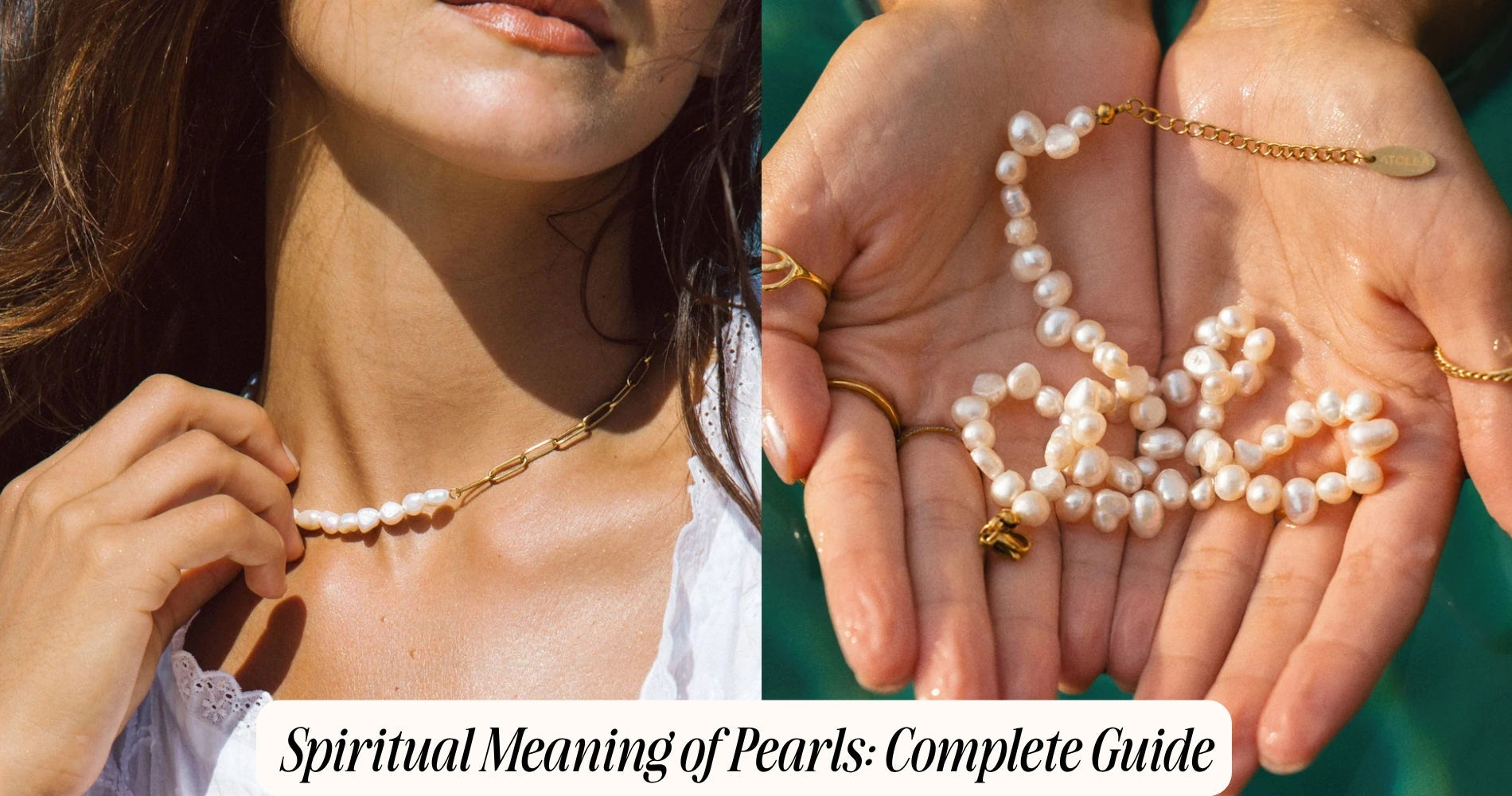
Spiritual Meaning of Pearls: Complete Guide
Pearls carry spiritual meaning that predates recorded history, and the consistency of those meanings across cultures that had no contact with each other suggests something genuinely resonant in the pearl as a spiritual object. The spiritual meaning of pearls is not a single tradition but a convergence: wisdom, purity, transformation, divine grace, and the capacity to produce beauty from difficulty appear independently across Eastern and Western spiritual traditions, ancient and contemporary. Freshwater Pearls Jewelry carries that tradition into wearable form. This guide covers the biological origin of pearl symbolism, the core spiritual meanings across major traditions, the pearl's significance in specific religious contexts, and how to wear pearl jewelry with awareness of what the symbol carries.
Why Pearls Carry Spiritual Weight: The Biological Origin
Pearl spiritual symbolism begins with the biological process that creates pearls, because that process is genuinely remarkable and maps directly onto spiritual concepts in ways that feel earned rather than assigned.
A pearl begins as an irritant: a grain of sand, a parasite, a fragment of shell that enters the mollusk and cannot be expelled. The mollusk's response is to encase the irritant in layer after layer of nacre, the same lustrous material that lines the inner shell. Over months and years, the nacre accumulates until the irritant is entirely enclosed within a smooth, luminous sphere. The original cause of discomfort has been transformed into one of the most prized objects in the natural world.

This transformation of irritation into beauty, of difficulty into something luminous and valuable, is the biological root of virtually every spiritual meaning pearls carry. The pearl does not deny the irritant. It does not expel it. It transforms it through sustained, patient secretion into something that has value precisely because of what it went through to exist.
The pearl is also created in darkness, inside a living creature, at the bottom of the sea. It is hidden from view during its entire formation period and only becomes visible when it is brought to the surface and the shell is opened. This hidden formation in depth, followed by emergence into light, connects pearls to spiritual concepts of inner transformation, contemplative development, and the gradual revelation of qualities formed in private.
Spiritual Meaning of Pearls: Core Meanings Across Traditions
Wisdom Through Experience
The most widely held spiritual meaning of pearls is wisdom, specifically the kind of wisdom that comes through experience rather than study. The phrase "pearls of wisdom" captures this meaning directly: wisdom that is hard-won, precious, and formed through the sustained process of living through difficulty rather than avoiding it.
In Buddhist teaching, the pearl is one of the Eight Precious Things in Chinese Buddhism and appears in the concept of the Cintamani, a wish-fulfilling jewel that represents ultimate wisdom and enlightenment. The Cintamani is often depicted as a radiant pearl held by Buddhist figures as a symbol of the mind's inherent luminous quality, uncovered through practice rather than acquired from outside.
In Western wisdom traditions, pearls appear in proverbs and spiritual teaching as symbols of truth and insight that must be discovered beneath the surface and protected from those who cannot appreciate their value. The injunction not to "cast pearls before swine" uses the pearl specifically as a symbol of spiritual insight whose worth is invisible to those not prepared to receive it.
The wisdom meaning of pearls connects directly to their biological origin: wisdom, like a pearl, is formed through the patient transformation of experience, not through the avoidance of difficulty.
Purity and Integrity
Pearls carry associations with purity across Eastern and Western spiritual traditions, and this meaning has a specific character that distinguishes it from simple innocence.
Pearl purity is not the purity of something untouched by difficulty. It is the purity of something that has been through difficulty and emerged without corruption. A pearl has been formed by an irritant in a marine environment that contains everything the ocean carries, and it emerges as a smooth, luminous sphere without blemish. This is the purity of integrity rather than innocence: the quality of maintaining essential nature through process.
In Hindu tradition, pearls are associated with the moon and with the quality of pure, reflected light. The pearl does not generate its own light but reflects it completely, which connects it to the spiritual quality of pure receptivity and the capacity to reflect divine light without distorting it. Pearl jewelry has been used in Hindu ceremonial contexts for thousands of years as a symbol of this lunar purity.
In Christian tradition, the pearl is used as a metaphor for the Kingdom of Heaven in the parable of the Pearl of Great Price, in which a merchant sells everything to acquire a single perfect pearl. The pearl represents ultimate spiritual value, a truth or state of being so complete and pure that everything else is worth trading for it.

Transformation and Inner Alchemy
The pearl's formation process is the most direct natural metaphor for spiritual transformation available in the natural world, which is why transformation appears as a pearl meaning across so many traditions independently.
The irritant that begins the pearl's formation is not removed or denied. It is transformed by the organism's sustained response into something entirely different from what it was. The grain of sand or parasite that caused discomfort becomes the nucleus of something luminous. The difficulty that initiated the process is not separate from the pearl. It is the pearl's center.
This is the spiritual meaning most relevant to the concept of inner alchemy: the idea that the circumstances that challenge and irritate us are the specific material from which our most significant personal growth is formed, not despite those circumstances but through them and because of them.
Contemporary spiritual practitioners who wear pearls for this meaning often do so as a reminder that current difficulties are not obstacles to their development but the specific irritants around which something luminous is forming. The pearl becomes a visible symbol of a process that is happening invisibly.
Divine Grace and Blessing
In multiple traditions, pearls are associated with divine grace: the quality of receiving something precious that is not earned through effort but given through the generosity of a larger spiritual reality.
In Islamic tradition, pearls appear in descriptions of paradise, where the righteous are described as living in dwellings made of pearl. The pearl in this context represents the beauty and preciousness of divine blessing, the quality of existence in a state of complete alignment with the divine will.
In Chinese culture, pearls are associated with the dragon, the most powerful and auspicious symbol in the Chinese spiritual tradition. The dragon is often depicted pursuing or holding a pearl, which represents spiritual wisdom, divine blessing, and the quality of illumination that the most enlightened teachers carry. A pearl in this context is not simply beautiful. It is a concentrated form of spiritual power and divine favor.
In Polynesian and Pacific cultural traditions, pearls from the black-lipped oyster carry associations with Oro, the god of peace and fertility, and with the connection between the ocean depths and the divine. The pearl is a gift from the ocean's interior, which in Pacific spiritual understanding is a living, conscious realm rather than an empty space.

Calm and Emotional Balance
A fifth spiritual meaning of pearls that appears across traditions is calm: the quality of stillness and emotional balance that comes from depth rather than from the absence of experience.
The pearl sits at the bottom of the sea, formed in the quietest, most stable part of its environment, insulated from the storms and surface turbulence that affect the water above it. In meditation traditions, the pearl is sometimes used as an object of contemplation specifically because its depth of origin symbolizes the state of mind available beneath surface emotional reactivity.
Wearing pearl jewelry in this context is associated with accessing the calm that exists beneath the emotional surface, with finding the still point inside the movement of daily life, and with maintaining equanimity in circumstances that create reactivity in others.
Pearls in Major Religious and Spiritual Traditions
| Tradition | Pearl Meaning | Specific Context |
|---|---|---|
| Buddhism | Wisdom, enlightenment, Cintamani | Eight Precious Things, wish-fulfilling jewel |
| Hinduism | Lunar purity, divine reflection | Moon association, ceremonial use |
| Christianity | Ultimate spiritual value, Kingdom of Heaven | Parable of the Pearl of Great Price |
| Islam | Divine beauty, paradise | Descriptions of paradise in the Quran |
| Chinese spiritual tradition | Divine wisdom, dragon power, auspicious blessing | Dragon and pearl imagery |
| Pacific traditions | Ocean gift, divine connection | Pearls as gifts from Oro and the ocean realm |
| Western wisdom traditions | Hard-won wisdom, truth | Pearls of wisdom, casting before swine |

Frequently Asked Questions
What is the spiritual meaning of pearls in Christianity?
In Christian tradition, pearls most famously represent the Kingdom of Heaven in the Parable of the Pearl of Great Price (Matthew 13:45-46), where a merchant sells everything he has to buy one perfect pearl. The pearl in this parable represents ultimate spiritual value, a truth or state of being so complete that everything else is worth giving up to attain it. Pearls also appear in the description of the gates of heaven in Revelation and in references to wisdom and divine truth throughout scripture.
What do pearls symbolize in Eastern traditions?
In Buddhism, pearls are one of the Eight Precious Things and represent enlightenment and the luminous quality of the awakened mind. In Hinduism, pearls are associated with the moon and with pure, reflected divine light, and have been used in ceremonial jewelry for thousands of years. In Chinese spiritual tradition, the pearl represents divine wisdom and appears in dragon imagery as a symbol of supreme auspicious blessing and illumination.
Do pearls bring good luck spiritually?
In many traditions, particularly Chinese, Hindu, and Pacific island traditions, pearls are considered carriers of blessing and good fortune. Chinese tradition associates the pearl with the dragon, the most auspicious symbol in the tradition. Hindu tradition uses pearls in ceremonial contexts connected to blessings and divine favor. Whether pearls bring luck in a literal sense is a matter of individual belief, but the association with blessing and favorable spiritual influence is consistent across several major traditions.
What does it mean when someone gives you pearls?
Receiving pearls as a gift carries spiritual meaning from several traditions. In the wisdom tradition, being given pearls suggests the giver sees you as someone capable of receiving and appreciating deep truth. In the transformation tradition, pearls as a gift can mark a period of significant personal growth or a recognition of difficulty beautifully transformed. In the grace and blessing tradition, pearl gifts carry the intention of divine favor and prosperity. The specific meaning depends on the context and the traditions meaningful to both the giver and receiver.
Why are pearls associated with tears?
The association between pearls and tears appears across several cultures, including in European folklore where pearls were sometimes called "tears of the sea" or "mermaid tears." This association connects to the pearl's formation through difficulty (the irritant creating the pearl parallels the way meaningful emotion is formed through experience) and to the pearl's rounded, luminous form that physically resembles a tear. In some traditions this association gives pearl gifts a melancholic quality, while in others it deepens the pearl's connection to emotional authenticity and the value of genuine feeling.
Conclusion
The spiritual meaning of pearls is grounded in the biological reality of how pearls form: through the patient transformation of an irritant into something luminous, in hidden depth, over extended time. That process maps onto the deepest spiritual concepts across virtually every major tradition independently: wisdom formed through experience, purity maintained through process, transformation as the specific alchemy of difficulty into beauty, divine grace as a gift from the ocean's depths, and the calm of a center formed below surface turbulence. A pearl worn with awareness of any of these meanings becomes more than an accessory. It becomes a carried reminder of a truth the wearer knows, a small luminous thing formed from the same process the wearer is going through.
















Leave a comment
This site is protected by hCaptcha and the hCaptcha Privacy Policy and Terms of Service apply.