

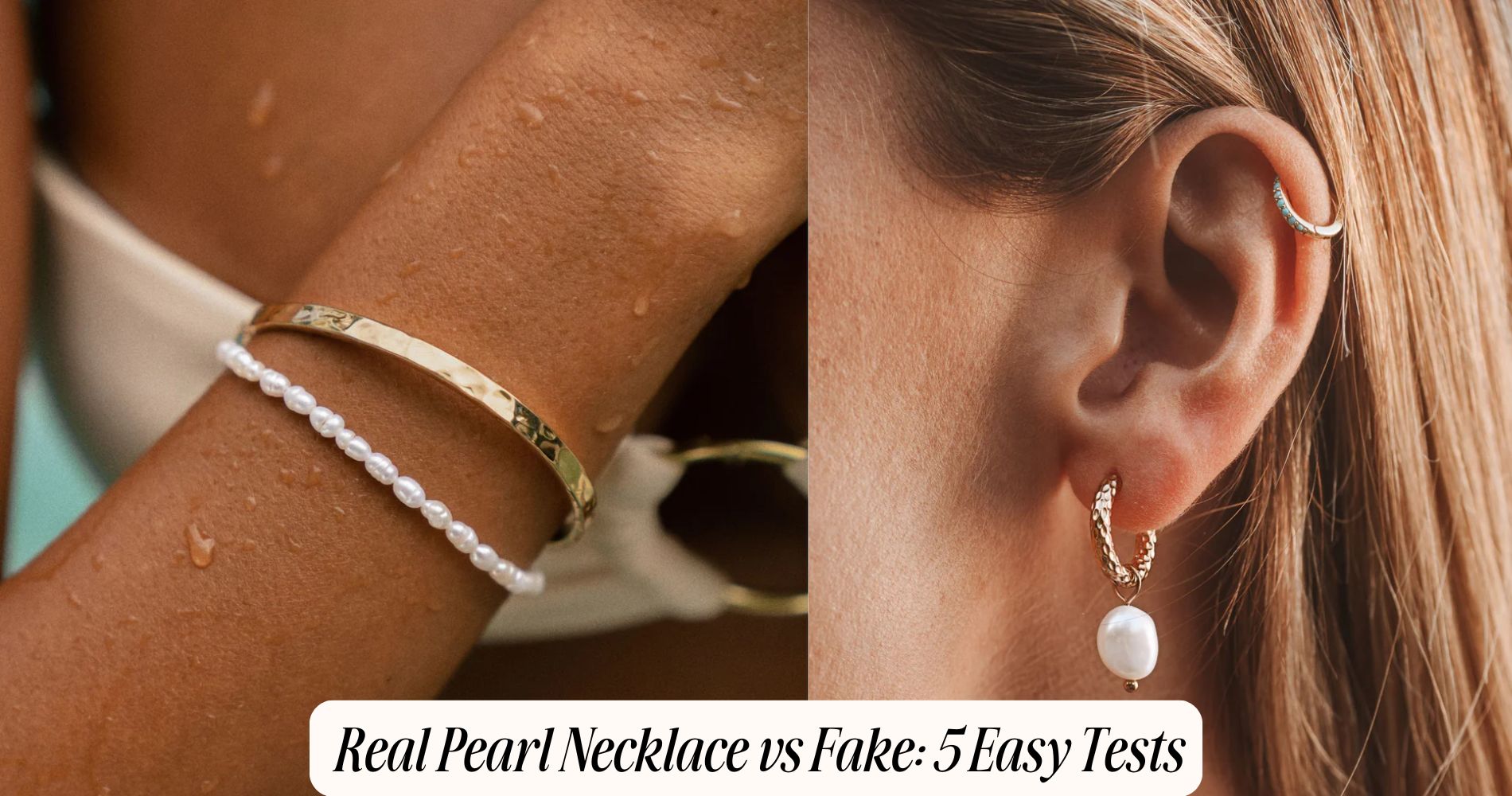
Real Pearl Necklace vs Fake: 5 Easy Tests
When comparing a real pearl necklace vs fake, a few simple checks can reveal the truth quickly. Begin by examining luster under neutral light—authentic pearls reflect sharply with a deep, layered glow and defined rims formed by nacre. Next, test texture by gently rubbing a pearl against your front teeth or between two pearls; real pearls feel subtly gritty and may leave faint powder. Use a loupe to inspect shape, color variation, and drill holes—natural pearls often show slight asymmetry, tonal differences, and visible nacre layers. Finally, assess temperature and weight: genuine pearls feel cool at first touch and are heavier than plastic imitations. These practical tests are especially helpful when evaluating pieces like Freshwater Pearls Jewelry before moving on to more advanced authentication cues.
Check Luster and Depth of Shine
Although size and color catch your eye, start by evaluating luster—the intensity and sharpness of light reflected from the pearl’s surface.
View pearls under neutral lighting and rotate them. In a luster comparison, real pearls show crisp, mirror-like reflections and distinct highlights with minimal haze. You’ll see face features reflected with sharper edges.
Assess shine depth next: genuine nacre creates a layered, almost three-dimensional glow, as if light emanates from within rather than just the surface.
Check contrast: high-luster pearls exhibit strong light–dark separation, not a milky blur. Note edge definition—real pearls maintain bright rims without diffused halos.
Observe color overtones; natural nacre often displays subtle, complex overtones that shift with angle.
Document observations side-by-side to reduce bias and confirm consistent optical behavior.

Feel the Texture: Gritty vs. Smooth
Texture tells a quick truth: perform the “tooth test” by gently rubbing a pearl along your front teeth. Real pearls feel distinctly gritty or sandy because their nacre layers contain microscopic crystalline platelets. That resistance indicates natural origin or at least a thick nacre coating.
By contrast, plastic or glass imitations feel uniformly smooth and slick due to molded or lacquered surfaces.
Test multiple beads to reduce error. Most pearl types—Akoya, South Sea, Tahitian, and many freshwater—exhibit that fine drag when authentic. Slight variation occurs: thicker nacre generally yields stronger grit.
If you sense mixed results, lightly rub two pearls together; real nacre produces faint powder and audible friction, while fakes glide silently.
After testing, wipe pearls with a soft cloth to remove residue and protect luster.
Inspect Shape, Size, and Drill Holes
Symmetry is a fast visual clue. Examine each pearl’s outline: natural pearls are rarely perfectly round, often showing minor ellipticity or baroque contours. Uniformly spherical beads throughout a strand can indicate imitation.
Check size gradation; cultured strands usually display subtle, consistent tapering, while fakes often show factory-perfect uniformity. Compare pearl colors under neutral light; genuine strands exhibit slight tonal and overtone variation, not paint-like sameness.
Inspect drill holes with a loupe. Real pearls show sharp, clean edges with nacre layers visible as concentric growth, and the hole path stays centered.
Look for chipping or nacre “rings” around the aperture—both consistent with genuine nacre. Plastic or glass imitations reveal melted, beveled rims, off-center drilling, and coating flake at the hole—warning signs for necklace authenticity.

Test Temperature and Weight in Hand
Beyond shape and drill clues, your hands offer quick data points. Place the strand in your palm at room temperature. Genuine pearls feel initially cool due to low thermal conductivity, then warm gradually within 10–20 seconds.
Glass imitations often match ambient temperature immediately; plastic warms almost instantly. Next, assess mass. Compare the necklace to a known glass-bead strand of similar size. Real pearls typically show moderate heft—denser than plastic, lighter than most solid glass cores.
Note distribution: cultured pearls on silk drape with subtle, even weight; lightweight synthetics feel buoyant. Observe color variations and surface imperfections concurrently; natural nacre layers create subtle tone shifts and micro-pitting that align with realistic temperature and weight behavior, while uniform fakes often pair consistent warmth with monotone surfaces.
Rub Test and Tooth Test (Gently)
A pair of simple friction tests can reveal nacre. Use the rub method first: select two pearls and gently rub them together or rub one against the necklace’s clasp.
Genuine nacre feels subtly gritty, like fine sandpaper, due to microscopic aragonite platelets. Glass or plastic imitations feel uniformly smooth. Avoid force; you’re detecting texture, not abrading surfaces.
Next, try the tooth technique. Lightly drag a pearl across your front teeth’s biting edge. Real pearls produce a faint, chalky resistance; fakes glide slickly.
Clean the pearl before and after to remove residue. Both tests are screening tools, not definitive authentication.
If results are ambiguous—e.g., slightly gritty coated beads—seek magnified inspection or professional evaluation to confirm nacre thickness and surface structure.

Frequently Asked Questions
Are There Reliable At-Home UV Light Tests for Pearls?
Yes, but you should treat them as preliminary. Under UV light, many natural pearls appear inert or faintly green, while some cultured/dyed fluoresce. At home tests can mislead; verify alongside magnification, surface texture, drill-hole inspection, and professional evaluation.
How Do I Identify Pearl Types Like Akoya vs. Freshwater?
You compare nacre structure, lustre differences, and pearl shapes. Akoya pearls show high, mirror-like lustre, round symmetry, thinner nacre, smaller sizes. Freshwater pearls exhibit softer lustre, varied shapes (oval, button, baroque), thicker nacre, larger size range. Verify drill holes.
Can Perfume or Sweat Damage Real Pearls Over Time?
Yes. You risk gradual nacre erosion from acids, alcohols, and salts in perfume and sweat. Prioritize pearl care: minimize chemical exposure, apply perfume before wearing, wipe pearls after use, store dry, restring periodically to prevent abrasion and thread degradation.
Do Certification Documents Verify Authenticity and Origin?
Yes. Reputable lab certificates provide authenticity verification and origin assessment, detailing species, natural vs. cultured status, treatments, and grading. You should confirm issuing authority, report number, and matching photos. Understand certification importance: not all documents carry equal evidentiary weight.
What Pricing Ranges Indicate Genuine Pearls Versus Imitations?
Expect genuine pearls to range roughly $300–$5,000+ per strand, depending on type and quality; imitations cluster under $100–$300. You’ll spot price differences, consistent sizing, overly glossy coatings, and lightweight feel as key imitation indicators.
Conclusion
By now, you can evaluate pearls with confidence. Prioritize luster and depth, then verify texture for a natural grit. Cross-check uniformity in shape, size, and drill holes for machining clues. Assess temperature and weight for organic density. Finally, confirm with a careful rub or tooth test—gentle friction should feel sandy, not slick. When results align across tests, authenticity is likely. If conflicting, consult a gemologist for x-ray diffraction or spectroscopy to decisively distinguish cultured, natural, and imitation pearls.









Leave a comment
This site is protected by hCaptcha and the hCaptcha Privacy Policy and Terms of Service apply.