

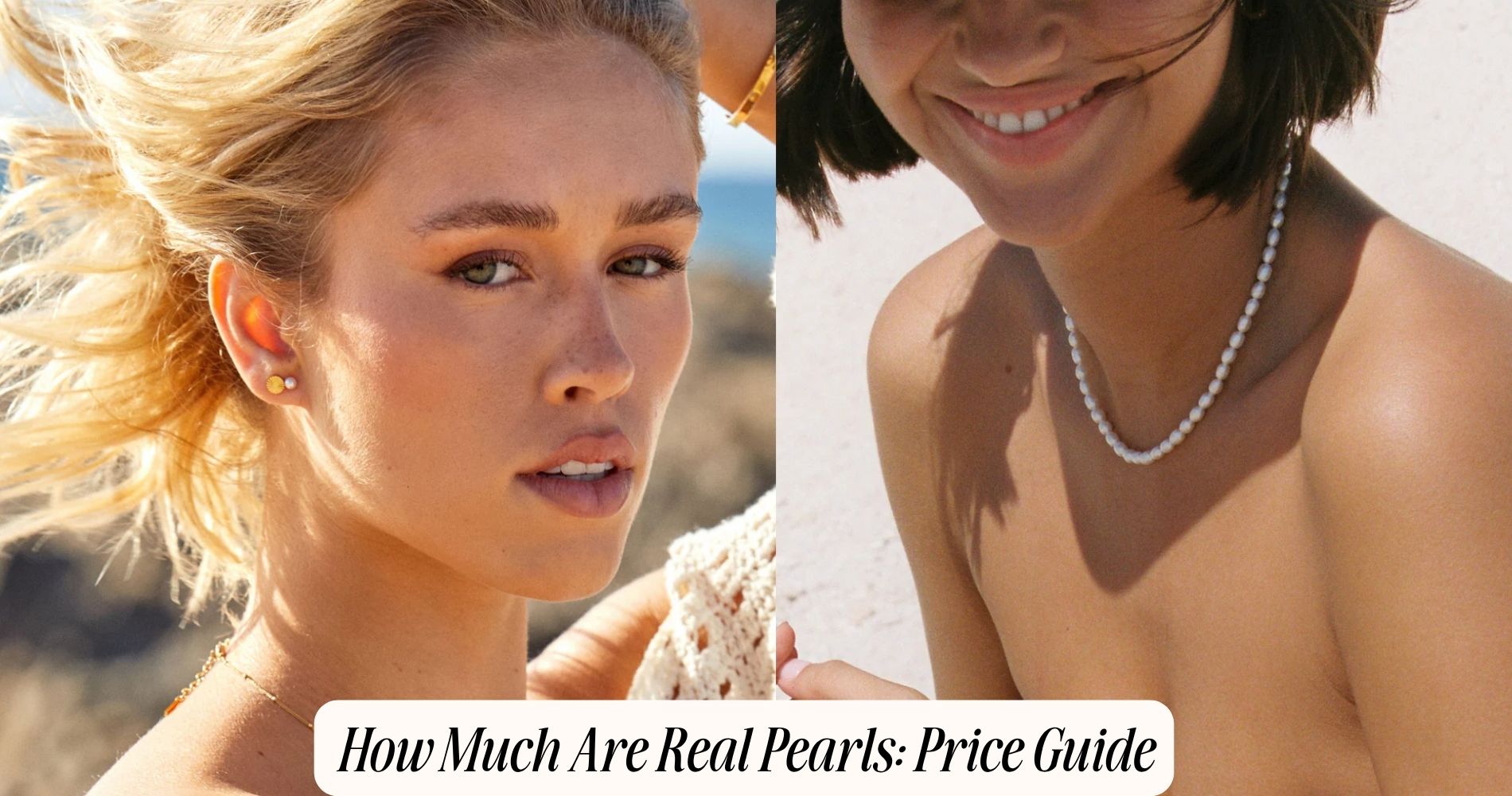
How Much Are Real Pearls: Price Guide
Pearl prices span a wider range than almost any other jewelry material, from a few dollars for a single freshwater pearl to hundreds of thousands for a fine natural saltwater strand. The spread is so large that the question of how much real pearls cost has no single answer without understanding what drives that range. Knowing how much are real pearls worth at different quality and type levels gives you the framework to evaluate any pearl purchase accurately, whether you are buying a single pendant or a full strand. Freshwater Pearls Jewelry sits at one end of that spectrum as an accessible entry point. This guide breaks down pearl pricing by type, explains the quality factors that drive value within each type, and helps you understand what you are actually buying at any price point.
Why Pearl Prices Vary So Widely
The price range for real pearls is wider than for almost any other gemstone because several distinct variables interact to determine value, and those variables compound rather than add linearly.
Pearl type is the largest single variable. The four major commercial pearl types, freshwater, Akoya, Tahitian, and South Sea, are produced by different mollusk species in different geographic regions and have fundamentally different production costs, rarity, and market positioning. A fine South Sea pearl is not simply a larger or shinier freshwater pearl. It is a different material in terms of nacre thickness, luster quality, and the economics of its production.

Within each type, five quality factors further differentiate value: luster, surface quality, shape, size, and color. A top-grade Akoya pearl and a low-grade Akoya pearl from the same harvest can differ significantly in price because the quality distribution within any type is wide.
Finally, the way pearls are sold, loose, strung as a strand, or set in jewelry, affects price because of the labor involved in matching and setting. A matched strand of graduated Akoya pearls requires significant time to assemble from a much larger pool of individual pearls, and that matching effort is reflected in the price.
How Much Are Real Pearls: By Type
Freshwater Pearls
Freshwater pearls are produced by freshwater mussels, primarily in China, and account for the large majority of pearl production worldwide. Modern freshwater pearl farming has advanced significantly over the past two decades, and current top-grade freshwater pearls rival Akoya pearls in luster and surface quality at significantly lower prices.
Price range for freshwater pearls:
- Single loose pearl: $1 to $50 depending on size, shape, and quality
- Simple freshwater pearl pendant or stud earrings: $20 to $150
- Freshwater pearl strand (16 inches, mixed quality): $30 to $200
- High-quality freshwater pearl strand (round, high luster): $200 to $800
- Baroque or irregular freshwater pearl jewelry: $15 to $100 per piece
Freshwater pearls are the most accessible real pearl option. Their price accessibility does not mean low quality in the current market. High-grade freshwater pearls with strong luster, minimal surface blemishes, and near-round shapes can be visually comparable to Akoya pearls at a fraction of the price. The distinction is primarily in nacre composition (freshwater pearls are solid nacre throughout, without a bead nucleus) and in the specific luster quality that Akoya pearls produce.

Akoya Pearls
Akoya pearls are the classic round white pearl associated with the traditional Japanese pearl strand. Produced primarily by Pinctada fucata oysters in Japan and China, Akoya pearls are bead-nucleated, meaning a round shell bead is inserted into the oyster and nacre is deposited over it over one to two years. This nucleus produces a rounder shape and a specific mirror-like luster quality that Akoya pearls are known for.
Price range for Akoya pearls:
- Single loose Akoya pearl: $30 to $200 depending on size and quality
- Simple Akoya pearl pendant or stud earrings: $100 to $500
- Akoya pearl strand (16 inches, standard quality): $300 to $1,500
- Fine Akoya pearl strand (high luster, minimal blemishes): $1,500 to $5,000 and above
Akoya pearls range from 5mm to 9mm in diameter for most commercial production, with larger sizes commanding significant price premiums. The distinction in luster between a high-grade Akoya and a freshwater pearl is real but requires side-by-side comparison to appreciate. For most everyday jewelry applications, the luster difference is not dramatic enough to justify the price difference unless the mirror-like Akoya quality is specifically desired.
Tahitian Pearls
Tahitian pearls are produced by Pinctada margaritifera, the black-lipped oyster, in French Polynesia. They are the only naturally dark pearl type and produce a range of colors from charcoal gray and deep black through green, peacock, and aubergine overtones. Each color combination is distinct and the most prized Tahitian pearls show strong peacock or green overtone against a dark body color.
Price range for Tahitian pearls:
- Single loose Tahitian pearl: $50 to $500 depending on size, color, and quality
- Tahitian pearl pendant or drop earrings: $150 to $1,000
- Tahitian pearl strand (16 inches): $500 to $5,000 and above for well-matched strands
Tahitian pearls range from 8mm to 16mm in diameter, with the largest sizes and the most prized color combinations (peacock overtone, deep luster, minimal blemishes) reaching the upper end of that range and beyond.
South Sea Pearls
South Sea pearls are the most valuable cultured pearl type. Produced by Pinctada maxima, the largest pearl oyster, in Australia, Indonesia, and the Philippines, South Sea pearls develop over two to four years with nacre layers that are significantly thicker than any other cultured pearl type. This thick nacre produces an exceptionally deep luster with a warm, satiny quality distinct from Akoya's mirror-like brightness.
Price range for South Sea pearls:
- Single loose South Sea pearl: $200 to $2,000 and above
- South Sea pearl pendant or drop earrings: $500 to $5,000
- South Sea pearl strand (16 inches): $5,000 to $50,000 and above for fine matched strands
White South Sea pearls range from 10mm to 20mm in diameter. Golden South Sea pearls from the gold-lipped variety of Pinctada maxima are among the rarest and most valuable cultured pearls available.
Pearl Type Price Comparison
| Pearl Type | Size Range | Single Pearl Range | Strand Range | Key Characteristic |
|---|---|---|---|---|
| Freshwater | 5 to 12mm (up to 15mm baroque) | $1 to $50 | $30 to $800 | Solid nacre, most accessible |
| Akoya | 5 to 9mm | $30 to $200 | $300 to $5,000+ | Mirror luster, classic round |
| Tahitian | 8 to 16mm | $50 to $500 | $500 to $5,000+ | Natural dark colors |
| South Sea | 10 to 20mm | $200 to $2,000+ | $5,000 to $50,000+ | Thickest nacre, satiny luster |

The Five Quality Factors That Drive Pearl Price
Within any pearl type, five quality factors determine where a specific pearl falls in the price range.
Luster is the most important quality factor for pearl value. It refers to the depth and intensity of the reflection from the pearl's surface and is produced by the thickness and regularity of the nacre layers. High-luster pearls show a sharp, clear reflection with depth. Low-luster pearls appear chalky or dull. Two pearls of the same type, size, and shape can differ dramatically in price based on luster alone.
Surface quality refers to the presence and visibility of blemishes: pits, bumps, spots, scratches, and surface irregularities that are natural artifacts of the pearl's formation. Flawless or near-flawless surfaces command significant premiums. Slight blemishes reduce price modestly. Heavy blemishes reduce price substantially. Blemish-free surfaces are rare, and expecting perfection in natural pearl products leads to price shock when shopping for high grades.
Shape has a strong influence on price because perfectly round pearls require the greatest luck or control in production. Round and near-round pearls command the highest prices within any type. Off-round, oval, drop, and button shapes are less expensive. Baroque pearls, with irregular organic shapes, are the least expensive by shape and are sometimes the most interesting aesthetically.
Size scales price significantly because larger pearls require more time in the water, more nacre deposition, and are naturally rarer. Within any type, each millimeter increase in diameter above the average size for that type produces a meaningful price increase. A 9mm Akoya pearl costs substantially more than a 7mm Akoya of identical quality.
Color matters for Tahitian and South Sea pearls especially, where certain color combinations are significantly more prized than others. For white pearls (freshwater and Akoya), a clean white with a pink or silver overtone commands a slight premium over cream or yellowish body colors.

How to Tell Real Pearls From Fake
Since pearl jewelry spans such a wide price range, knowing how to verify authenticity protects against paying real pearl prices for imitations.
The most reliable at-home test is the tooth test. Rub the pearl gently against the edge of a front tooth. Real pearls, whether natural or cultured, have a slightly gritty or sandy texture from the crystalline surface of the nacre. Imitation pearls made from glass or plastic feel smooth or waxy against the tooth. This works because nacre's aragonite crystal microstructure creates a natural micro-roughness that no smooth synthetic coating replicates at that scale.
Weight is a secondary indicator. Real pearls are dense and feel heavier than glass or plastic imitations of the same size. Holding a real pearl and a convincing fake in each hand often reveals the difference through the weight differential.
For expensive purchases, a professional gemological assessment provides definitive verification and is worth the cost for fine Akoya, Tahitian, or South Sea pearl jewelry.
Frequently Asked Questions
How much do real pearl earrings cost?
Freshwater pearl stud or drop earrings range from $20 to $150 for quality everyday pieces. Akoya pearl earrings range from $100 to $500 for standard quality. Tahitian or South Sea pearl earrings start around $150 to $500 and reach several thousand dollars for large, high-quality pieces. The type, size, and luster of the pearl are the primary price drivers.
Are freshwater pearls real pearls?
Yes. Freshwater pearls are real pearls produced by freshwater mussels, primarily in China. They are not imitations or synthetic materials. Modern high-grade freshwater pearls are solid nacre throughout rather than bead-nucleated, which some consider a higher-quality construction than the thin nacre layer over a bead nucleus that characterizes Akoya pearls.
Why are some pearls so much more expensive than others?
Pearl price differences come from the interaction of type, size, luster, surface quality, and shape. South Sea pearls are more expensive than freshwater pearls because they take longer to grow, are rarer, and develop thicker nacre that produces a different luster quality. Within any type, a large, round, high-luster, nearly blemish-free pearl is dramatically more expensive than a small, baroque, chalky one of the same species.
What is a fair price for a pearl necklace?
A freshwater pearl strand of decent quality runs $50 to $300 for 16 inches. A quality Akoya strand runs $500 to $2,000. Tahitian strands start around $1,000 for modest quality. These ranges represent retail prices for genuinely cultured pearls. Prices significantly below these ranges for claimed Akoya or South Sea pearls warrant verification of authenticity.
How can you tell if pearls are real?
The tooth test is the most accessible check: rub the pearl against your front tooth. Real pearls feel gritty from the crystalline nacre surface. Imitations feel smooth. Real pearls also have visible depth to their luster in good lighting and feel heavier than plastic or resin imitations of the same apparent size. For expensive pieces, a gemologist can provide definitive verification.
Understanding Pearl Value Before You Buy
How much are real pearls ranges from under ten dollars for a loose freshwater pearl to tens of thousands for a matched South Sea strand, with the difference driven by type, size, luster, surface quality, and shape interacting together. Freshwater pearls are the most accessible genuine pearl option and current production quality at the top grades is significantly better than the freshwater pearl reputation from a decade ago. Understanding which quality factors matter most to you, whether luster, size, shape, or surface perfection, helps you identify where in the price range the right piece for you actually sits.











Leave a comment
This site is protected by hCaptcha and the hCaptcha Privacy Policy and Terms of Service apply.