


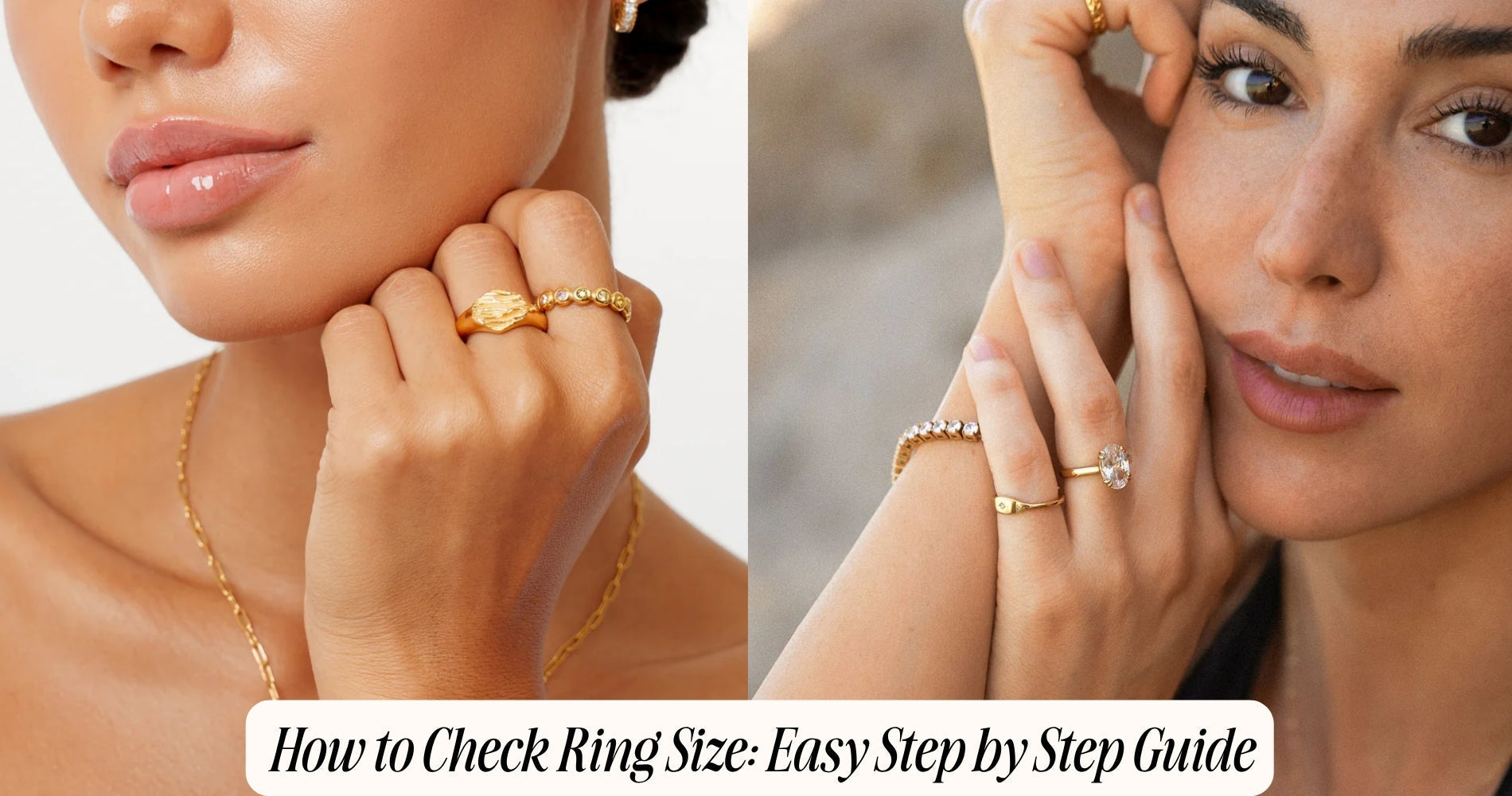
How to Check Ring Size: Easy Step by Step Guide
Getting ring size wrong is one of the most common jewelry buying mistakes, and it is entirely avoidable with a few minutes of accurate measurement at home. Knowing how to check ring size before buying means the ring fits the first time rather than requiring a return, resize, or the disappointment of wearing a piece that does not sit correctly on the finger. Minimalist Gold Rings in standard sizing benefit from accurate measurement before purchase. This guide covers three reliable at-home measurement methods, an international ring size conversion chart, the variables that affect sizing accuracy, and how to size correctly for ring stacking.
Why Ring Size Accuracy Matters
A ring that is one size too small creates pressure on the finger and leaves marks after extended wear. Two sizes too small cannot be worn comfortably at all. A ring one size too large shifts and rotates during movement and can slide off in cold water or during physical activity. Two sizes too large requires significant modification before it can be worn safely.
For rings worn continuously through daily activity including gym sessions, swimming, and beach days, fit accuracy also affects how the ring wears over time. A ring that spins and shifts constantly experiences more friction at the inner shank than a well-fitted ring. For thin stacking rings in particular, loose fit causes rings to knock against each other and against surfaces during movement, which accelerates surface wear at contact points.
Getting the size right before buying is significantly easier than resizing after. Stainless steel rings cannot be resized due to the metal's hardness, which makes accurate initial sizing essential for that material. Gold rings can be resized but only within a limited range of one to two sizes in either direction, and resizing adds both cost and turnaround time. Accurate measurement prevents both problems.

How to Check Ring Size: Three At-Home Methods
Method 1: The Paper Strip Method
This is the most accessible method and requires only a strip of paper, a pen, and a ruler.
Step by step:
- Cut a strip of paper approximately 6mm wide and at least 10cm long.
- Wrap the paper strip around the base of the finger you intend to wear the ring on, just above where the finger meets the hand.
- Mark the point where the paper meets itself with a pen.
- Lay the strip flat against a ruler and measure the distance from the end to the mark in millimeters. This is your finger circumference.
- Use the size chart below to find your ring size based on the circumference measurement.
Wrap the strip snugly but not tightly. The measurement should reflect the finger's resting circumference rather than a compressed one. A useful test: if the wrapped paper slides off the finger freely without significant resistance, it is correctly snug rather than tight.
For fingers with larger knuckles than the finger base, measure both the base circumference and the widest point of the knuckle. Choose the size that passes over the knuckle comfortably and accept a small amount of movement at the base. This is the standard approach for prominent knuckle sizing.
Method 2: The Existing Ring Method
If you own a ring that fits the intended finger well, it can determine the correct size without measuring the finger directly.
Step by step:
- Select a ring that fits the intended finger comfortably at its base.
- Place the ring flat on a piece of paper and trace the inside of the ring with a pen, creating a circle matching the ring's inner diameter.
- Measure the diameter of the traced circle in millimeters: a straight line across the center of the circle from one inner edge to the directly opposite inner edge.
- Use the diameter column in the size chart below to find the corresponding ring size.
Alternatively, measure the inner diameter of the ring directly with digital calipers if available. Calipers provide precision to 0.1mm and are the most accurate at-home measurement tool for this method.
This method requires the existing ring to fit the specific finger and position where the new ring will be worn. A ring worn on the right hand ring finger does not necessarily reflect the left hand ring finger size, and a mid-finger fit does not reflect the base sizing.

Method 3: The Printable Ring Sizer
Many jewelry brands and sizing websites offer printable ring sizer guides, which are scaled circular guides printed at specific diameters corresponding to ring sizes.
Step by step:
- Download a printable ring sizer from a reliable jewelry or sizing resource.
- Before printing, set the printer to 100% scale or "actual size." Never use "fit to page" or any automatic scaling option, as this is the most common printable ring sizer error.
- After printing, verify accuracy by measuring the printed scale reference bar against a ruler.
- Place an existing well-fitting ring over each printed circle until the ring's inner edge aligns with the printed circle's outer edge. The matching circle is your ring size.
International Ring Size Conversion Chart
Ring sizes use different systems across countries. US sizes use a numerical scale. UK and Australian sizes use letters. European sizes use inner circumference in millimeters.
| US Size | UK Size | EU Size | Inner Diameter (mm) | Inner Circumference (mm) |
|---|---|---|---|---|
| 4 | H | 46.5 | 14.8 | 46.5 |
| 5 | J | 49 | 15.7 | 49.3 |
| 6 | L | 51.5 | 16.5 | 51.9 |
| 7 | N | 54 | 17.3 | 54.4 |
| 8 | P | 57 | 18.2 | 57.2 |
| 9 | R | 59.5 | 18.9 | 59.5 |
| 10 | T | 62 | 19.8 | 62.1 |
| 11 | V | 64.5 | 20.6 | 64.7 |
| 12 | Y | 67 | 21.4 | 67.2 |
Most women's ring purchases fall in the US size 5 to 8 range, with size 6 to 7 being the most common. Most men's purchases fall in the US size 8 to 12 range. These are averages: always measure rather than assuming standard sizing applies.

Variables That Affect Ring Size Accuracy
Ring size is not a fixed measurement. Several variables cause the same finger to read differently at different times, and accounting for them prevents ordering a size that fits at measurement but not in regular wear.
Time of day. Fingers are slightly smaller in the morning before the day's activity and fluid accumulation cause minor expansion. They are slightly larger in the afternoon and evening. Measure mid-morning for the most practical average.
Temperature. Cold contracts fingers slightly, reducing circumference. Heat expands them. A measurement taken after coming in from cold weather reads smaller than the same finger measured during summer warmth. Measure at average temperature conditions rather than at extremes.
Dominant hand. The dominant hand's fingers are typically slightly larger than the non-dominant hand's due to muscle development from regular use. Always measure the specific hand on which the ring will be worn rather than assuming both hands are the same size.
Finger shape. Some fingers taper significantly from knuckle to base. Others are more cylindrical with minimal size difference between knuckle and base. Tapered fingers require sizing between the two measurements to balance comfortable passage over the knuckle with a secure fit at the base.
Activity level. Fingers swell slightly during physical activity as blood flow increases. For rings worn through gym sessions, outdoor workouts, and warm summer beach days, measuring after light activity rather than at complete rest produces a size that remains comfortable through active wear.

How to Size Rings for Stacking
Stacking multiple rings on the same finger requires specific consideration because adjacent rings affect the effective fit of each piece in the stack.
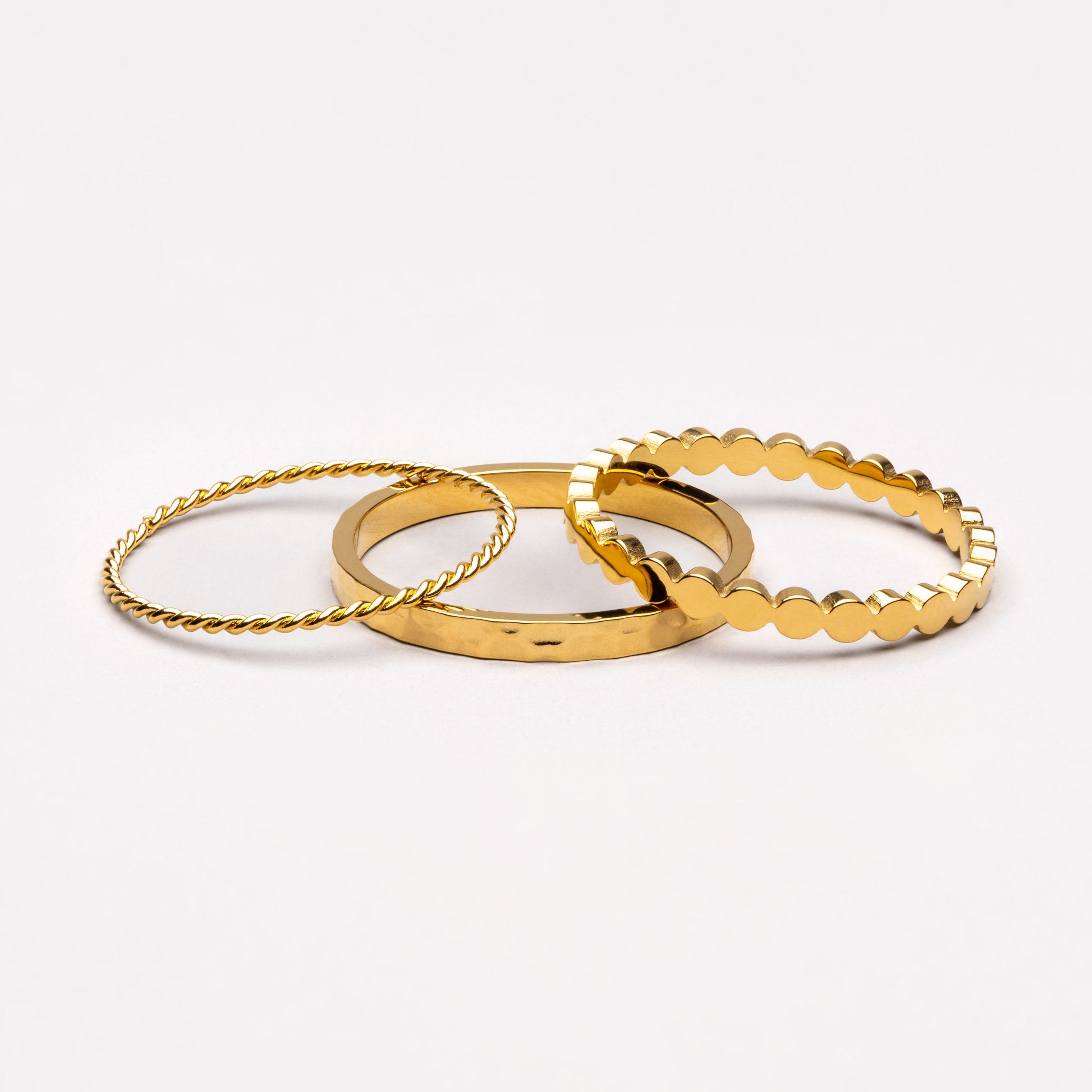
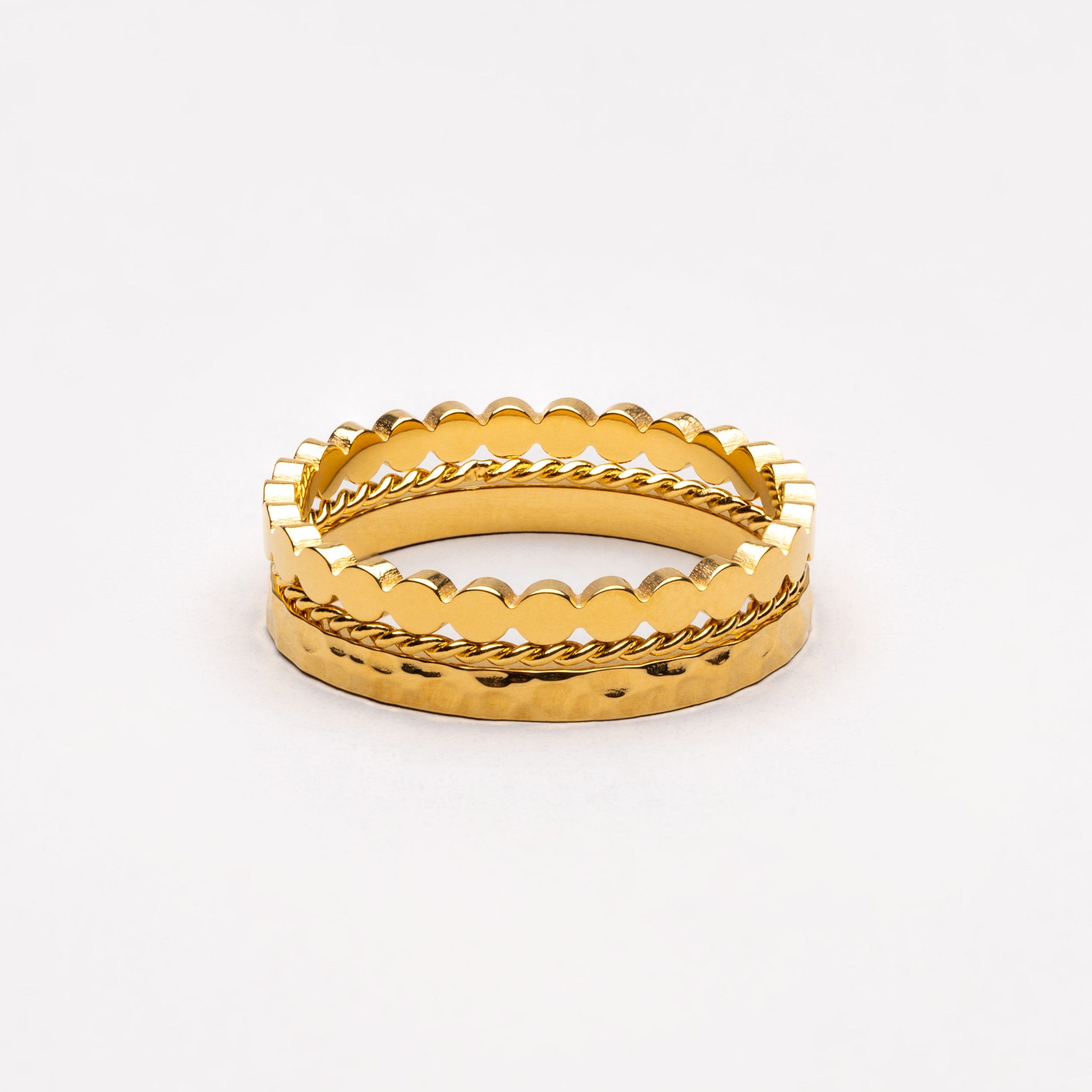
When rings are stacked, the combined width fills the finger's base area more completely than a single ring. A ring sized exactly to the base circumference for single wear can feel snug once one or two other rings sit alongside it, because neighboring rings restrict the natural lateral spreading of the finger.
For a stacking ring collection, size each ring at the standard measurement without going down a half size to compensate for perceived stack tightening. Rings that fit individually will stack comfortably at standard sizing. Sizing down for stacking creates rings that are individually too tight, which causes pressure marks and discomfort during extended wear.
For active daily wear through swimming, gym sessions, and beach days, choosing rings at the standard measurement ensures the ring does not create pressure as the finger warms and swells slightly during activity. Because PVD-coated stainless steel rings cannot be resized after purchase, accurate initial sizing is the only opportunity to get this right. ATOLEA's minimalist ring range uses standard US sizing, and a lifetime color warranty on every piece means the finish holds through daily active wear once the correct size is confirmed.

Frequently Asked Questions
How do I measure my ring size at home without any tools?
Use the paper strip method: cut a thin strip of paper, wrap it around the base of the finger, mark where it meets itself, lay it flat, and measure the length in millimeters with a standard ruler. Use the circumference column in the size chart above to find the corresponding US size. This method produces results accurate within half a size, which is sufficient for most ring purchases.
What is the most accurate way to check ring size at home?
Using digital calipers to measure the inner diameter of an existing well-fitting ring is the most accurate at-home method. Calipers measure to 0.1mm precision, which is more accurate than the paper strip method. Professional jewelers offer ring sizing with a graduated ring mandrel that identifies size precisely across the full range.
Should I size up or down if I am between sizes?
Size up if the finger has a prominent knuckle: the larger size passes over the knuckle more comfortably and sits with minimal movement at the base. Size down if the finger is more cylindrical with little size difference between knuckle and base. For rings worn in warm climates or through physical activity where fingers swell, sizing to the looser end of the comfortable range is more practical.
Does ring size differ between fingers?
Yes, significantly. Each finger on each hand has a different circumference, and the same finger on each hand is often a different size due to dominant hand muscle development. Always measure the specific finger on the specific hand where the ring will be worn rather than using a general hand size estimate.
How do I size a ring as a gift without telling the person?
The most reliable approach is to borrow a ring the person wears on the intended finger while it is out of sight, trace the inner diameter onto paper, and measure the traced circle. Alternatively, compare the traced circle against the size chart. A ring worn on the right hand ring finger typically corresponds to the left hand ring finger within half a size for most people, though measuring the correct hand is always preferable when possible.
Can I resize a stainless steel ring if I get the size wrong?
No. Stainless steel is too hard for standard jewelry resizing tools to work on without risk of cracking or deforming the ring. Getting the correct size before purchasing is essential for stainless steel rings. If a stainless steel ring does not fit, replacement in the correct size is the practical solution rather than attempting a resize.
Conclusion
How to check ring size at home comes down to three methods: the paper strip technique for circumference measurement, the existing ring trace for diameter measurement, and the printable ring sizer for a visual diameter comparison. The international size chart converts any of those measurements into the US, UK, or EU size a specific retailer uses. Accounting for time of day, temperature, dominant hand, and finger shape produces a measurement accurate enough to order confidently. For stainless steel rings that cannot be resized, accurate measurement before purchase is the one step that makes the entire process work correctly.










コメントを書く
このサイトはhCaptchaによって保護されており、hCaptchaプライバシーポリシーおよび利用規約が適用されます。