

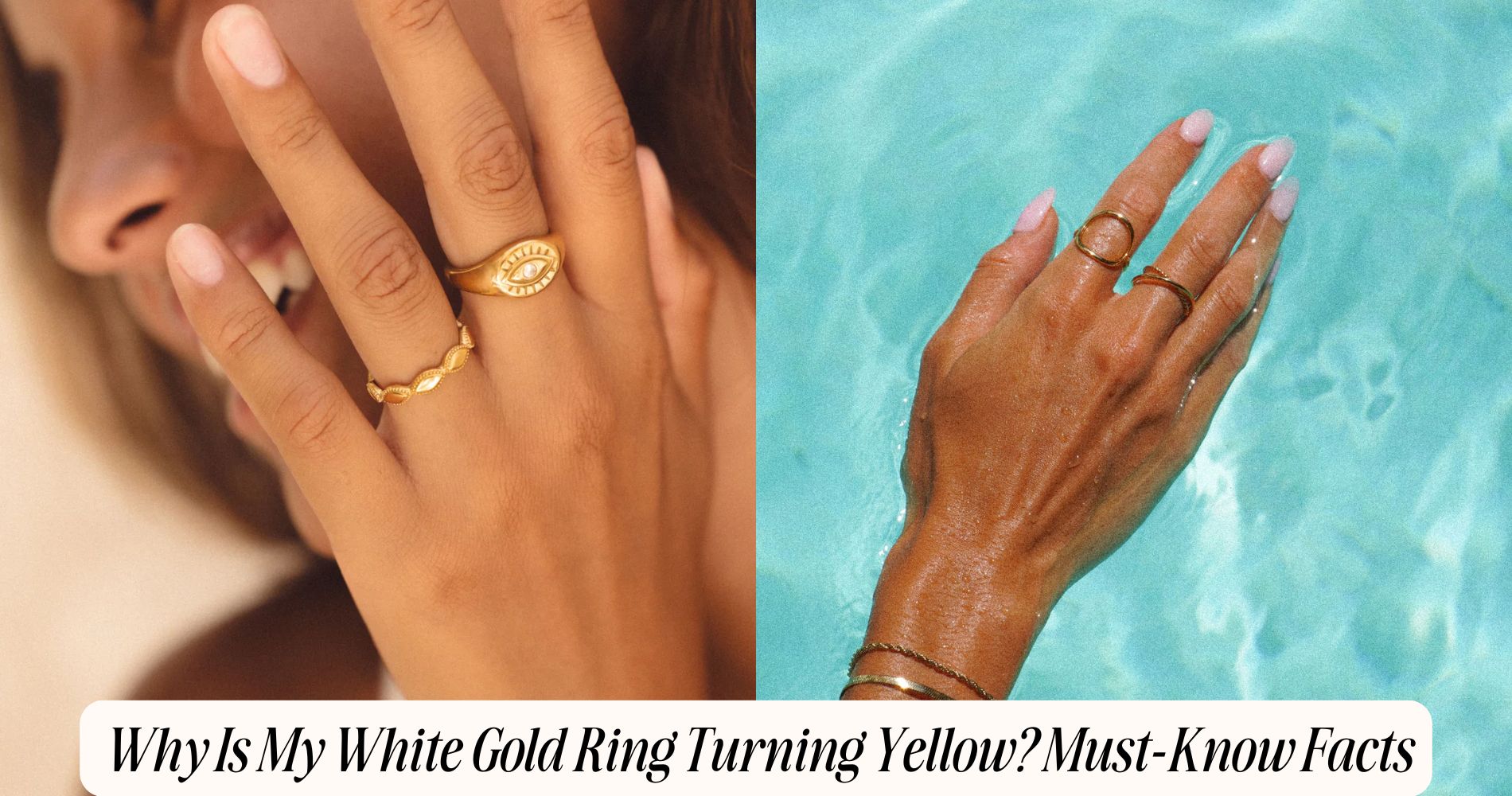
Why Is My White Gold Ring Turning Yellow? Must-Know Facts
Why is my white gold ring turning yellow? Your white gold ring is turning yellow because the thin rhodium plating that gives it a bright white finish is wearing away, revealing the warm-toned gold alloy underneath. White gold is naturally yellow gold mixed with metals like nickel, palladium, silver, and zinc. Daily abrasion, soaps, sweat, chlorine, bleach, and cosmetics speed up micro-wear and plating loss—especially with 18K alloys. Choosing durable, low-maintenance designs such as Waterproof Rings can help reduce everyday exposure. Re-polishing and rhodium re-plating restore the neutral-white finish, and there’s more to understand about how and why this happens.
What White Gold Really Is and How It’s Made
Beneath its cool, silvery surface, white gold is actually a yellow gold alloy that’s been engineered to look white. When you buy a white gold ring, you’re really getting gold blended with “bleaching” metals.
Typical white gold composition uses 14K or 18K gold mixed with nickel, palladium, silver, and small amounts of copper and zinc to modify hardness, ductility, and color.

During the manufacturing process, refiners melt pure gold and alloying elements in controlled ratios, then cast the molten metal into ingots.
Mills hot-roll and cold-roll these ingots to refine grain structure and improve strength.
Next, fabricators draw, forge, or stamp the stock into ring blanks, then solder, machine, and polish them, creating the finished white gold setting you wear.
The Role of Rhodium Plating in That Bright White Shine
In nearly all modern white gold jewelry, that crisp, mirror‑bright “white” you see isn’t the alloy itself—it’s a thin electroplated layer of rhodium.
Rhodium, a platinum‑group metal, has exceptional reflectivity, high hardness, and superior corrosion resistance, which is why jewelers use rhodium plating to override white gold’s naturally warm, slightly yellowish tone.
During plating, they submerge your ring in a rhodium salt solution and pass an electric current through it, bonding a microscopically thin metallic film to the surface.
This coating masks alloy discoloration, tightens surface grain structure, and enhances optical brilliance.
For long‑term shine maintenance, it’s essential to understand you’re actually preserving that rhodium shell.
Once it wears, the underlying white gold’s true color characteristics become visually dominant.
Common Reasons Your White Gold Ring Starts Turning Yellow
As that rhodium layer inevitably thins and breaks down, the underlying white gold alloy’s true chromatic bias begins to show, so the ring appears progressively more yellow.
You’re seeing the native tone of the gold–nickel, gold–palladium, or other metal alloys beneath, which are only “white” relative to pure yellow gold, not optically neutral.

If your ring maintenance is irregular, microscopic abrasions from daily wear remove rhodium faster on high-contact zones like prongs and shanks.
Softer karatages (18K vs. 14K) contain a higher percentage of pure gold, so the exposed alloy often looks warmer.
In addition, manufacturing variables—thin initial rhodium deposits, suboptimal surface preparation, or porous casting—let the substrate color bleed through sooner, making the yellowing appear accelerated.
Everyday Habits and Chemicals That Speed Up Discoloration
Although the alloy’s composition sets the baseline, your daily habits and chemical exposures largely dictate how fast your white gold ring loses its rhodium sheen and turns yellow.
Lifestyle factors like frequent handwashing, gym workouts, and cooking expose the surface to moisture, salts, and acids that abrade or chemically attack the rhodium plate.
Household cleaning products are especially aggressive: chlorine bleach, ammonia, and strong detergents accelerate micro‑corrosion and porosity in the plating layer.
Cosmetics, sunscreens, and fragrances contain solvents and emulsifiers that soften or etch the surface, increasing frictional wear.
Even pool water and hot tubs, with chlorinated or brominated compounds, strip rhodium and expose the slightly yellowish white‑gold substrate, making discoloration appear faster than from alloy aging alone.
How to Tell Normal Wear From Potential Damage
When your white gold ring starts looking less bright, you need to distinguish predictable rhodium wear from structural or chemical damage that warrants prompt attention.
With normal wear, you’ll see uniform yellowing on high-friction areas: the underside of the band, edges, and contact points. The underlying white gold alloy remains smooth, with no pitting, deep scratches, or metal distortion.
Potential damage looks irregular or localized. Watch for porous-looking areas, rough texture, or reddish or brownish staining that can indicate copper-rich zones or corrosion.
Check prongs and settings for thinning, bending, or asymmetry, which signal metal fatigue. Any sudden color change after exposure to strong chemicals, hot tubs, or ultrasonic cleaners suggests surface etching, micro-fracturing, or compromised solder joints, not simple rhodium loss.

Ways to Restore a Yellowing White Gold Ring
Restoring a yellowing white gold ring involves either re-establishing the rhodium-plated surface or refining the underlying alloy so it reflects light cleanly.
You’ll usually start with non-abrasive cleaning methods: a mild surfactant solution, soft brush agitation, and ultrasonic cleaning to remove adsorbed oils, oxidized residues, and particulate grime that mute reflectivity.
Next, your jeweler applies controlled polishing techniques using progressively finer abrasives on a buffing wheel to level micro-scratches and re-create a high-specular surface without over-thinning prongs or edges.
After mechanical finishing, they typically perform rhodium electroplating: the ring is cathodically charged and immersed in a rhodium electrolyte bath, where a thin, bright, highly reflective rhodium layer deposits uniformly, restoring the neutral-white hue and optical brilliance.
Tips to Keep Your White Gold Looking Bright Longer
Once your white gold ring has a fresh, bright surface and new rhodium plating, the way you wear and maintain it largely determines how long that whiteness lasts.
You should minimize abrasive contact that erodes the plating layer: remove the ring before weightlifting, gardening, or handling rough materials like concrete or granite countertops.
Use gentler cleaning techniques: soak the ring in a lukewarm solution of mild pH‑balanced soap, then brush with a soft-bristle toothbrush along the metal grain.
Avoid ultrasonic cleaners if the ring has fragile stones or inclusions.
Key maintenance tips: keep the ring away from chlorine, bleach, and sulfur-containing cosmetics or hair products, which accelerate rhodium breakdown.
Store it separately in a soft-lined box to prevent micro-scratches and plating wear.
Frequently Asked Questions
Does Resizing My White Gold Ring Affect How Quickly It Turns Yellow?
Resizing doesn’t inherently accelerate yellowing, but ring resizing can expose fresh alloy and alter metal composition at the solder joint. If the jeweler uses lower rhodium plating thickness or different alloy mix, that localized area may yellow faster.
Are Some Skin Types More Likely to Discolor White Gold Jewelry?
Yes, your skin chemistry can accelerate white gold discoloration; higher acidity, perspiration, and chloride ions attack rhodium plating and exposed alloys. You’ll mitigate tarnish and yellowing with meticulous jewelry care: frequent cleaning, re-plating, and reduced chemical exposure.
How Does White Gold Compare to Platinum in Durability and Maintenance?
You’ll find platinum durability superior due to its higher density, work-hardening, and metal retention, while white gold maintenance demands periodic rhodium re-plating, stricter avoidance of abrasives, and vigilance against alloy metal loss, micro-scratching, and surface oxidation.
Can I Be Allergic to White Gold or Rhodium Plating Specifically?
You can be allergic to white gold if nickel sensitivity’s present, while rhodium itself rarely triggers reactions. However, once rhodium durability diminishes and micro-abrasions expose nickel-containing alloy, you’ll experience contact dermatitis, erythema, and pruritic peri-ring inflammation.
Is Vintage or Antique White Gold More Prone to Yellowing Than Modern Alloys?
Yes, vintage or antique white gold often yellows faster because vintage alloys used higher nickel, lower palladium, and thinner rhodium plating, so the underlying warm-toned gold diffuses optically sooner, especially after decades of abrasion and micro-corrosion.
Conclusion
Understanding that white gold is yellow gold alloyed with whitening metals and topped with a rhodium plating helps you see why it eventually warms in tone. When that thin rhodium layer abrades, the underlying alloy’s natural color reappears. By minimizing exposure to abrasives and chemicals, monitoring prong and shank wear, and scheduling periodic re-plating and polishing, you’ll preserve reflectivity, color uniformity, and structural integrity—keeping your white gold ring looking bright, stable, and chemically resilient longer.









コメントを書く
このサイトはhCaptchaによって保護されており、hCaptchaプライバシーポリシーおよび利用規約が適用されます。