

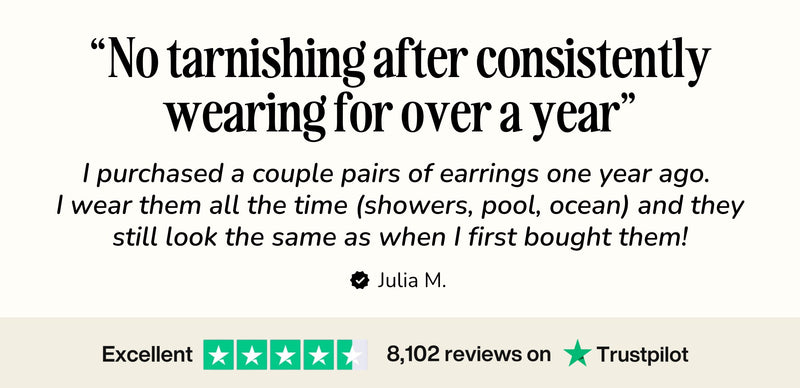

Metals That Don't Turn Skin Green Ranked
When choosing metals that don't turn skin green, prioritize purity, passivation, and biocompatibility. At the top are platinum (chemically inert and highly skin-safe) and 18K/14K yellow gold with lower base-metal content. Titanium follows, protected by a stable TiO₂ film, along with surgical-grade stainless steel 316L/316LVM that relies on a passivated chromium-oxide layer. Palladium provides noble-metal stability with minimal ion release, while rhodium-plated sterling silver adds a protective barrier against tarnish, and niobium forms a hypoallergenic oxide layer. Selecting pieces like a Hypoallergenic Necklace ensures these skin-friendly properties are built in. Choose polished finishes and high-purity alloys, avoid nickel-heavy mixes, and clean with mild detergent, drying thoroughly to keep your jewelry—and your skin—looking its best.
Platinum
Platinum sets the standard for hypoallergenic jewelry metals due to its chemical inertness and high purity. You benefit from a metal that rarely provokes contact dermatitis because it contains minimal alloying elements and resists corrosion, oxidation, and tarnish.
Its high density and malleability enable secure stone settings and long-term structural integrity. You won’t see green discoloration with platinum because it doesn’t leach copper salts or nickel ions.
Clinical evidence supports superior biocompatibility, making it suitable for sensitive skin and continuous wear. Platinum durability exceeds most precious metals under abrasive, humid, or perspiration-prone conditions, retaining mass rather than wearing away.
While initial cost is higher, a platinum investment often yields lower lifetime maintenance, fewer replatings, and stable resale value. Choose hallmark-stamped 950 platinum for assured composition and performance.
18K and 14K Yellow Gold
Yellow gold alloys, typically labeled 10K (41.7% gold) and 14K (58.5% gold), balance durability with reduced risk of skin discoloration compared with lower-karat options.
You’ll see fewer green or gray marks because higher gold purity reduces exposure to reactive base metals. In a yellow gold alloy, copper and silver predominate; nickel is uncommon but may appear in trace amounts. If you’re nickel-sensitive, verify composition or choose 14K to minimize irritants.
Corrosion resistance correlates with gold purity: 14K resists sweat, soaps, and chlorides better than 10K, lowering ion release that can stain skin.
Surface finish matters—polished, rhodium-flashed, or well-maintained pieces shed fewer ions. Clean routinely with mild detergent, rinse thoroughly, and dry. Remove jewelry during exercise and overnight to limit moisture-driven tarnish.
Titanium
Although lightweight, titanium offers exceptional biocompatibility and rarely causes green skin discoloration because it forms a stable, inert oxide film (TiO2) that resists corrosion in sweat, soaps, and chlorides.
You benefit from this passive layer because it limits metal ion release, a key factor in contact dermatitis and staining. Among titanium benefits, low density guarantees comfort, while high tensile strength improves durability for daily wear.
Choose commercially pure Grade 2 or Grade 5 (Ti-6Al-4V) titanium jewelry with minimal nickel or cobalt contamination to reduce sensitization risk.
You can expose it to exercise, swimming pools, and routine handwashing with negligible tarnish. Maintenance is simple: clean with mild detergent and water; avoid abrasive polishing that could disrupt the oxide.
For piercings, guarantee mirror-finished surfaces and ASTM-compliant composition.
Surgical-Grade Stainless Steel (316L/316LVM)
Two closely related alloys—316L and 316LVM—offer reliable, low-risk options that rarely turn skin green. You benefit from their low carbon content, high chromium and nickel levels, and molybdenum addition, which enhance corrosion resistance in chloride-rich sweat.
In surgical applications, 316LVM (vacuum-melted) provides tighter control of inclusions and surface cleanliness, reducing sensitization and localized irritation compared with conventional 316L.
If your skin reacts to base metals, these alloys minimize ion release under normal wear. Their passive chromium-oxide film resists pitting and crevice corrosion, limiting discoloration and dermatitis.
Choose polished, implant-grade finishes to reduce biofilm adherence and improve tolerance. While not entirely inert, well-made jewelry in 316L/316LVM performs predictably, maintains luster, and seldom causes green staining, especially when you clean and dry pieces after exposure to sweat.
Palladium
If you want a noble metal that resists skin discoloration at least as reliably as 316L/316LVM, palladium is a strong candidate. You benefit from its inert surface chemistry, high corrosion resistance, and absence of copper—the usual culprit in green staining.
Palladium properties include a stable oxide layer, low allergenicity, and minimal galvanic activity in perspiration, which reduces ion release.
For daily-wear palladium jewelry, you’ll prefer high-purity alloys (Pd950 or Pd900). These maintain colorfastness and avoid nickel, lowering sensitization risk.
Palladium’s density provides durability without excessive weight; its Vickers hardness supports scratch resistance comparable to platinum alloys after proper work-hardening. It also resists sulfide tarnish, maintaining luster in humid or acidic environments.
If you sweat heavily or have reactive skin, palladium offers predictable, low-staining performance.
Sterling Silver With Rhodium Plating
While sterling silver can leach copper ions that stain skin, rhodium plating creates an inert barrier that blocks discoloration and tarnish. You gain hypoallergenic performance because rhodium, a noble platinum-group metal, resists corrosion and ion release under sweat, cosmetics, or chlorides.
Rhodium plating benefits include enhanced surface hardness, higher reflectivity, and reduced maintenance versus uncoated 925 alloys.
Expect finite coating longevity. Typical deposits measure 0.05–0.25 microns; thinner layers abrade faster on rings and bracelets. For durability, request thicker plating on high-wear zones and avoid abrasive polishing cloths.
Prioritize gentle sterling silver care: wash with mild soap, pat dry, store individually, and remove jewelry during exercise or swimming.
When brightness fades or yellowing appears, schedule professional re-plating to restore barrier integrity and skin-safety.

Niobium
Rhodium-plated silver protects skin by blocking ion exchange; niobium goes further because the base metal itself remains inert. You won’t catalyze verdigris because niobium forms a stable oxide (Nb2O5) that’s chemically passive in sweat, saline, and mildly acidic environments. That oxide is integral, not a coating you can scratch off.
If you’ve got sensitive skin or nickel allergy, choose niobium jewelry. Hypersensitivity reactions are rare because trace impurities are tightly controlled and niobium doesn’t release allergenic ions.
Niobium properties include high corrosion resistance, low reactivity, and excellent biocompatibility; these attributes parallel materials used in surgical implants. Anodized colors arise from interference within the oxide layer, not dyes, so you retain inertness.
You’ll also gain durability: the oxide self-heals, resisting tarnish, pitting, and discoloration during everyday wear.
Frequently Asked Questions
How Does Skin Ph Influence Metal Discoloration Risk?
It increases discoloration risk. Higher skin acidity effects accelerate corrosion and ion release, especially with copper and nickel, while sweat chloride amplifies reactions. Metal reactivity factors, moisture, friction, and duration of contact modulate complex formation, producing green or dark surface residues.
Do Lotions or Perfumes Increase Chances of Skin Staining?
Yes. You increase staining risk when lotion ingredients or perfume chemicals acidify sweat, disrupt sebum, or chelate metal ions. Emulsifiers, fragrances, and alcohols accelerate metal ion release, forming salts or oxides that transfer to skin, especially with perspiration.
Can Sweat Chemistry From Exercise Affect Metal Reactions?
Yes. Your sweat composition (pH, chloride, lactate, urea) modulates corrosion and ion release from different metal types. Higher acidity and salts accelerate reactions, increasing discoloration and dermatitis risk. Rinse post-exercise, dry thoroughly, and select hypoallergenic alloys.
Are Hypoallergenic Metals Always Tarnish-Resistant?
No. Hypoallergenic metals aren’t always tarnish-resistant. You’ll tolerate hypoallergenic materials (e.g., titanium, niobium), yet some metal alloys still oxidize or discolor. Tarnish resistance depends on passivation layers, noble metal content, and environment, not solely allergenicity. Verify manufacturer specifications.
How Do Plating Thickness and Wear Impact Skin Discoloration?
Plating thickness and wear directly affect skin discoloration: thicker layers reduce ion release; thin, abraded coatings expose reactive metal alloys. You prioritize plating durability, minimize friction, and avoid moisture/chemicals to limit copper/nickel corrosion products that cause green or gray staining.
Conclusion
You can minimize skin discoloration by choosing inert, hypoallergenic metals with low nickel release. Prioritize platinum, 18K/14K yellow gold, titanium, surgical-grade stainless steel (316L/316LVM), palladium, rhodium‑plated sterling silver, and niobium. These alloys exhibit high corrosion resistance, stable passivation layers, and biocompatibility documented in dermatologic literature. Verify alloy purity, request nickel-release testing (EN 1811), and maintain routine cleaning to limit chloride-induced corrosion. If you have nickel sensitivity or eczema, select platinum, titanium, niobium, or palladium for best tolerance.









%20and%2018K/14K%20yellow%20gold%20with%20l...)
コメントを書く
このサイトはhCaptchaによって保護されており、hCaptchaプライバシーポリシーおよび利用規約が適用されます。