


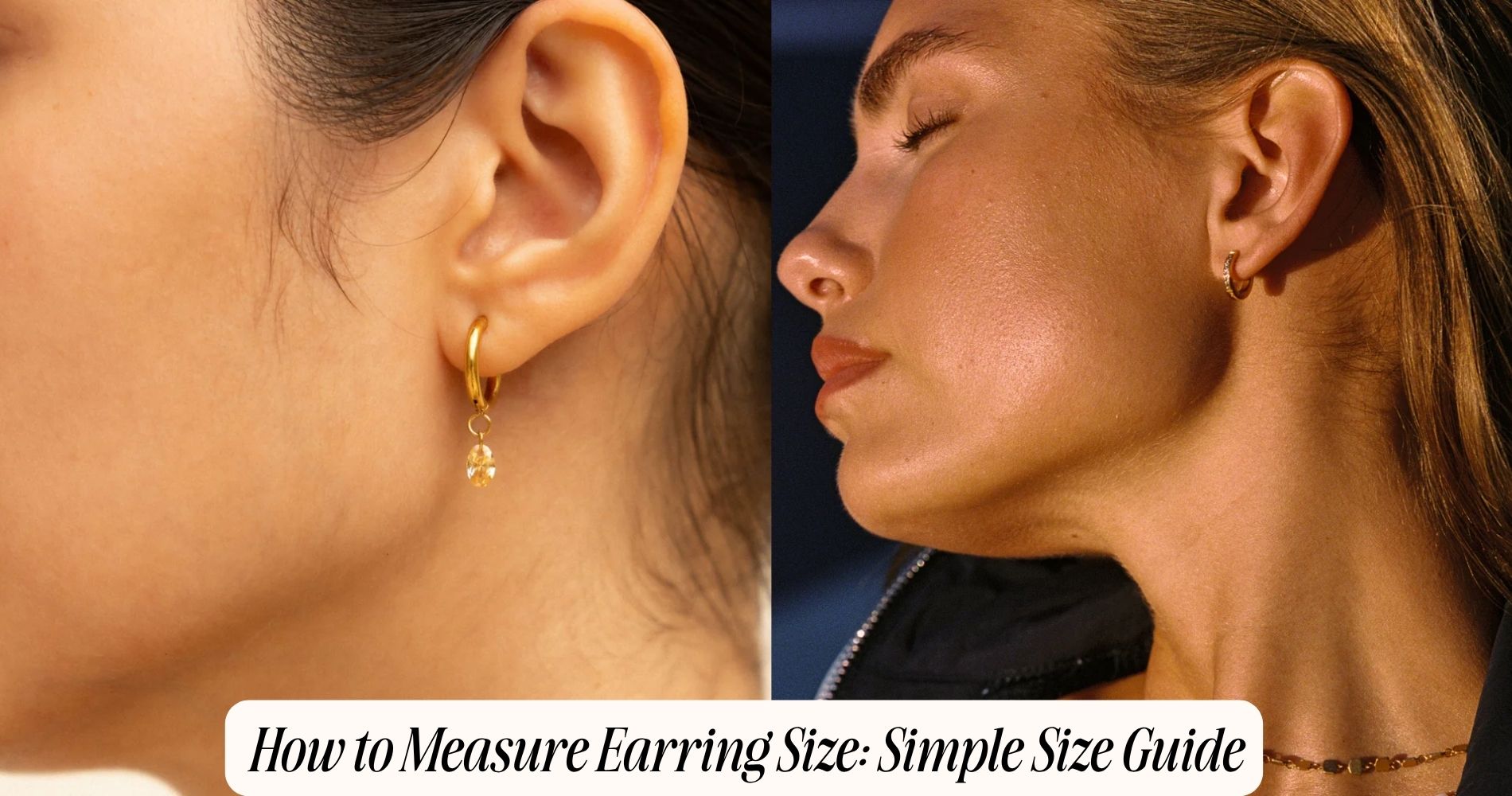
How to Measure Earring Size: Simple Size Guide
Earring sizing is not standardized the way clothing or ring sizing is, which makes shopping by measurement alone genuinely confusing. Two earrings listed at the same size can read very differently in person depending on the style, the wire gauge, and what the measurement is actually referring to. Knowing how to measure earring size accurately requires understanding that each earring type uses a different measurement convention, and that the number alone does not tell the full story. Waterproof Earrings listed with accurate measurements across studs, hoops, and drops give you a reliable size reference for daily wear. This guide covers exactly how to measure each earring type, what those measurements mean in practice, and how to use them to buy with confidence.
Why Earring Sizing Varies by Style
Before covering the measurement methods, it helps to understand why earring sizing cannot be reduced to a single number or standard.
A stud earring is measured across its face diameter because the relevant dimension is how much of the earlobe it covers visually. A hoop earring is measured by its inner diameter because the relevant dimension is the size of the circular opening and how far it drops below the lobe. A drop earring is measured by its total length because the relevant dimension is how far it extends below the piercing.

These three measurements describe fundamentally different physical properties and cannot be compared directly. A 20mm hoop and a 20mm drop earring are not the same visual size: the hoop creates a circular ring sitting at the lobe level, while the 20mm drop hangs 20mm below the lobe as a linear piece. A 6mm stud refers to a flat face diameter that has no equivalent comparison in hoop or drop measurements.
Additionally, the same measurement on different construction types reads differently. A 30mm hoop in a 1mm wire gauge looks smaller in person than a 30mm hoop in a 3mm flat tube because the outer diameter, which your eye actually perceives, is the inner diameter plus twice the wire thickness. Knowing this prevents the common experience of ordering a listed size and finding the actual piece looks larger or smaller than expected.
How to Measure Stud Earring Size
Stud earrings are measured by the diameter of their face: the front surface that sits visibly against the lobe. For a perfectly round stud, this is a single measurement across the widest point. For oval, marquise, or geometric studs, the convention varies by brand: some list the longest measurement, some list both dimensions (for example, 5mm x 7mm for an oval), and some list only one without specifying which axis.
To measure a stud you already own:
Place the stud face-up on a flat surface. Use a millimeter ruler and measure straight across the widest point of the face from one edge to the other. Do not include the post or any setting metal that extends behind the face plane. The number you get is the face diameter.
To estimate stud size before buying:
Use these everyday reference points to visualize listed stud sizes:
| Stud Size | Everyday Reference | Visual Effect at Conversational Distance |
|---|---|---|
| 3mm | Watch crown width | Barely visible, accent only |
| 4mm | Standard pen cap rim | Subtle, suits secondary piercings |
| 5mm | Pencil barrel width | Delicate, visible up close |
| 6mm | Half an average fingernail width | Balanced everyday presence |
| 7mm | Small shirt button | Clear presence without dominance |
| 8mm | Large shirt button | Confident daily statement |
| 10mm | Pencil eraser diameter | Bold single-earring statement |
For round stone-set studs, the listed size refers to the stone diameter. The overall earring including the setting and prong tips reads approximately 0.5mm to 1mm larger than the listed stone size because the setting metal adds visible perimeter around the stone.

How to Measure Hoop Earring Size
Hoop earring size is measured by inner diameter: the distance across the empty space inside the ring. This is the most important measurement for understanding how a hoop will sit on the ear because it determines how far the hoop drops below the lobe.
The drop distance is approximately half the inner diameter. A hoop with a 30mm inner diameter drops roughly 15mm below the lobe. A hoop with a 40mm inner diameter drops roughly 20mm below the lobe. This calculation is approximate because the exact piercing position relative to the lobe edge affects where the hoop sits, but it gives a reliable working estimate for purchase decisions.
To measure a hoop you already own:
Lay the hoop flat on a surface. Measure across the inside of the ring from one inner edge to the directly opposite inner edge. This is the inner diameter. To find the outer diameter, measure from the outer edge of the wire on one side to the outer edge of the wire on the directly opposite side.
To use drop distance as your measuring method:
Hold a ruler against your earlobe with the zero mark at your piercing hole. Decide where you want the bottom of the hoop to sit. The distance from the piercing to that point is your desired drop. Double that number to get your target inner diameter. If you want the hoop to drop 15mm below your lobe, you need a hoop with an inner diameter of approximately 30mm.

Standard hoop sizes and their drop distances:
| Inner Diameter | Approximate Drop Below Lobe | Typical Category |
|---|---|---|
| 10 to 14mm | 5 to 7mm | Huggie hoop |
| 16 to 20mm | 8 to 10mm | Small hoop |
| 25 to 30mm | 12 to 15mm | Medium everyday hoop |
| 35 to 40mm | 17 to 20mm | Large hoop |
| 50mm and above | 25mm and above | Oversized statement |
Wire gauge adds to the outer diameter but not the inner diameter. A 25mm inner diameter hoop with a 2mm flat wire gauge has an outer diameter of 29mm. The outer diameter is what creates the visual presence of the hoop, so for thick-gauge hoops the outer diameter is a more useful comparison point than the inner diameter alone.
How to Measure Drop and Dangle Earring Size
Drop earrings are measured by total length from the top of the finding (the ear wire, post, or hook) to the lowest point of the piece. This total length measurement tells you how far below your earlobe the earring will extend.
To measure a drop earring you already own:
Hold the earring by its top finding in its natural hanging position. Measure from the very top of the finding to the lowest point of the piece in millimeters. This is the total length. If you want to know the drop below the lobe specifically rather than the total length, subtract approximately 5mm to 8mm for the portion of the finding that sits above the lobe within or above the piercing.
Standard drop lengths and their visual reference:
- Under 15mm: Drop sits very close to the lobe, reads almost like a stud with slight movement
- 15mm to 25mm: Short drop, visible movement without extending past the jaw area on most necks
- 30mm to 45mm: Standard drop, reaches toward the neck area, suits most occasions
- 50mm to 65mm: Long drop, reaches toward or to the collarbone level
- 70mm and above: Statement length, reaches collarbone or below
For drops with multiple components (a chain leading to a charm, for example), the measurement convention varies. Some brands list only the pendant length, excluding the finding. Others list total length including the ear wire. When buying drops, checking whether the measurement includes the finding prevents the common surprise of receiving a piece that hangs noticeably longer or shorter than expected.

Frequently Asked Questions
How do you measure earring size at home?
For studs, use a millimeter ruler and measure straight across the widest point of the face. For hoops, measure across the inside of the ring from one inner edge to the directly opposite inner edge. For drops, hold the earring in its natural hanging position and measure from the top of the finding to the lowest point. A standard ruler with millimeter markings is all you need for all three measurements.
What is the standard earring size?
Standard sizes vary by style. For studs, 6mm to 8mm is the most common everyday range. For hoops, 20mm to 30mm inner diameter covers the most versatile everyday size. For drops, 25mm to 40mm total length covers daily to dressed-up contexts. These ranges represent what most people consider a normal earring presence rather than a very minimal or statement-level size.
How do I know what size hoop will fit my ear?
Use the drop distance method: hold a ruler at your piercing hole and mark where you want the bottom of the hoop to sit. Double that distance to get your target inner diameter. Also account for your face proportions. Smaller faces tend to suit the 15mm to 25mm range for everyday hoops. Larger faces read medium hoops at 25mm to 35mm as a comparable visual presence.
Does earring size include the backing or finding?
For studs, the listed size refers to the face only, not the post or back. For hoops, the listed size refers to the inner diameter, not the outer edge. For drops, conventions vary: some brands include the finding in total length, others list pendant length only. Checking the product description for clarification on what the measurement includes prevents sizing surprises on drop earrings in particular.
What does 6mm mean on an earring?
On a stud, 6mm means the face diameter is 6mm, roughly half the width of an average fingernail. It is the most commonly worn everyday stud size for a primary piercing because it sits at the proportional balance point for most ear and lobe sizes: clearly visible at conversational distance without dominating the face. On a hoop, 6mm would refer to inner diameter, which would be a very small huggie. On a drop, 6mm total length would be barely visible.
Measuring with Confidence Before You Buy
How to measure earring size uses three different methods depending on the style: face diameter for studs, inner diameter for hoops, and total length for drops. Each measurement describes a different physical property, which is why they cannot be compared directly across styles. Using everyday object references for stud sizes, the drop-distance calculation for hoops, and the finding-inclusive length check for drops gives you the full picture any measurement alone leaves out. With those methods in hand, the listed size on any earring translates accurately to how it will actually look and sit on your ear.










コメントを書く
このサイトはhCaptchaによって保護されており、hCaptchaプライバシーポリシーおよび利用規約が適用されます。