



How Do You Know if Your Necklace Is Real Gold: Easy Guide
Testing a necklace for real gold is not quite the same exercise as testing a ring or a pair of earrings. A chain has links that flex and rub against each other constantly, a clasp that takes the most mechanical stress of any part of the piece, and often a pendant that hangs separately and may even be a different gold purity than the chain itself. If you are wondering how do you know if your necklace is real gold, knowing exactly where on the piece to look, and why those specific spots matter, gives you a much more reliable answer than a generic once over.
In this guide, we will walk through the specific places on a necklace worth checking, why chains reveal plating wear differently than other jewelry types, and how to read what you find. If you want a piece you can trust from the moment you put it on, our Everyday Gold Necklace collection is clearly labeled so there is no guessing involved.
Start at the Clasp, Not the Chain
On most necklaces, the clasp is the single most reliable place to find a hallmark, since manufacturers typically stamp purity markings on this small, relatively flat component rather than on individual chain links, which are usually too small and too mobile to hold a legible stamp.
Look closely at the clasp itself, including the small tab or spring mechanism, for tiny engraved markings such as 14K, 18K, or a millesimal number like 585 or 750. A jeweler's loupe or a strong magnifying glass is genuinely useful here, since these stamps are often only a millimeter or two in size. If your necklace has a lobster clasp, spring ring, or toggle closure, check the flat outer surface of the clasp body specifically, since that is where stamps are most commonly placed during manufacturing.
If the clasp shows no markings at all, do not assume this automatically means the piece is not gold. Some finer, more delicate necklaces, particularly vintage or handmade pieces, may carry their hallmark elsewhere, such as on a small tag near the clasp rather than the clasp itself. Check for any small, flat metal tag attached near the closure before concluding no hallmark exists.

Why Chain Links Wear Differently Than a Ring or Earring Post
A ring wears down primarily at points of direct contact with hard surfaces, and an earring post experiences relatively little friction at all. A necklace chain is different: every single link rubs against its neighboring links with each movement of the wearer's body throughout the day, creating a slow, continuous, low level friction across the entire length of the chain rather than concentrated at one or two specific points.
This matters significantly for gold plated necklaces specifically, since this constant link on link friction tends to wear away thin plating more evenly across the whole chain, rather than producing one obvious worn spot the way a ring's underside might show wear first. Instead of looking for a single dramatic discoloration, examine several links at different points along the chain's length, comparing their color and shine to one another. If you notice a subtle but consistent dulling or a faint color shift running throughout multiple links rather than isolated to one area, this pattern is often more indicative of plating wear on a chain than a single obvious bald spot would be.
Checking the Pendant Separately From the Chain
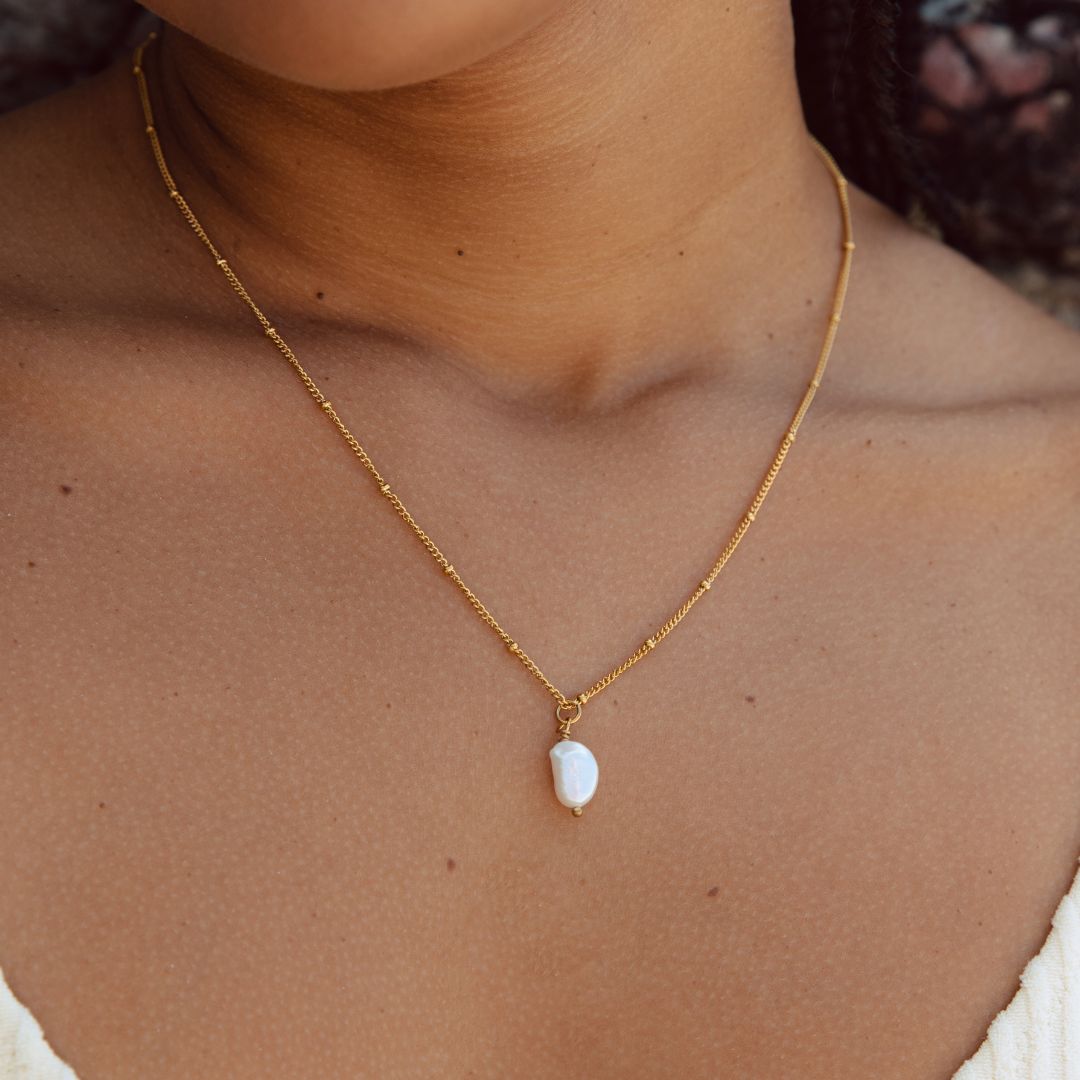
If your necklace includes a pendant, treat it as its own separate piece for testing purposes, since pendants and chains are frequently manufactured separately, sometimes even by different companies, and are not guaranteed to share the same gold purity or construction.
Check the back of the pendant, particularly near the bail, the small loop that connects it to the chain, for its own hallmark stamp. It is entirely possible, and not uncommon, for a necklace to have a solid gold chain paired with a gold plated pendant, or the reverse, so confirming each component independently gives you a more accurate overall picture than assuming uniformity across the whole piece.

The Float Test, Adapted for a Full Necklace
The float test, dropping jewelry into a glass of water to observe whether it sinks quickly due to gold's natural density, works differently on a necklace than on a single ring, simply because a chain's shape and flexibility affect how it settles in water.
To apply this test meaningfully to a necklace, gently coil the chain loosely rather than letting it clump, and drop it into the water from a slight height so it can settle naturally. A solid gold chain will generally sink promptly and settle at the bottom in a relatively controlled, coiled shape. A lighter, gold plated chain over a lower density base metal may drift, sink unevenly, or take longer to fully settle. This test works best as a supporting clue rather than a definitive answer on its own, since a chain's flexible shape introduces more variability than a solid ring would.
The Magnet Test on Clasps and Findings
Because gold itself is not magnetic, a magnet test can help identify whether a necklace's base metal contains iron or steel, materials sometimes used in lower quality plated jewelry. On a necklace specifically, the clasp and any metal findings, such as jump rings connecting a pendant to the chain, are worth testing individually, since these small components are sometimes made from a different, less expensive metal than the main chain itself, even on otherwise genuine gold pieces.
Hold a reasonably strong magnet near the clasp first, then separately near the chain and pendant. Strong, immediate attraction at any single point, even if the rest of the necklace shows no reaction, can indicate that specific component is not genuine gold, which is a distinction the float or visual tests alone might miss.

Examining Wear Patterns at the Clasp Attachment Points
The points where the clasp attaches to the chain, and where a pendant's bail meets the chain, experience more repeated stress and metal on metal contact than almost any other part of a necklace, since these connection points bear the weight and movement of the entire piece every time it is put on or taken off. Examine these specific junctions closely for any discoloration, since attachment points are frequently among the first places gold plating wears through on a necklace, even before the rest of the chain shows visible change.
Weighing a Necklace as a Whole
Solid gold necklaces generally feel more substantial for their visual size compared to gold plated chains of similar length and link style, since gold plated pieces are typically built on a lighter base metal. If you have access to a small jewelry scale, weighing the full necklace and comparing it to published weight specifications for a similar solid gold chain style and length can offer a helpful data point, though this comparison works best when you can reference the specific chain style and gauge, since weight varies considerably across different chain designs.
Putting the Necklace Specific Checks Together
No single test tells the whole story, but checking the clasp for a hallmark first, then examining multiple points along the chain rather than assuming uniform wear, testing the pendant and chain as separate components, and paying particular attention to connection points where stress concentrates, together builds a considerably more reliable picture for a necklace specifically than applying a single generic test to the whole piece at once.
When to Involve a Professional
For a necklace with genuine sentimental or financial significance, particularly an inherited piece or one without any documentation, a jeweler equipped with an electronic gold tester or acid testing kit can provide a definitive answer for the chain, clasp, and pendant individually. This is especially worthwhile given how often necklace components are manufactured separately and may not share the same gold content throughout the entire piece.

Final Thoughts
So, how do you know if your necklace is real gold? Start with the clasp, since it is the most likely place to find a legible hallmark, then examine the chain across multiple points rather than looking for one obvious worn spot, check the pendant as its own separate component, and pay close attention to connection points like the clasp attachment and pendant bail, where stress and wear concentrate first. Taken together, these necklace specific checks offer a far more reliable read than treating a chain the same way you would test a ring.
Frequently Asked Questions
1. Where is the most likely place to find a hallmark on a necklace?
The clasp is typically the most reliable spot, since it offers enough flat surface area for a legible purity stamp, unlike individual chain links.
2. Can a necklace have a solid gold chain but a plated pendant, or vice versa?
Yes, chains and pendants are often manufactured separately, so it is worth checking each component's hallmark independently rather than assuming they match.
3. Why does a gold plated chain wear differently than a gold plated ring?
A chain's links rub against each other constantly, causing more even, gradual wear across the whole chain, while a ring typically shows wear concentrated at one specific contact point.
4. Should I test the clasp separately from the rest of the necklace?
Yes, clasps and findings are sometimes made from a different metal than the main chain, so testing them individually can reveal inconsistencies a single overall test might miss.









Leave a comment
This site is protected by hCaptcha and the hCaptcha Privacy Policy and Terms of Service apply.