


How Long a Necklace Should Be: Size Guide
How long a necklace should be? Choose length based on where you want the chain to rest and how your body affects drape. Chokers sit at 14–16 inches at the base of the neck, princess lengths fall around 18 inches at the clavicle, matinee chains run 20–22 inches at the upper bust, opera styles span 24–30 inches, and rope lengths reach 36 inches or more. Measure your neck at collar level and add about two inches for comfort—shorter necks, broader shoulders, and heavier pendants can shift placement. Match length to neckline (V-necks look best with pendants sitting one to two inches above the point) and space layered chains two to three inches apart. For comfortable everyday fits, explore styles from our Hypoallergenic Necklaces collection—next, learn how to size with precision.
Standard Necklace Lengths and Where They Sit
Although body proportions vary, standard necklace lengths fall into clear categories that help you predict where each style will rest on your body.
A 14–16 inch choker sits at the base of your neck. An 18 inch princess length typically lands at the clavicle, balancing most necklines. A 20–22 inch matinee drops to the upper bust, offering modest drape. A 24–30 inch opera reaches the mid-bust to upper ribcage, enabling single or doubled wear. A 36+ inch rope extends below the bust, creating elongation and layering options.
These conventions trace to historical necklace styles—collars, sautoirs, and ropes—standardized by jewelers for predictability across collections.
When you need exact placement for pendants, formal dress codes, or medical devices, specify custom necklace lengths to control resting point within millimeters.

How Body Type and Height Affect Necklace Fit
Those standardized lengths provide a starting map, but your height, neck circumference, shoulder width, and bust prominence determine where a chain actually lands and how it reads.
Measure your neck at the collar level; add 2 inches for comfortable drape, more if you prefer mobility.
Account for body proportions: a shorter neck or broader shoulders make a choker feel tighter and elevate the resting point of princess lengths.
Height variations shift visual balance; on petite frames, 18 inches can appear matinee, while on taller frames it may sit closer to collarbone.
Bust prominence lifts chains forward and shortens perceived length, especially for pendants. Heavier pendants lengthen drop due to gravity.
Validate fit by checking where the clasp settles and how the pendant centers.
Matching Necklace Lengths to Necklines and Outfits
A necklace–neckline pairing works when the chain’s resting point echoes or counterbalances the garment’s shape.
For V-neckline styles, choose a pendant that ends 1–2 inches above the point to reinforce the angle; avoid lengths that cross the fabric.
For crew necks, use a collar or short princess length to create a defined frame; with high necks, select a matinee or opera length to elongate the torso.
For scoop necks, match the curve with a softly arced short necklace; for square necklines, use geometric pendants that sit just above the edge.
Strapless or sweetheart necklines pair best with chokers that maintain visual balance.
With button-downs, position a pendant at the open placket’s midpoint.
For layered outfit coordination, keep one focal length and vary texture, not competing lengths.
Measuring Your Neck and Choosing the Right Size
Two measurements determine a well-fitting necklace: your neck circumference and the drop you want below the collarbone.
Use validated neck measurement techniques: wrap a flexible tailor’s tape at the base of your neck, parallel to the floor, without compressing skin. Record to the nearest millimeter. For accuracy, measure twice, morning and evening, since hydration can alter soft-tissue girth slightly.
Convert circumference to baseline length by adding 5 cm (2 in) for a close choker, 8–10 cm (3–4 in) for a standard collar, and 15–20 cm (6–8 in) for a pendant that clears the clavicle.
Map desired drop by measuring vertically from the sternal notch to your target point.
Then select chains with built-in necklace size adjustments—extender links or micro-increment clasps—to fine-tune fit across seasonal or day-to-day variability.
Layering Chains and Common Sizing Mistakes to Avoid
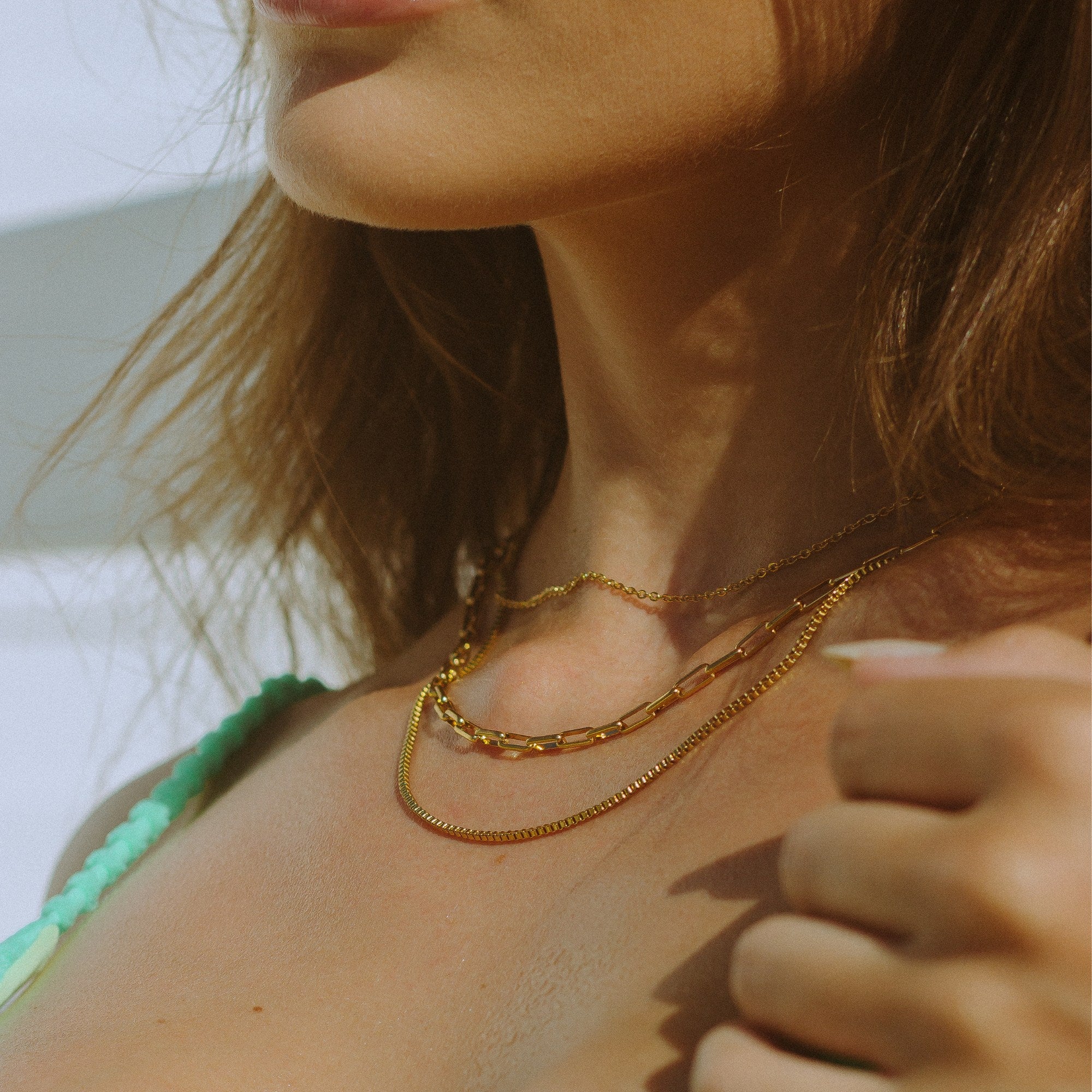
While layering chains adds visual depth and balance, it demands disciplined spacing and accurate lengths to avoid tangling and awkward overlaps. Apply layering techniques with 2–3 inch differentials between chains: for example, 14–16–18–20 inches.
Use graduated weights so heavier pendants sit lowest and don’t drag lighter strands. Mix chain materials thoughtfully—smooth snake or box chains reduce friction when paired with textured cable or rope links.
Anchor the shortest layer at or above the collarbone to prevent bunching when you move. Add extenders to fine-tune drape over varied necklines. Avoid identical lengths, bulky clasps clustered together, and pendant points that collide.
Consider skin sensitivity; some alloys can irritate at tighter fits. Finally, test motion: rotate your shoulders and bend—if layers snag, adjust spacing or weights.

Frequently Asked Questions
How Do Necklace Lengths Differ Across International Sizing Systems?
Necklace lengths vary because metric and imperial standards coexist. You’ll see centimeters vs inches, and named categories differ by region. You should use international sizing references and conversion charts to translate, compare, and select consistent lengths across markets.
What Clasp Types Affect Adjustable Length and Comfort?
Lobster, spring ring, and magnetic clasp types influence adjustable comfort most. Add extender chains for incremental length. Slider bead bolo clasps offer micro-adjustment. Toggle clasps adjust via alternative links. Consider dexterity, skin sensitivity, and weight distribution to optimize comfort and stability.
How Do Pendant Sizes Influence Perceived Necklace Length?
Pendant sizes alter perceived length by shifting the drop point; larger pendants sit lower and extend the visual line. You assess pendant weight, chain tension, and visual balance to prevent ride-up, torque, and misalignment, ensuring consistent drape and proportion.
Are There Recommended Lengths for People With Sensory Sensitivities?
Yes. You’ll typically tolerate longer lengths—18–22 inches—avoiding tight contact points. Prioritize adjustable chains to tune sensory preferences, choose comfort materials like silk cord or silicone, minimize weight, and avoid textures. Test wear time‑limited, then incrementally increase duration.
How Do Necklace Lengths Interact With Hair Length and Styles?
Necklace length interacts with hair length by visibility and snag risk: short hair showcases chokers; medium bobs suit 16–18 inches; long hair favors 20+ inches. Optimize hairstyle compatibility and necklace layering by staggering lengths, avoiding clasps near hair ends.
Conclusion
You’ve got the tools to choose necklace lengths that flatter your proportions, complement your necklines, and fit comfortably. Measure your neck, reference standard lengths, and adjust for height, build, and pendant drop. Pair choker, princess, or matinee lengths strategically with collars, crewnecks, and V-necks. When layering, vary lengths by 2 inches, balance chain weights, and avoid tangling. If in doubt, test with a soft tape and extender. Prioritize proportion, comfort, and coherence for polished results.











コメントを書く
このサイトはhCaptchaによって保護されており、hCaptchaプライバシーポリシーおよび利用規約が適用されます。