


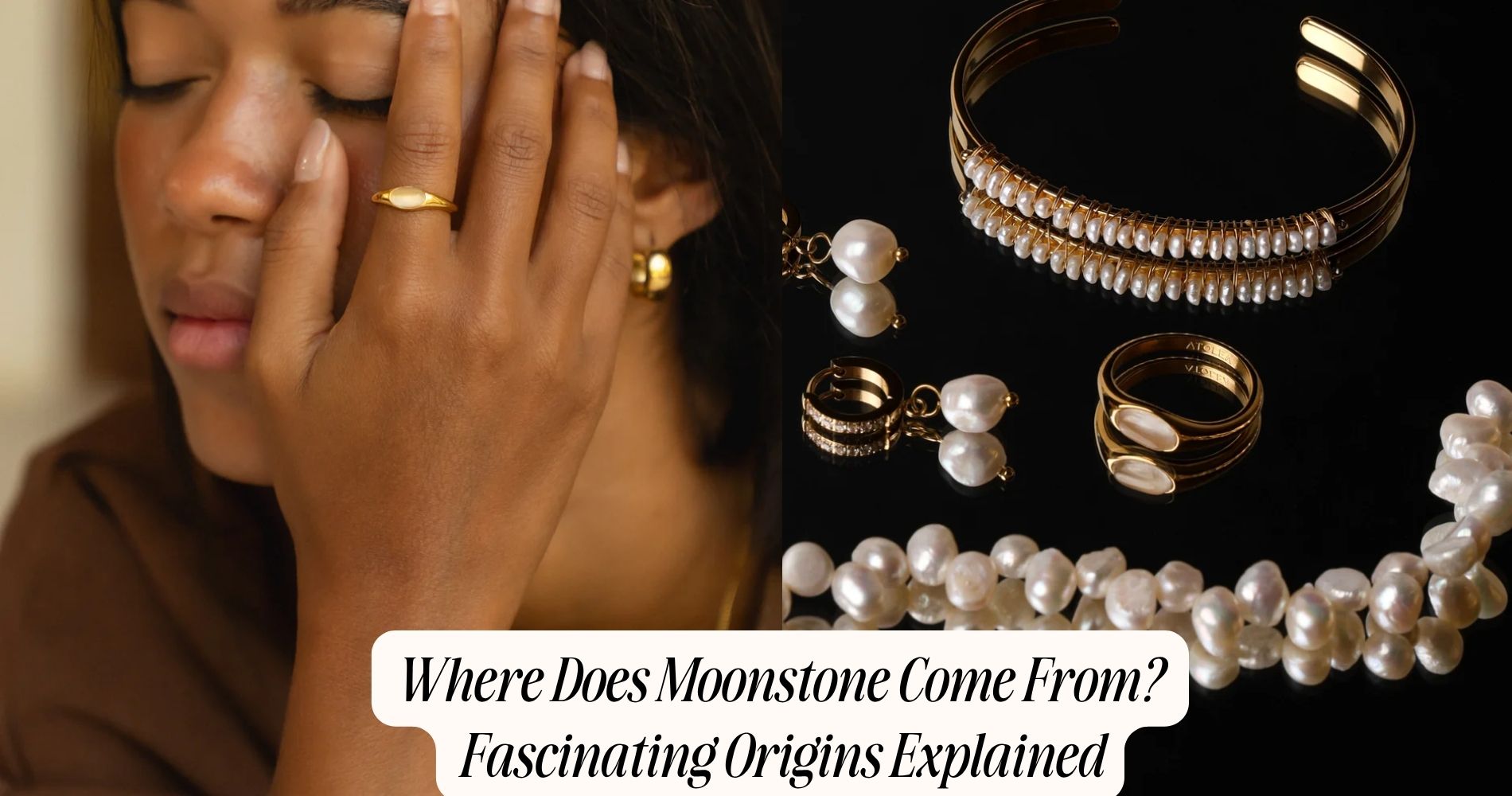
Where Does Moonstone Come From? Fascinating Origins Explained
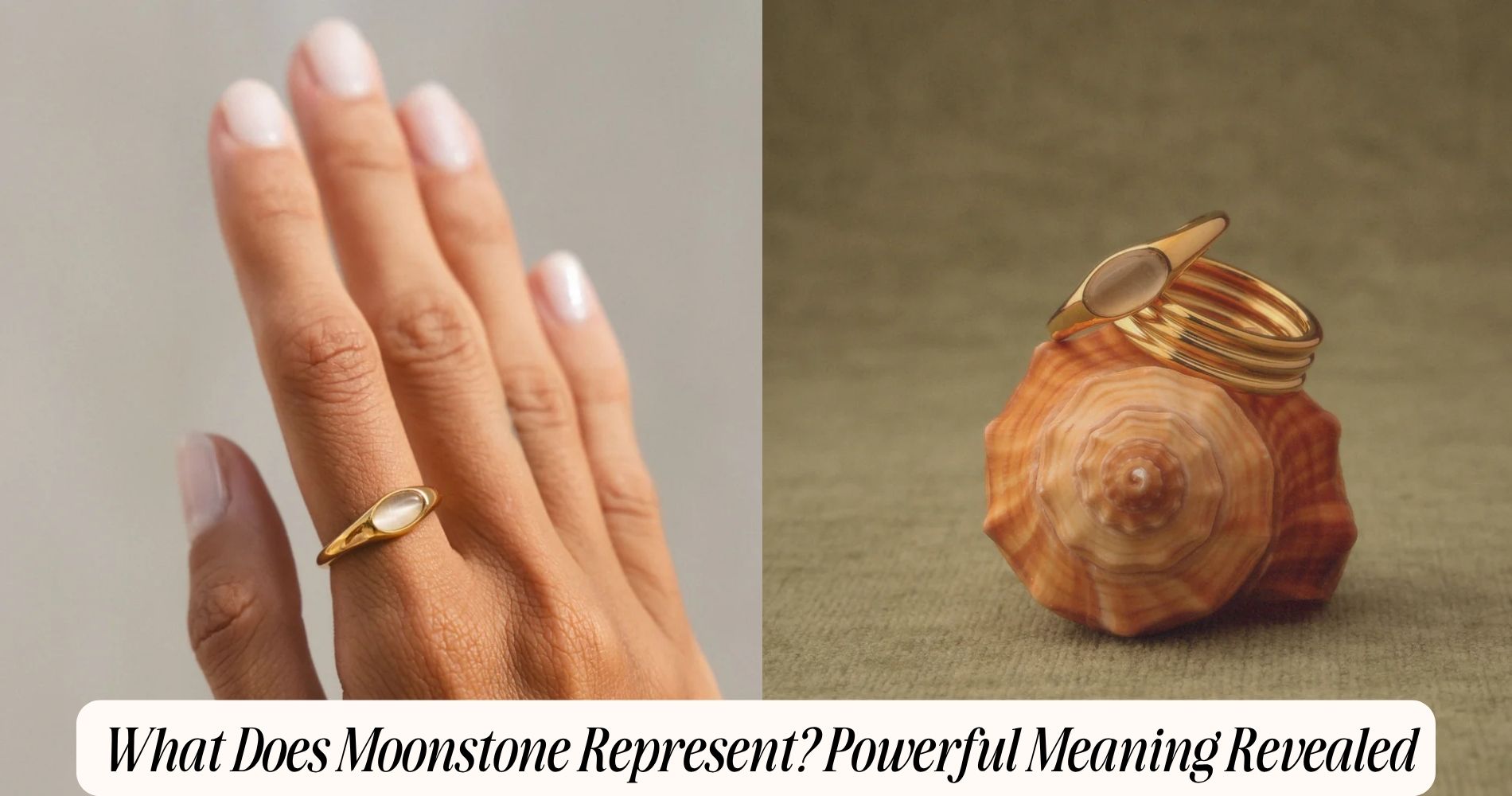
Where does moonstone come from? You’re looking at a feldspar gemstone that forms deep underground in slow-cooling igneous bodies, where sodium- and potassium-rich feldspar separate into microscopic layers. These lamellae create moonstone’s signature blue to silvery adularescence through thin-film interference and light scattering. Major deposits appear in Sri Lanka, India, Madagascar, Mexico, the USA, and Australia, each producing stones with slightly different chemistry, sheen, and clarity. Pieces featured in the Stone Collection highlight how these natural variations influence the beauty and character of moonstone jewelry.
What Is Moonstone and Why It Matters
Moonstone is a feldspar-group mineral defined by its distinctive adularescence—an optical phenomenon caused by light scattering at interfaces between intergrown feldspar layers. You recognize it by its bluish to silvery sheen, typically within potassium feldspar of the orthoclase–microcline series, often paired with albite.
When you evaluate moonstone significance, you’re examining more than aesthetics. Its optical behavior makes it a diagnostic example of exsolution and lamellar structure in feldspars, useful when you study mineral textures and light–matter interactions.
You also see strong cultural symbolism: many traditions link moonstone to lunar cycles, intuition, and protection. Because of this dual role—scientific reference material and culturally charged gemstone—you treat moonstone as a bridge between mineralogical analysis and human meaning.

How Moonstone Forms Underground
Understanding its optical and cultural significance naturally leads you to the conditions that create moonstone in the crust. You’re dealing with feldspar crystals that originate in slow-cooling magmas, where igneous processes control texture and mineral composition.
As the melt cools, sodium-rich and potassium-rich feldspar segregate into thin lamellae within a single crystal.
You typically find moonstone forming in granitic and syenitic bodies, or in associated pegmatites, where water-rich magmas lower crystallization temperatures. You then get prolonged cooling, which lets feldspar exsolve into discrete compositional layers.
Later, tectonic uplift and erosion expose these feldspar-bearing rocks. Weathering releases individual crystals, which you can recover from primary pegmatite veins or from secondary alluvial deposits derived from those original intrusive bodies.
What Gives Moonstone Its Glow
Although it looks like an internal light source, the glow in moonstone arises from light scattering within its feldspar lamellae rather than from any intrinsic luminescence.
When you examine moonstone, you’re seeing adularescence, not simple reflection. Incoming light penetrates the surface, encounters alternating layers of orthoclase and albite, and scatters through thin-film interference.
You perceive this as a soft, mobile sheen that many compare to lunar reflection, but mineralogically it’s a controlled set of optical phenomena.
The thickness and spacing of the lamellae determine the glow’s intensity and color, often producing blue or white sheens. As you tilt the stone, the scattering geometry changes, so the glow appears to drift across the surface, pinpointing the internal microstructure.

Major Moonstone Sources Worldwide
Across the globe, only a few geological settings consistently yield gem-grade moonstone, and each locality imprints a distinct mineralogical signature on the material.
You’ll see classic orthoclase–albite intergrowths from long-exploited Sri Lankan pegmatites, which historically dominated the gemstone trade and shaped much of moonstone’s cultural uses.
Madagascar mining now supplies large volumes; its feldspars typically show cooler blue adularescence and frequent internal fracturing.
Mexico deposits, often in volcanic terrains, yield material with warmer sheen and higher inclusions.
USA sources, particularly in Virginia and New Mexico, provide feldspar with variable adularia–sanidine chemistry.
Australia varieties, commonly from alkali feldspar-rich intrusions, display subtle sheen yet stable clarity.
Across all regions, you must consider environmental impact and evolving extraction ethics.
Rare and Unusual Moonstone Origins
While commercial supply centers on a few major districts, a small set of atypical geological environments yields moonstone with highly diagnostic features and sporadic availability.
You’ll encounter pegmatites intruding high‑grade metamorphic terranes, alkalic syenite complexes, and even contact‑metasomatic zones that generate uncommon moonstone varieties with unusual chemistry and microtexture.
These bodies are often lens‑shaped, discontinuous, and structurally disrupted, so you can’t apply conventional bulk extraction.
Instead, you rely on unique mining techniques: selective hand‑cobbing along tight fracture networks, micro‑mapping of feldspar zoning, and low‑impact trenching guided by structural measurements and portable spectrometers.
Because these occurrences are small and erratic, they produce limited, highly traceable parcels that you must document carefully if you’re correlating origin with petrographic or geochemical datasets.
How Origin Changes Moonstone Color and Quality
Because each geological setting imposes distinct pressure–temperature paths, melt compositions, and cooling rates, moonstone from different origins develops systematically different color, adularescence, and clarity profiles.
When you compare deposits, you’re really comparing feldspar exsolution textures, trace-element budgets, and structural disorder.
You see color variations arise from differing potassium–sodium proportions, lamellar thickness, and minute inclusions such as ilmenite or hematite.
These parameters control light scattering and interference, so each source area imprints a characteristic spectral response.
Origin also governs key quality factors you’ll evaluate: intensity and directionality of sheen, transparency versus cloudiness, and the presence of stress fractures from tectonic overprinting.

Sri Lankan vs Indian Moonstone Differences
Most gemologists treat Sri Lankan and Indian moonstone as distinct feldspar populations with reliably different optical behavior and inclusion suites.
When you examine Sri Lankan characteristics, you usually see transparent to translucent orthoclase with fine albite lamellae, strong blue adularescence, and minimal particulate inclusions.
Indian features, by contrast, often involve thicker lamellae, higher inclusion density, and more diffuse or multicolored sheen.
You’ll notice systematic color variations: Sri Lankan material tends toward near‑colorless or very light bodycolor, while Indian stones commonly show beige, brown, or gray tones.
Clarity differences follow: Sri Lankan stones generally present cleaner interiors; Indian gems show more internal textures.
Cultural significance and market preferences diverge regionally, guiding how cutters orient cabochons and prioritize optical performance.
How Origin Affects Moonstone Value
Collectors quickly discover that moonstone origin isn’t just a geographic label but a primary value driver tied to reproducible optical and structural traits.
When you assess value factors, you’re really comparing how different deposits control feldspar chemistry, exsolution lamellae thickness, and resulting adularescence.
Sri Lankan material, with fine, regular lamellae, typically yields stronger blue sheen and higher transparency, so it commands premium pricing.
Indian sources often produce creamier bodycolor and broader sheen, shifting them into a different price band, even at similar sizes.
You also have to track market demand.
Historically favored origins build pricing momentum because designers, collectors, and auction houses reference them as benchmarks, reinforcing a feedback loop where provenance, optical performance, and scarcity co‑determine moonstone value.
How Experts Tell Where a Moonstone Comes From
Although moonstones are widely traded as generic “rainbow” or “blue sheen” gems, origin determination is a disciplined process that combines visual, microscopic, and analytical criteria.
You first evaluate bodycolor, adularescence strength, and transparency, then correlate them with known production profiles from Sri Lanka, India, Tanzania, or Myanmar.
Next, you examine inclusion scenes under a gem microscope. Exsolution lamellae geometry, stress fractures, and mineral guest phases often reflect specific geological factors in the source terrain.
You then verify mineral composition with advanced testing. Refractive index, specific gravity, and Raman or FTIR spectroscopy confirm whether you’re dealing with orthoclase, albite, or an intermediate feldspar.
Finally, trace-element chemistry and fluid-inclusion studies narrow the moonstone’s likely deposit.

Frequently Asked Questions
Can Moonstone Be Ethically and Sustainably Sourced From All Major Mining Regions?
You can’t assume moonstone’s ethical sourcing and sustainable mining across all major regions; deposit governance, traceability systems, labor enforcement, and reclamation standards vary widely, so you must audit individual mines, demand certifications, and prioritize transparent supply chains.
How Does Moonstone Origin Influence Its Use in Cultural or Spiritual Traditions?
Moonstone origin shapes how you interpret moonstone symbolism, cultural significance, spiritual beliefs, and healing properties; you’ll see Indian stones linked to lunar deities, Sri Lankan to purity and prophecy, and Scandinavian material to protection, intuition, and dream-work.
Are There Environmental Risks Unique to Mining Moonstone in Different Countries?
You encounter distinct environmental risks: each country’s mining practices, host-rock geology, and regulatory rigor shape environmental impact, including slope instability in pegmatite pits, sediment-laden runoff, habitat fragmentation, groundwater drawdown, and improper tailings handling in artisanal extraction zones.
Can Lab-Grown or Synthetic Moonstones Replicate Specific Regional Characteristics?
You can approximate regional traits, but synthetic moonstones rarely duplicate them perfectly; controlled growth reproduces crystal structure, basic color variations, and adularescence, yet subtle trace-element signatures and micro-inclusions from natural localities usually remain distinguishable.
How Do Import Regulations Differ for Moonstone From Conflict-Prone Mining Areas?
You’ll face stricter import controls for moonstone sourcing from conflict‑prone regions, including heightened due‑diligence, traceability documentation, country‑of‑origin certification, and potential embargoes, as mining regulations and conflict‑minerals laws trigger enhanced customs scrutiny and possible seizure.
Conclusion
You now know moonstone’s identity, structure, and geological setting, so you can evaluate specimens with a mineralogist’s eye. When you observe adularescence, body color, and transparency, you’re really reading its tectonic history and cooling rate. By comparing Sri Lankan, Indian, and rarer origins, you’ll link optical effects to chemistry and microstructure. Use these clues—plus expert testing—to judge authenticity, locate provenance, and understand why some moonstones command considerably higher value.










Leave a comment
This site is protected by hCaptcha and the hCaptcha Privacy Policy and Terms of Service apply.