


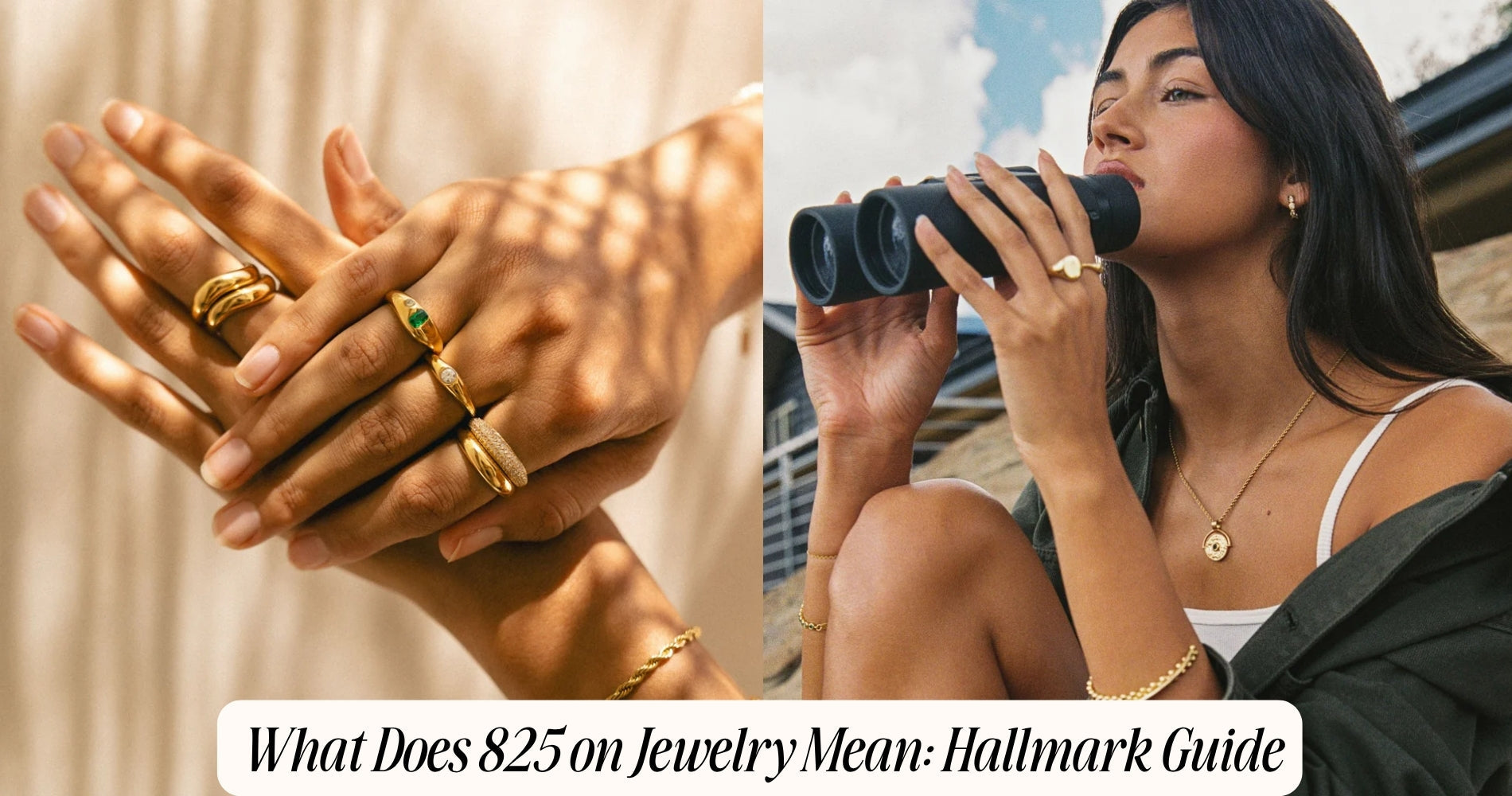
What Does 825 on Jewelry Mean: Hallmark Guide
You pull out an older piece from your jewelry box, turn it over, and find a small stamp that reads 825. It does not match the 14k or 18k marks you usually see, and that uncertainty is worth clearing up before wearing or buying anything similar. What does 825 on jewelry mean comes down to gold purity: the number indicates the percentage of pure gold in the alloy as a decimal fraction. Waterproof Jewelry takes a different approach to lasting wear, but understanding hallmarks helps you evaluate any gold piece with confidence. This guide covers what the 825 stamp signifies, how it compares to more common karat marks, and what it means for durability and daily wear.
What the 825 Hallmark Actually Tells You
Gold hallmarks use a millesimal fineness system, which expresses gold purity as parts per thousand. A stamp of 825 means the piece contains 825 parts pure gold out of 1,000 total parts by weight. That translates to 82.5% pure gold content.
In karat terms, 825 falls between 19k and 20k gold. Standard 18k gold contains 75% pure gold, and 22k contains 91.7%. The 825 mark sits above 18k but below the 22k threshold, placing it in a relatively uncommon middle range.
This system is the standard used in European, British, and many international markets, where millesimal fineness stamps are legally required on precious metal goods. In the United States, karat marks (14k, 18k, 24k) are more common, which is why 825 can appear unfamiliar to buyers accustomed to American jewelry retail.
The millesimal system is actually more precise than karat stamps. A piece marked 750 contains exactly 75% gold. A piece marked 18k is understood to contain at least 75% gold but the stamp itself does not confirm the exact figure in the way the millesimal number does.

Common Gold Hallmarks and How 825 Compares
Understanding where 825 sits in the broader landscape of gold purity marks helps you evaluate its value and practical properties accurately.
| Hallmark | Gold Content | Karat Equivalent | Common Markets |
|---|---|---|---|
| 999 | 99.9% | 24k | Bullion, fine jewelry |
| 958 | 95.8% | 23k | Some European jewelry |
| 916 | 91.6% | 22k | Indian, Middle Eastern jewelry |
| 825 | 82.5% | Approx. 20k | European, antique pieces |
| 750 | 75% | 18k | International fine jewelry |
| 585 | 58.5% | 14k | US, European mainstream |
| 375 | 37.5% | 9k | UK, Australian jewelry |
The 825 mark appears most frequently on antique and vintage European pieces, particularly jewelry made in the mid-twentieth century and earlier. It is less common in contemporary production, where 750 (18k) has become the dominant international fine jewelry standard and 585 (14k) dominates the mainstream market.
If you encounter an 825 stamp on a newer piece, it may originate from Eastern Europe or the Middle East, where certain regional standards still use this purity level. Antique dealers and estate jewelry specialists are familiar with it, but general retail staff in the United States may be less so.
What Does 825 on Jewelry Mean for Durability and Wear
Gold purity directly affects how a piece behaves during daily wear, and understanding this relationship helps you decide whether an 825-stamped piece suits your lifestyle.
Pure gold (24k) is too soft for most jewelry applications. It bends, scratches, and loses its shape under everyday contact. The metals added to create gold alloys, typically silver, copper, zinc, or palladium, provide structural hardness. The lower the gold percentage, the more alloy metals are present, and generally the harder and more durable the piece.
At 82.5% gold content, an 825-marked piece is softer than 14k or 18k gold but harder than 22k or 24k. It will show surface scratches more readily than a 14k piece worn through the same conditions. For rings and bracelets that take friction from daily movement, this is a relevant practical consideration.

On the positive side, higher gold content means lower reactivity. An 825 piece contains less copper and zinc than a 14k piece, which reduces the risk of skin discoloration. People who notice greenish marks from 14k gold or develop reactions to lower-karat alloys often find higher-gold pieces more comfortable against their skin, particularly during gym sessions or beach days when sweat concentrates at the skin-jewelry contact point.
Tarnish resistance also improves with higher gold content. The 825 purity level tarnishes less readily than 14k or 9k gold in the same environmental conditions, though no karat gold tarnishes as quickly as silver or brass-based fashion pieces.
What Does 825 on Jewelry Mean for Value and Authenticity
An 825 hallmark carries genuine gold value because the piece contains a substantial amount of pure gold by weight. It is not a plated piece. It is not gold-filled. It is solid gold alloy with 82.5% gold content throughout its construction.
For value assessment, the relevant figures are the piece's total weight and the current spot price of gold. A jeweler or appraiser can calculate the intrinsic metal value precisely. Because 825-purity gold sits above the more common 18k threshold, the metal content value per gram is higher than an equivalent-weight 18k piece.
Authenticity verification is straightforward with the right tools. A professional jeweler can confirm an 825 stamp using acid testing or electronic gold testers, both of which measure the actual gold content of the alloy rather than simply reading the stamp. If you are purchasing a piece marked 825 in an estate sale or from a private seller, this verification step is worth taking before committing to a price based on the hallmark alone.
Counterfeit stamps do exist, particularly on pieces sold without certification. A genuine 825 stamp should be crisp, evenly pressed, and consistent in depth with any other engravings on the piece. A shallow, uneven, or smudged stamp warrants testing before purchase.

When You Might Encounter the 825 Mark
Knowing where the 825 hallmark typically appears helps you recognize it in context and assess its significance accurately.
Estate jewelry and antique pieces are the most common source. If you inherited jewelry from European relatives or purchased pieces at an estate auction, the 825 mark is likely a regional standard from the piece's country of origin. Scandinavian, German, Dutch, and Eastern European jewelry frequently carries millesimal fineness stamps in this range.
Some Middle Eastern gold jewelry also carries 825 or similar marks in that purity range, particularly pieces made for local markets where higher gold content is culturally preferred over the 14k standard common in Western retail.
Contemporary pieces marked 825 are less common but do appear in specialty markets. A jeweler who produces custom work for clients who request a specific gold content may use 825 alloy, particularly for clients who want higher gold content than 18k but prefer not to work with the greater softness of 22k.

Frequently Asked Questions
What does 825 on jewelry mean in terms of gold purity?
825 is a millesimal fineness stamp indicating the piece contains 825 parts pure gold per 1,000 parts total weight. That equals 82.5% pure gold content, which falls between 19k and 20k in karat terms. It is solid gold alloy throughout, not plated or gold-filled, and carries genuine gold value based on weight.
Is 825 gold real gold?
Yes. A piece stamped 825 is solid gold alloy containing 82.5% pure gold. It is not a surface coating over a base metal. The stamp is a millesimal fineness mark used in European and international markets to indicate exact gold content, and it represents a higher gold purity than both 18k (75%) and 14k (58.5%).
Is 825 gold better than 14k?
825 gold contains more pure gold than 14k and tarnishes less readily. However, the higher gold content also makes it softer, meaning it accumulates surface scratches more easily under daily friction. Whether 825 is better than 14k depends on your priorities: more gold content and less reactivity with skin versus greater hardness and scratch resistance for active daily wear.
Where does the 825 hallmark come from?
The 825 stamp uses the European millesimal fineness system, which expresses gold purity as parts per thousand rather than as a karat fraction. It appears most frequently on antique and vintage European jewelry, estate pieces from Scandinavia and Eastern Europe, and some Middle Eastern gold jewelry where higher gold content is the regional standard. It is less common in contemporary American jewelry retail.
How do I verify that a piece stamped 825 is genuine?
A professional jeweler can confirm gold content using acid testing or an electronic gold tester, both of which measure actual alloy composition rather than reading the stamp alone. For estate purchases or pieces from private sellers, this verification is worth the small cost. Genuine stamps are crisply pressed, consistent in depth, and match the declared purity when tested.
Reading Hallmarks With Confidence
What does 825 on jewelry mean comes down to a specific and verifiable fact: 82.5% pure gold content, stamped in the millesimal fineness system used across European and international markets. It represents solid gold alloy, not plating, and its purity level sits above 18k in gold content. The practical trade-off is softness: higher gold content means a warmer, more reactive-resistant piece that scratches more readily than 14k under daily wear. The waterproof jewelry range is a useful reference point for comparing how different construction approaches, from karat gold to PVD-coated stainless steel, perform across everyday active conditions.










Leave a comment
This site is protected by hCaptcha and the hCaptcha Privacy Policy and Terms of Service apply.