

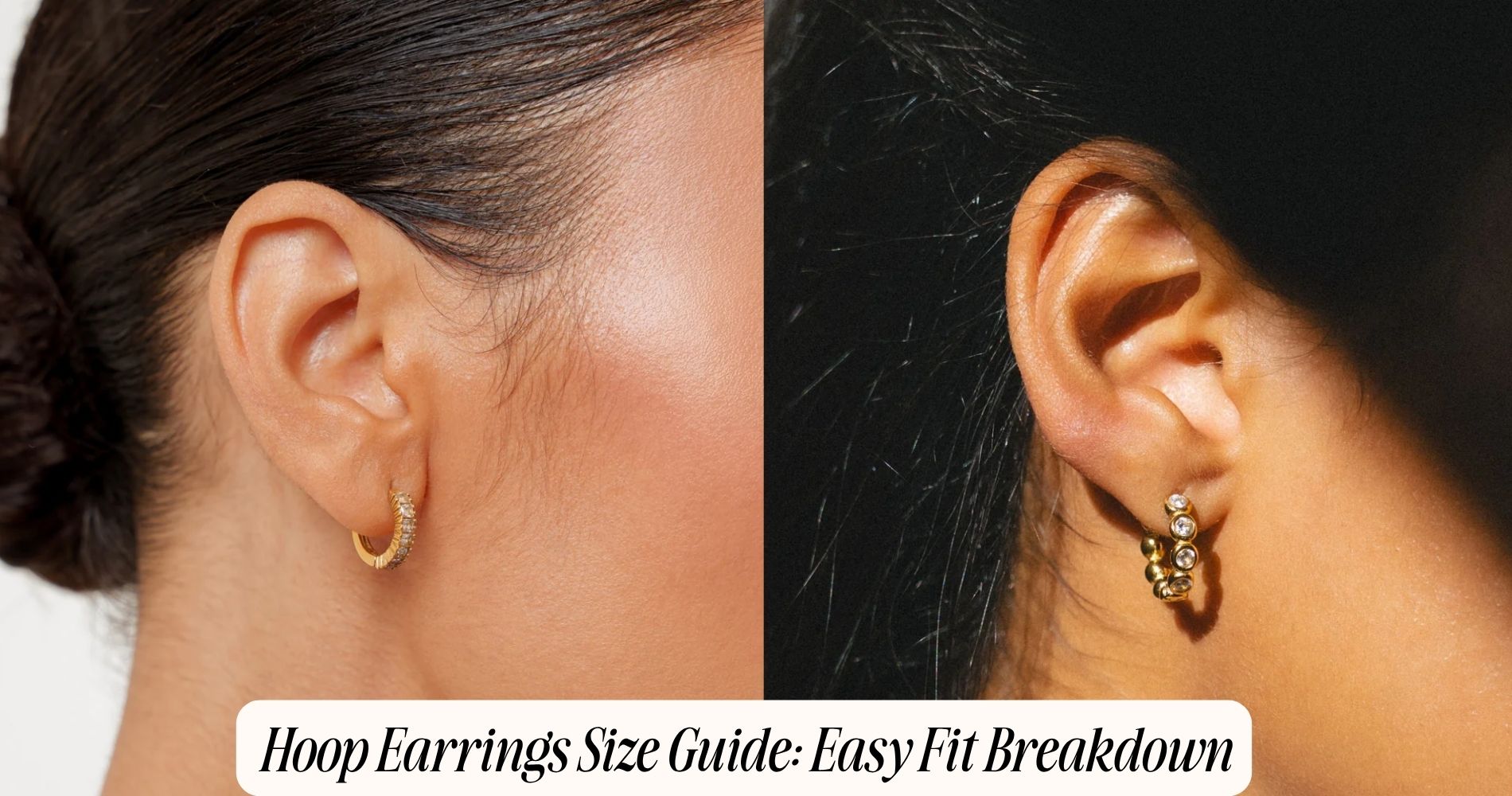
Hoop Earrings Size Guide: Easy Fit Breakdown
Hoop earring sizing is measured differently from stud sizing and the numbers can be misleading without context. A 30mm hoop looks very different on a small face than on a larger one, and a 15mm hoop that reads as a subtle classic on one person can look barely visible on another. A practical hoop earrings size guide gives you more than a number. It tells you what that number means on your specific proportions, how different sizes work for different occasions, and what wearing considerations matter beyond appearance. Hypoallergenic Hoop Earrings in a range of diameters are built to fit different face shapes and wearing contexts. This guide breaks down every size tier from huggie to oversized with the proportional context that makes the measurement actually useful.
How Hoop Earring Size Is Measured
Hoop size is measured by inner diameter: the distance across the empty space inside the hoop, not the overall outer width of the piece. This is an important distinction because two hoops of the same inner diameter can read differently in size depending on the wire gauge used. A thick-gauge hoop adds its own width to the inner diameter measurement, producing a noticeably larger overall circumference than a thin-wire hoop at the same listed size.
When a hoop is listed as 25mm, that measurement tells you how much space is inside the ring. The outer diameter, which is what your eye actually reads when the hoop is in your ear, is the inner diameter plus twice the wire thickness. For thin wire hoops (around 1mm gauge), the difference is minimal. For thicker tube hoops or flat hoops (2mm to 4mm gauge), the outer diameter can be 4mm to 8mm larger than the listed inner diameter.

How a hoop sits on the ear also affects visual size. The hoop does not sit centered on the earlobe: the top portion goes through the piercing, so roughly half the hoop hangs below the lobe and the upper half is pulled toward the ear canal. This means a 30mm inner diameter hoop drops approximately 15mm below the lobe. Knowing that drop distance helps you judge whether a given size will brush your jaw, sit at neck level, or sit cleanly above the jawline.
Hoop Earrings Size Guide: Every Tier Explained
Huggie Hoops (10mm to 14mm)
Huggie hoops are small, close-fitting hoops that sit snugly against the earlobe. The inner diameter is small enough that the hoop presses close to the ear rather than hanging away from it. At 10mm to 12mm, the hoop sits nearly flush. At 14mm, it begins to develop a slightly more visible circular shape while still sitting close.
Huggies are the most practical hoop style for active wear. Their close fit means they do not swing during movement, do not catch on towels, swim caps, or clothing, and stay secure through gym sessions, beach days, and swimming. For continuous wear including sleep, they are the most comfortable option because there is no pendulum movement against the neck.
For face proportions, huggies work across all face shapes because their minimal projection does not create strong tension with any facial geometry. They are the default recommendation for second or third piercings in a stacked ear because their size reads as a complement rather than a competing statement.
Small Hoops (15mm to 20mm)
At 15mm to 20mm inner diameter, a hoop transitions from huggie territory into a visible circle that hangs just at or slightly below the lobe. This size range is what most people picture as a classic small hoop: clearly a hoop shape, visible from a conversational distance, but understated enough for professional and everyday contexts.
A 16mm to 18mm hoop in a thin wire gauge is one of the most versatile everyday sizes because it registers as deliberate jewelry without dominating the face or creating movement that becomes distracting during the day. It suits most face shapes and works with most neckline types without requiring coordination.
This size range works particularly well for oval, heart, and longer face shapes, where the close-to-lobe fit does not add significant width at the ear level.

Medium Hoops (25mm to 35mm)
The 25mm to 35mm range is what most people identify as a standard hoop earring. At 25mm, the hoop drops approximately 12mm below the lobe. At 35mm, it drops approximately 17mm below the lobe, sitting well clear of the earlobe while still staying above the jaw on most face sizes.
| Inner Diameter | Drop Below Lobe | Visual Effect | Best Face Shapes |
|---|---|---|---|
| 25mm | 12mm | Classic circle, balanced presence | Oval, round, heart |
| 28mm | 14mm | Confident everyday hoop | Most shapes |
| 30mm | 15mm | Standard statement hoop | Oval, square, long |
| 35mm | 17mm | Clear presence, approaches jaw | Oval, square, long |
This range suits the widest variety of face shapes and occasions. For round face shapes, 25mm to 30mm creates a circular shape that can echo the face's roundness, so elongated oval hoops or those with a slightly angular profile at this diameter often work better than perfectly circular rings. For square and angular face shapes, the circular geometry of a round hoop softens the jaw visually.
For everyday casual wear, a 25mm to 30mm hoop in a medium wire gauge is the standard reference point: visible, present, and versatile from a coffee run to a beach day to an evening out.
Large Hoops (40mm to 50mm)
At 40mm to 50mm, a hoop makes a clear statement. The drop below the lobe at 40mm is approximately 20mm, and at 50mm it is approximately 25mm, which means the lowest point of the hoop sits roughly an inch below the lobe. On most people this places the hoop in the middle neck area.
This size range is best suited for casual, weekend, and occasion wear rather than daily professional contexts. The movement created by a 40mm to 50mm hoop during activity is noticeable and adds a kinetic quality to the piece that suits relaxed environments more than structured ones.
For face proportions, large hoops benefit longer or more angular face shapes by adding width at the jaw level. On rounder or shorter face shapes, very large circular hoops can amplify roundness. Oval or teardrop shapes in this diameter range work better for round faces because the vertical elongation of the shape counterbalances the face's width.

Oversized Hoops (55mm and Above)
Oversized hoops at 55mm and above are statement pieces that work best as a single focal point with a simple outfit. At 60mm, the hoop can reach toward or past the jaw on shorter necks. These sizes are not practical for physical activity, travel days, or extended wear because their weight and movement become uncomfortable over several hours.
They suit structured occasion wear, fashion-forward casual looks, and contexts where the earring is intended to be the centerpiece of the outfit. Thin wire construction in this size range reduces weight and makes them more wearable than tube or flat-profile hoops at the same diameter.
How Face Shape Affects Hoop Size Choice
Face shape is the most consistent variable that shifts the ideal size range up or down from the general guidelines.
Oval: The most versatile shape for hoop sizing. Most sizes from 15mm to 50mm work in proportion. The classic 25mm to 35mm range reads as balanced and is the default recommendation.
Round: Hoops that hang below the lobe create vertical length that elongates the face. The 25mm to 35mm range works well when the hoop shape has some oval quality or vertical emphasis. Very large circular hoops at 45mm and above can widen the visual field at jaw level and are better avoided in perfectly circular shapes.

Square: The circular or curved shape of a hoop softens angular jawlines effectively. Medium to large hoops at 30mm to 45mm work particularly well because the sweep of the circle creates contrast with the straight lines of a square jaw.
Heart: Width at the jaw balances the broader forehead. Medium hoops at 25mm to 35mm add that width naturally. Short huggies can accentuate the temple width, so dropping to the 20mm to 30mm range tends to create better balance.
Long or narrow: Shorter, wider hoop profiles at 15mm to 25mm add horizontal visual weight that benefits a narrow face. Very long drops from large hoops can extend the face further and are better balanced with the shorter end of the range.
Frequently Asked Questions
What is a good hoop size for everyday wear?
A 20mm to 30mm inner diameter hoop suits everyday wear for most face and ear proportions. This range is visible and present as jewelry without creating the movement and weight that larger sizes accumulate through a full day. For a first hoop purchase intended for daily use, 25mm in a thin or medium wire gauge is the most versatile starting point.
What hoop size suits a round face?
Hoops that drop below the lobe create vertical length that suits round faces better than hoops that sit close to the ear. A 25mm to 35mm hoop in an oval shape or with slight vertical emphasis works better than a perfectly circular hoop at the same diameter. Avoiding very large circular hoops above 45mm prevents adding further width at the jaw level.
How do I measure what hoop size I need?
Hold a ruler against your earlobe with the zero mark at your piercing hole. The point where you want the bottom of the hoop to sit gives you the approximate drop distance. Double that number to get the approximate inner diameter you need, since the hoop hangs roughly half its diameter below the piercing. This is a practical estimate rather than an exact calculation because the piercing position relative to the lobe edge also affects the final drop.
What is the difference between a 20mm and 30mm hoop?
A 30mm hoop has approximately 2.25 times the internal area of a 20mm hoop. Visually, the 30mm drops roughly 5mm further below the lobe and creates a noticeably larger circular sweep at conversational distance. On most medium-sized faces, a 20mm sits close to the lobe as a small refined circle while a 30mm reads as a classic medium hoop with clear presence. The difference is meaningful and both sizes are distinct rather than interchangeable.
Do hoop earrings suit all face shapes?
Yes, with size adjustments based on proportions. The circular shape of a hoop is inherently flattering across face shapes because its curved geometry contrasts with or softens most facial features. The key variable is diameter: smaller sizes for rounder faces where vertical drop matters, medium sizes for most shapes, and slightly larger sizes for square or angular faces where the curve of the hoop softens jaw lines.
Finding Your Hoop Size
A practical hoop earrings size guide starts with inner diameter as the base measurement and adjusts for wire gauge, face shape, and wearing context from there. Huggies at 10mm to 14mm for active daily and continuous wear. Small hoops at 15mm to 20mm for understated everyday styling. Medium hoops at 25mm to 35mm for the most versatile everyday to casual range. Large hoops at 40mm to 50mm for statement casual and occasion wear. The face shape guidelines shift those ranges by one tier in either direction, and lightweight hypoallergenic materials keep any size comfortable through a full day of wear.









Leave a comment
This site is protected by hCaptcha and the hCaptcha Privacy Policy and Terms of Service apply.