


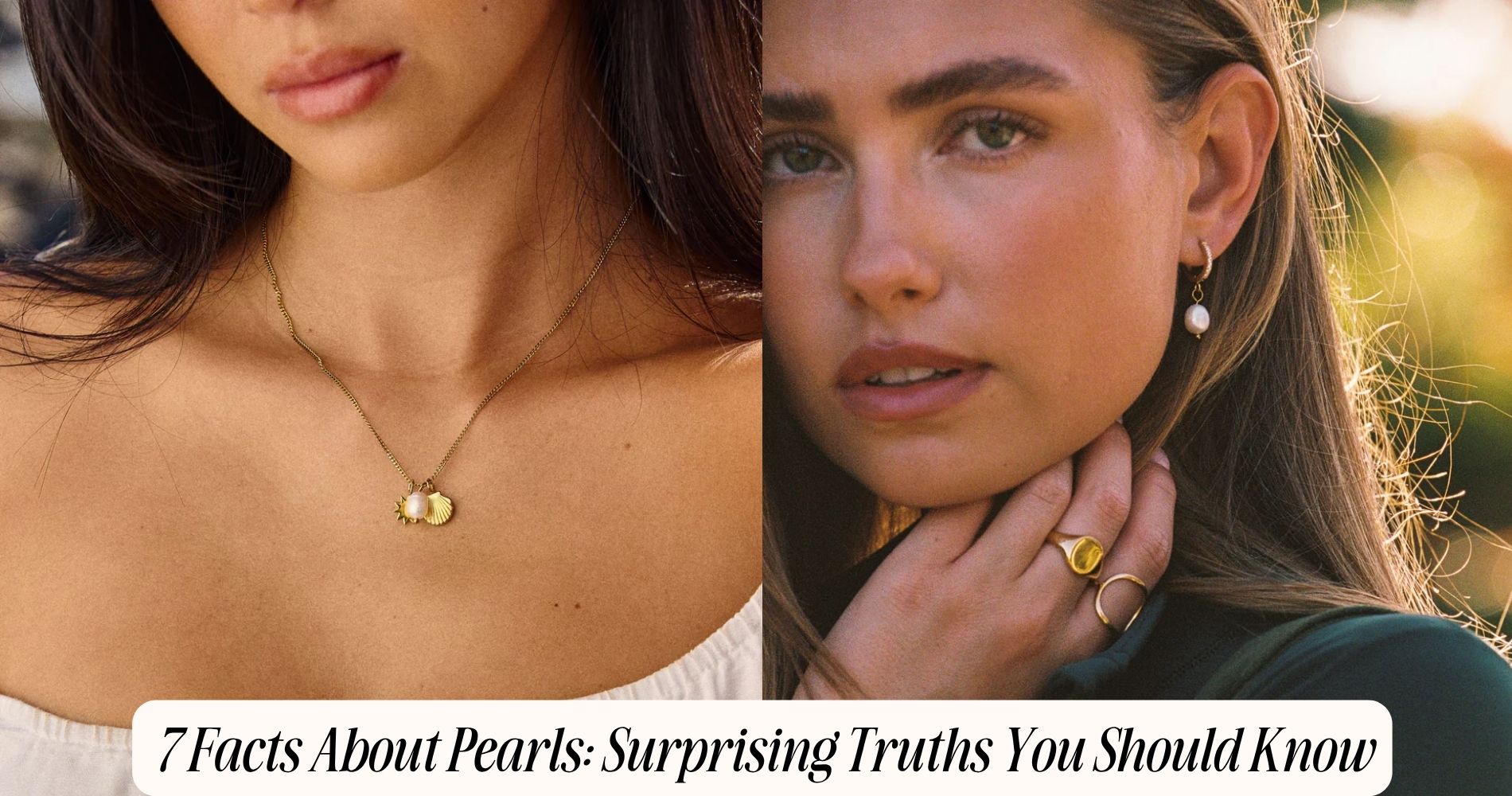
7 Facts About Pearls: Surprising Truths You Should Know
Exploring facts about pearls reveals that pearls are natural biominerals formed when mollusks build layered nacre—made of aragonite and conchiolin—around an irritant inside a pearl sac. While natural pearls are extremely rare, cultured pearls share the same composition but are created with human assistance. Learning key facts about pearls also means understanding the differences between Akoya, South Sea, Tahitian, and freshwater pearls, each recognized for unique luster, overtones, and shapes. Many everyday styles, including those in Atolea’s Freshwater Pearls Jewelry collection, highlight the versatility and beauty of these gems. Along the way, you can compare pricing factors, identify simple authenticity checks, and learn proper care methods that protect pearls for long-term wear.
How Pearls Are Formed in Nature
Although pearls seem almost magical, their formation follows a precise biological and mineralogical process inside a mollusk’s soft tissue. You start with an irritant—often a parasite or microscopic debris—penetrating the mantle epithelium. In a stable oyster environment, epithelial cells proliferate and form a pearl sac around this nucleus.
You then see secretion of nacre, a composite of aragonite platelets and conchiolin, in concentric lamellae. This biomineralization depends on tightly regulated ion transport, organic matrix proteins, and saturation levels of calcium carbonate.
Pearl anatomy reflects this layering: a central core, intermediary prismatic zone, and outer nacreous envelope. Growth lines record environmental fluctuations, while symmetry and crystal orientation determine luster, structural integrity, and the pearl’s long‑term optical performance.

Natural vs Cultured Pearls (and Why It Matters)
Once you understand how pearls form, the distinction between natural and cultured pearls becomes a question of origin, not composition. In both, the biomineral is the same—aragonite platelets bound by conchiolin—yet the initiation event differs.
Natural pearls arise from stochastic natural origins: an uncontrolled irritant enters the mollusk, triggering nacre secretion without human intervention.
Cultured pearls result from deliberate nucleation. Technicians perform surgical grafting, inserting a bead nucleus and mantle-tissue graft into the gonad or mantle. These farming techniques standardize pearl growth, diameter, and roundness, while allowing density-controlled stocking and environmental monitoring.
You should care because rarity, traceability, and value diverge sharply. Natural pearls command extreme scarcity premiums; cultured pearls offer consistency, ethical sourcing oversight, and scalable production without exhausting wild oyster populations.
Types of Pearls and How to Identify Them
Understanding origin sets the stage for recognizing what’s actually in front of you: the major commercial pearl types—Akoya, South Sea, Tahitian, and freshwater—each exhibit diagnostic signatures in luster, overtone, bodycolor, nacre thickness, and surface texture.
You’ll distinguish saltwater pearls (Akoya, South Sea, Tahitian pearls) by their sharper specular luster and often more saturated, predictable hues, versus freshwater pearls, which show softer glow, diverse shapes, and pastel bodycolors.
Akoya pearls are typically small, near-round, with mirror-like luster and neutral to rose overtones.
Tahitian pearls display natural gray-to-black bodies with green or peacock overtones.
South Sea pearls show satin luster and white, silver, or golden bodies.
Baroque pearls and keshi pearls reveal non-nucleated, irregular morphologies, demanding careful pearl grading criteria.

Why Some Pearls Cost Thousands (and Others Don’t)
A pearl’s price hinges on a tight interplay of rarity, formation mechanics, and grading metrics—factors that transform visually similar gems into pieces worth a few dollars or several thousand.
When you analyze pearl pricing factors, you’re really evaluating nacre thickness, luster intensity, surface cleanliness, size, and origin. Natural pearls, with uncontrolled biomineralization and microscopic nuclei, command premiums over cultured pearls because you’re paying for geological timescales and extreme scarcity.
You’ll see luxury pearl brands charge more not just for marketing, but for rigorous selection protocols, tight calibration, and provenance documentation.
High-end strands often use near-perfectly matched pearls from the same harvest, dramatically increasing labor and rejection rates. Conversely, mass-market pieces use thinner-nacred, visibly blemished pearls with relaxed grading tolerances.
Pearl Colors, Shapes, and What Makes Them Beautiful
Color and shape turn pearls from simple calcium carbonate objects into highly engineered optical surfaces, and gemologists read these traits the way a materials scientist reads a phase diagram. You’re really evaluating nacre architecture: platelets of aragonite stacked with organic binders that control light interference, producing pearl luster.
You’ll see bodycolor (white, cream, golden, black), overtone (rose, silver, green), and orient (subtle iridescent play) as separate optical phenomena. Round pearls maximize symmetry and value, but baroque, drop, and button shapes reveal growth stresses and mantle dynamics.
Pearl size interacts with nacre thickness—large diameters with fine, compact layering intensify luster and color saturation. When you compare strands, you’re unconsciously grading surface topology, refractive index contrasts, and geometric uniformity.
Are Your Pearls Real? Simple Tests You Can Try
How can you tell if the strand in your jewelry box is cultured nacre or molded plastic? You start with basic pearl authentication methods.
First, use the “tooth test”: glide a pearl gently across your incisors. Genuine nacre feels microscopically gritty due to crystalline aragonite platelets; glass or plastic feels uniformly smooth.
Next, examine surface topography under magnification—real pearls show irregular overtones, subtle growth lines, and non-identical blemish patterns, essential for distinguishing imitation pearls.
Check temperature and weight: authentic pearls feel cool initially, then warm against skin, and usually weigh more than acrylic beads.
Roll them on a flat surface; slightly irregular pearls won’t track perfectly straight. For higher certainty, consult a gemologist for X-ray or refractometer verification.
Caring for Pearls So They Last a Lifetime
Because pearls are biomineral composites rather than inert stones, you must treat them as delicate organic gems whose nacreous layers can dehydrate, abrade, or chemically etch over time.
You’ll protect them by mastering conservative cleaning techniques: use a barely damp, soft microfiber cloth, pH‑neutral water, and avoid detergents, ultrasonic units, steam, alcohol, or acids that compromise the aragonite tablets and conchiolin matrix.
Dry strands flat so stretched silk doesn’t wick moisture through drill holes.
Adopt protective storage solutions: keep pearls in a breathable, fabric‑lined box or pouch, segregated from harder gemstones and metals to prevent surface scratching.
Never use airtight plastic; minimal ambient humidity preserves luster.
Put pearls on last, after cosmetics and perfume, and remove them before chlorinated or saltwater exposure.

Frequently Asked Questions
Can Men Wear Pearls, and How Are They Styled in Modern Fashion?
You can absolutely wear pearls; modern masculinity embraces pearl accessories via layered chokers, baroque pendants, asymmetrical earrings, and mixed-metal chains, pairing them with structured tailoring, streetwear silhouettes, monochrome palettes, and textural contrasts for calibrated, contemporary visual impact.
Are Pearls Considered Ethical or Sustainable Compared to Other Gemstones?
You’ll generally find pearls more ethical than mined gemstones because controlled pearl farming can regenerate reefs, though you must audit environmental impact, chemical usage, farming density, labor practices, and traceability certifications (e.g., RJC, MSC-style standards) to validate sustainability claims.
Do Pearls Have Symbolic Meanings in Different Cultures and Traditions?
Yes, you’ll find pearls encode diverse symbolic meanings: in East Asia, you associate them with purity and wisdom; in Western iconography, you link them to virtue; many cultures’ traditional beliefs assign protective, fertility, and status-related cultural significance.
Can Pearls Be Used in Engagement Rings or Everyday Jewelry Without Damage?
You can use pearls in engagement rings and daily wear, but pearl durability is moderate. Prioritize protective settings, low-abrasion environments, regular restringing, and gentle cleaning; these engagement ring considerations minimize nacre erosion, surface scratching, dehydration, and chemical degradation.
How Have Pearls Been Portrayed in Art, Literature, and Historical Royal Jewelry?
You see Pearl symbolism convey purity, wealth, and mortality; artists deploy lustrous highlights and chiaroscuro; writers encode pearls as virtue or loss; royal regalia showcases graded strands, baroque drops, and en tremblant mounts as status-signaling Artistic interpretations.
Conclusion
Now that you understand nacre formation, luster, orient, and surface quality, you can evaluate pearls with a more critical eye. You’ll distinguish natural from cultured, recognize Akoya versus South Sea or Tahitian, and spot treatments or imitation materials. Use simple tests to verify authenticity, then store pearls properly, avoid harsh chemicals, and restring them periodically. With consistent care and informed buying, you’ll preserve structural integrity, minimize dehydration, and maintain that iridescent glow for decades.









Leave a comment
This site is protected by hCaptcha and the hCaptcha Privacy Policy and Terms of Service apply.