


What Is the Meaning of Mosaic: Complete Guide
Mosaic art has captivated people for thousands of years, transforming small, individual pieces of glass, stone, tile, or other materials into a unified, often stunning larger image or pattern. But beyond its visual beauty, mosaic carries a deeper symbolic meaning that has evolved across centuries of use in art, architecture, and design. If you have ever wondered what is the meaning of mosaic beyond its technical definition, the answer touches on themes of unity, resilience, and the beauty found in bringing many small pieces together.
In this guide, we will explore the history and symbolism behind mosaic art, how different cultures have used and interpreted this technique, and why mosaic inspired design continues to resonate in modern jewelry and style. If you love the idea of pieces built to handle real, everyday life the way mosaic art has endured for centuries, our Waterproof Jewelry collection offers designs made to last through daily wear.
What Is the Meaning of Mosaic
At its most basic level, mosaic refers to an artistic technique in which small individual pieces, called tesserae, typically made from materials like glass, stone, ceramic, or tile, are arranged together to form a larger image or decorative pattern. The word itself derives from the Greek term mouseios, meaning belonging to the muses, reflecting the technique's long standing association with inspired, artistic creation.
Beyond this technical definition, mosaic has come to symbolize something much broader: the idea that many small, seemingly disparate pieces can come together to form something whole, beautiful, and meaningful, a metaphor that has resonated across art, philosophy, and personal identity throughout history.

The Historical Origins of Mosaic Art
Mosaic art dates back thousands of years, with some of the earliest known examples found in ancient Mesopotamia, where small pieces of stone and shell were used to decorate walls and columns as far back as the third millennium BCE. The technique developed further and became particularly prominent within ancient Greek and Roman culture, where elaborate mosaic floors and walls depicting mythological scenes, geometric patterns, and everyday life became a hallmark of wealthy homes, public buildings, and religious structures.
This long, rich history across multiple ancient civilizations laid the foundation for mosaic's continued use and symbolic significance throughout later periods, including its prominent role within Byzantine religious art and architecture, where mosaic became closely associated with spiritual and religious storytelling.
Symbolic Meanings of Mosaic
Beyond its specific artistic technique, mosaic carries several layered symbolic meanings that have developed and evolved throughout its long history of use.
Unity From Many Parts
Perhaps the most widely recognized symbolic meaning associated with mosaic is the idea of unity formed from many individual, smaller pieces. Just as a mosaic artwork combines countless small tesserae into a single cohesive image, this technique has become a powerful metaphor for how diverse, individual elements, whether people, experiences, or ideas, can come together to form something greater and more meaningful as a whole.
Resilience and Transformation
Mosaic art often involves taking broken, fragmented, or discarded materials and transforming them into something beautiful and purposeful. This process has given mosaic a symbolic association with resilience and transformation, representing the idea that even broken or seemingly imperfect pieces can be reassembled into something new and valuable.

Complexity and Individuality Within a Whole
While a mosaic image appears unified from a distance, each individual tessera remains distinct and visible upon closer inspection. This duality has made mosaic a meaningful symbol for the relationship between individuality and community, representing how personal uniqueness can still contribute to and enhance a larger, shared whole.
Patience and Deliberate Creation
Because mosaic art requires painstaking, deliberate placement of countless small individual pieces, the technique has also come to symbolize patience, careful attention to detail, and the value of slow, intentional creation, particularly in contrast to more immediate or impulsive forms of artistic expression.
Mosaic Symbolism Across Different Cultures
Ancient Roman and Greek Traditions
Within ancient Roman and Greek culture, mosaic art frequently depicted mythological scenes and stories, using the technique's inherent symbolism of unity and assembled beauty to visually reinforce the broader narratives and cultural values being portrayed through these detailed, elaborate artworks.
Byzantine Religious Art
Byzantine mosaic art, particularly prominent within religious buildings and churches, closely tied the technique's symbolism to spiritual themes, using the assembly of small, individual pieces to represent the broader unity of faith and community within religious tradition.
Islamic Art and Architecture
Within Islamic art and architectural tradition, intricate geometric mosaic patterns became closely associated with mathematical precision, spiritual reflection, and the representation of infinite, divine patterns through repeated geometric forms, reflecting a slightly different but equally significant symbolic interpretation of the mosaic technique.
Modern Symbolism of Mosaic
In more contemporary contexts, mosaic has taken on additional symbolic meaning, particularly within discussions of personal identity, community, and diversity. The phrase mosaic of experiences or cultural mosaic has become a popular way to describe the idea that individual differences and diverse backgrounds can combine to create a richer, more vibrant collective whole, drawing directly on mosaic art's long standing symbolic association with unity formed from distinct, individual parts.
This modern interpretation has extended mosaic's symbolic reach well beyond visual art specifically, into broader conversations about community, personal growth, and the value found in bringing diverse elements together.
Mosaic Inspired Design in Modern Jewelry
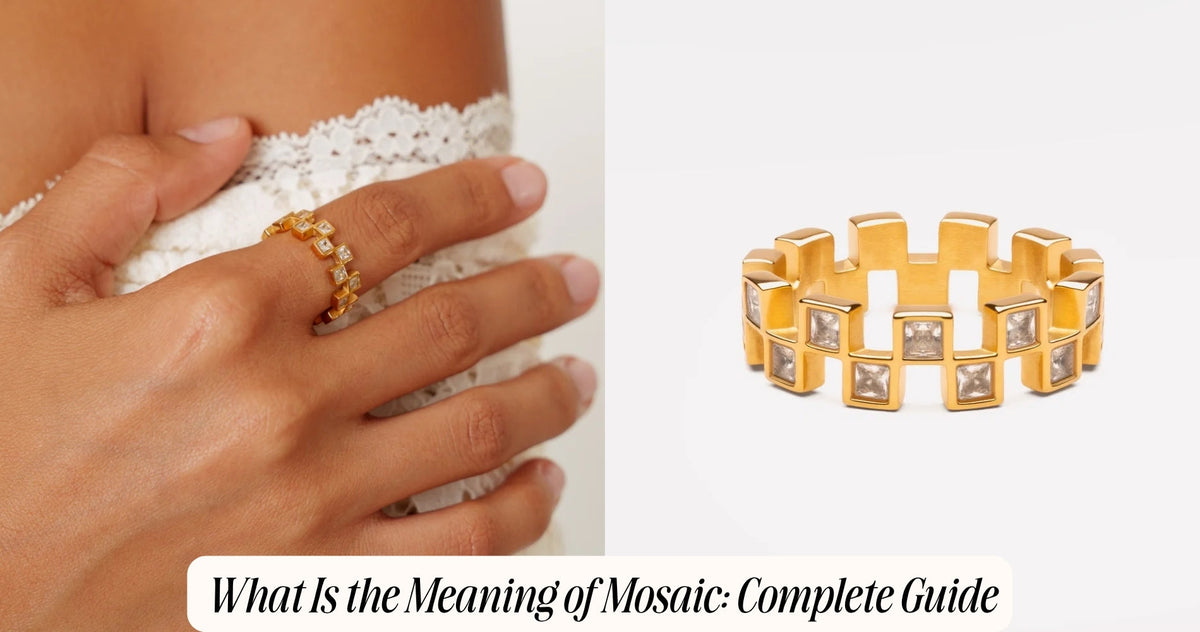
Given its rich symbolic history and striking visual appeal, mosaic patterns have become an increasingly popular design element within modern jewelry. Mosaic inspired pieces, whether featuring literal small tile or stone arrangements or simply drawing visual inspiration from the technique's layered, assembled aesthetic, offer a way to carry this meaningful symbolism throughout daily life.
For many people, mosaic inspired jewelry serves as a personal reminder of resilience, the beauty of unity formed from individual pieces, or simply an appreciation for the patience and craftsmanship this ancient technique represents.

Why Mosaic Symbolism Continues to Resonate
Part of what makes mosaic such an enduring, meaningful symbol is its ability to represent both individuality and connection simultaneously. Few artistic techniques manage to capture this particular duality quite as effectively, offering a visual metaphor that remains just as relevant today as it was thousands of years ago within ancient civilizations first developing this remarkable art form.
This layered symbolism allows mosaic to resonate across a wide range of personal interpretations, whether someone is drawn to its historical connection to unity and community, its representation of resilience and transformation, or simply its visually striking, intricate beauty.
Incorporating Mosaic Meaning Into Your Own Life
If mosaic symbolism resonates with you personally, there are several meaningful ways to incorporate this rich tradition into your everyday life beyond simply appreciating mosaic artwork from a distance. Choosing mosaic inspired jewelry or decor can serve as a daily, tangible reminder of the values this ancient art form represents, whether that is resilience through difficult transformation, unity found in diversity, or simply patience and intentional, careful creation.

Final Thoughts
So, what is the meaning of mosaic? At its core, this ancient artistic technique represents unity formed from many individual pieces, resilience through transformation, and the beauty found in patient, deliberate creation. From its origins in ancient Mesopotamia through its prominent use across Roman, Byzantine, and Islamic artistic traditions, mosaic has carried these layered symbolic meanings for thousands of years, continuing to resonate within modern design and personal symbolism today.
Whether you connect with mosaic symbolism through its rich art historical roots or simply its striking, intricate beauty, this timeless technique offers a meaningful way to celebrate the idea that many small, individual pieces can come together to form something truly remarkable.
Frequently Asked Questions
1. What does the word mosaic literally mean?
Mosaic derives from the Greek term mouseios, meaning belonging to the muses, reflecting the technique's long standing association with artistic inspiration.
2. What does mosaic symbolize in a broader, non artistic sense?
Mosaic commonly symbolizes unity formed from many individual parts, as well as resilience and transformation through the reassembly of smaller, sometimes fragmented pieces.
3. Where did mosaic art originate?
Some of the earliest known mosaic art dates back to ancient Mesopotamia, though the technique became particularly prominent within later Greek, Roman, and Byzantine traditions.
4. Why is mosaic used as a metaphor for community or diversity?
Because mosaic art combines many distinct individual pieces into a single, unified image, it serves as a fitting visual metaphor for how diverse individual elements can come together to form a richer collective whole.














Leave a comment
This site is protected by hCaptcha and the hCaptcha Privacy Policy and Terms of Service apply.