


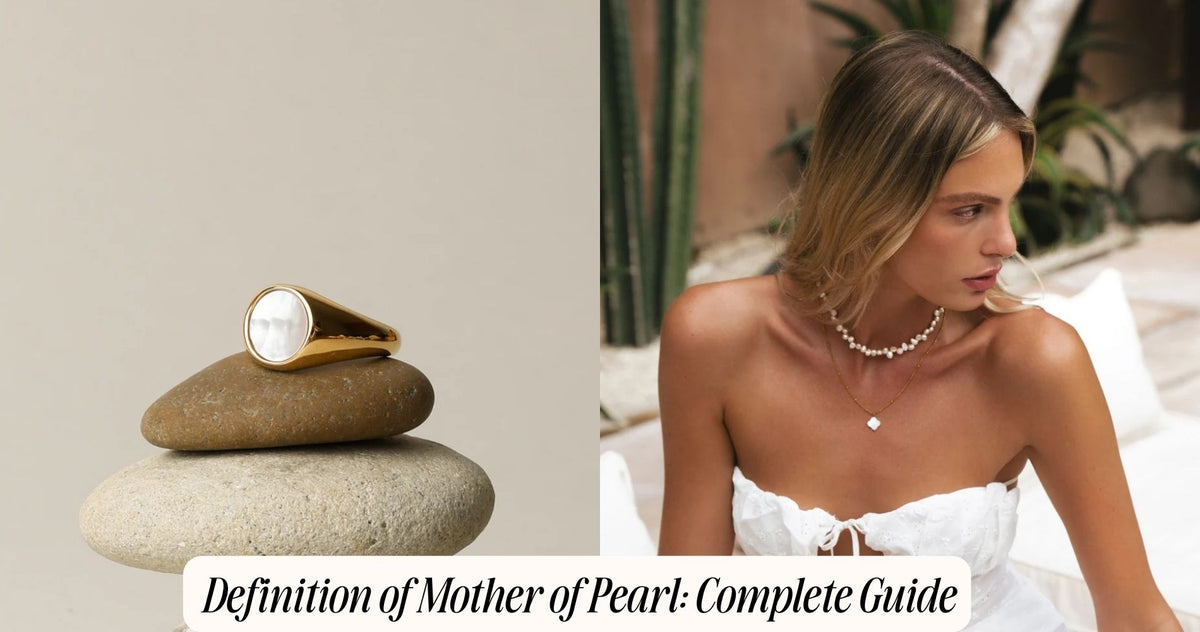
Definition of Mother of Pearl: Complete Guide
Mother of pearl shows up constantly in jewelry descriptions, from button embellishments to inlaid pendants, but many people are surprised to learn it is not actually the same thing as a pearl at all. Understanding the true definition of mother of pearl clears up a common point of confusion and reveals a material with its own distinct identity, formation process, and long history of use in decorative art and jewelry.
In this guide, we will explain exactly what mother of pearl is, how it forms, how it differs from a pearl itself, and why it remains such a popular material in jewelry today. If you love the luminous, iridescent quality mother of pearl shares with true pearls, our Single Pearl Necklaces collection offers genuine pearl pieces worth exploring alongside it.
Definition of Mother of Pearl
Mother of pearl, also known by its scientific name nacre, is the iridescent, layered material that certain mollusks, primarily oysters, mussels, and abalone, secrete to line the interior of their shells. This same substance is also what mollusks use to coat an irritant when forming an actual pearl, which is precisely why the two materials are so closely related, share a similar luminous appearance, and are frequently confused with one another despite being genuinely distinct products of the same biological process.
In short, mother of pearl is the smooth, iridescent shell lining itself, while a pearl is a separate, rounded formation that develops when the same nacre substance builds up in layers around a specific irritant inside the mollusk.

How Mother of Pearl Actually Forms
To understand mother of pearl clearly, it helps to understand the mollusk's biological process from the beginning. Mollusks like oysters and mussels secrete nacre continuously throughout their lives as a protective measure, lining the entire interior surface of their shell with smooth, hardened layers. This coating serves a practical biological purpose, smoothing over any rough or irritating surfaces on the inside of the shell and protecting the mollusk's soft body from damage.
When a foreign object, such as a grain of sand or a parasite, becomes lodged inside the shell rather than simply being part of the shell's interior surface, the mollusk responds by coating that specific irritant with the same nacre substance, gradually building up layer upon layer around it. Over time, this process produces the free formed, rounded structure recognized as a pearl. Mother of pearl, by contrast, remains fixed in place as part of the shell's actual structure rather than forming as a separate, standalone object.
Mother of Pearl Versus Pearl: Key Differences
While both materials share the same underlying substance and similar iridescent luster, several practical differences separate mother of pearl from an actual pearl.
Formation Location
Mother of pearl coats the interior surface of the shell itself, remaining permanently attached as part of the shell's structure. A pearl forms as a separate, freestanding object inside the mollusk, unattached to the shell and capable of being removed as an individual gem.
Shape and Consistency
Because mother of pearl lines the shell's interior, it takes on a relatively flat or gently curved form, following the natural shape of the shell. Pearls, by contrast, typically develop a rounded or oval form, since they build up in layers around a central irritant in a more three dimensional way.
Value and Rarity
Pearls, particularly natural pearls formed without human intervention, are considerably rarer and more valuable than mother of pearl, since not every oyster produces a usable pearl, while mother of pearl lines the shell of essentially every relevant mollusk and can be harvested in much larger, more consistent quantities.
How Each Is Obtained
Pearls must be carefully extracted from inside a mollusk, often requiring the animal to be opened and, in wild harvesting, frequently resulting in the mollusk's death regardless of whether a usable pearl is found. Mother of pearl is harvested directly from the shell itself after the mollusk has already been processed, typically for food, meaning it is often considered a byproduct material obtained more efficiently and at a larger scale.

Where Mother of Pearl Comes From
Mother of pearl is sourced from a variety of mollusks around the world, each contributing slightly different color and quality characteristics to the finished material.
Oysters, particularly certain saltwater varieties, produce mother of pearl with the classic white to cream coloring most commonly recognized in jewelry and decorative applications.
Abalone, a type of large sea snail, produces mother of pearl with a strikingly vivid, multicolored iridescence, often displaying blues, greens, and purples across its surface, making it a particularly popular choice for statement jewelry pieces.
Freshwater mussels also produce usable mother of pearl, historically significant for their role in the mother of pearl button industry, which thrived throughout the early 20th century before synthetic materials became more widely available.
Historical Use of Mother of Pearl
Mother of pearl has been used decoratively for thousands of years, appearing in ancient jewelry, inlay work, and religious artifacts across numerous civilizations. Its natural iridescence made it a prized material long before modern gemology existed, valued simply for its beautiful, shifting luster under different lighting conditions.
During the 19th and early 20th centuries, mother of pearl became especially significant in the button making industry, with entire communities built around harvesting freshwater mussels specifically to produce mother of pearl buttons before plastic alternatives eventually took over much of that market.
Mother of Pearl in Modern Jewelry
Today, mother of pearl remains a popular material across a wide range of jewelry styles, prized for offering a similar luminous, iridescent quality to true pearls at a considerably more accessible price point. Because it can be cut and shaped more flexibly than a pearl, which is naturally constrained to its rounded form, mother of pearl is frequently used in inlay work, cut into specific decorative shapes, or set as flat panels within pendants, earrings, and rings.
Its relative affordability compared to pearls also makes mother of pearl a popular choice for larger statement pieces or designs incorporating the material across a broader surface area, applications that would be considerably more costly using actual pearls given their smaller, naturally rounded form.

Caring for Mother of Pearl Jewelry
Because mother of pearl shares nacre's organic, somewhat porous composition with true pearls, it requires similarly gentle care. Avoid soaking mother of pearl jewelry in water for extended periods, apply perfume and lotion before putting the jewelry on rather than after, and store pieces separately from harder materials to prevent scratching, since mother of pearl is relatively soft compared to many gemstones.
Clean mother of pearl gently using a soft, slightly damp cloth rather than harsh chemicals or abrasive cleaning methods, which can dull its natural iridescence over time.
Is Mother of Pearl a Genuine, Valuable Material
While mother of pearl does not carry the same value or rarity as an actual pearl, it is a genuine, naturally occurring material rather than an imitation or synthetic substitute. Its lower cost compared to pearls reflects greater availability rather than any lack of authenticity, and high quality mother of pearl, particularly from abalone with especially vivid, multicolored iridescence, can still command meaningful value within jewelry and decorative art markets.

Final Thoughts
Understanding the definition of mother of pearl clears up a common point of confusion in the jewelry world. It is the iridescent nacre lining found inside the shells of certain mollusks, sharing its origin and luminous quality with true pearls but remaining a distinctly different material in terms of formation, shape, and value. Whether used in delicate inlay work, statement jewelry pieces, or classic button design throughout history, mother of pearl continues to offer a beautiful, accessible way to enjoy nacre's natural iridescence.
Frequently Asked Questions
1. Is mother of pearl the same substance as a pearl?
Yes, both are made of nacre, but mother of pearl lines the interior of the shell itself, while a pearl is a separate, rounded formation that develops around an irritant inside the mollusk.
2. Is mother of pearl less valuable than an actual pearl?
Generally yes, since mother of pearl can be harvested in larger, more consistent quantities from the shell, while true pearls, especially natural ones, are considerably rarer.
3. What mollusk produces the most colorful mother of pearl?
Abalone is particularly known for producing vividly iridescent mother of pearl, often displaying blues, greens, and purples across its surface.
4. How should I care for mother of pearl jewelry?
Treat it gently, similar to true pearls, avoiding prolonged water exposure, harsh chemicals, and contact with harder materials that could scratch its relatively soft surface.









Leave a comment
This site is protected by hCaptcha and the hCaptcha Privacy Policy and Terms of Service apply.