

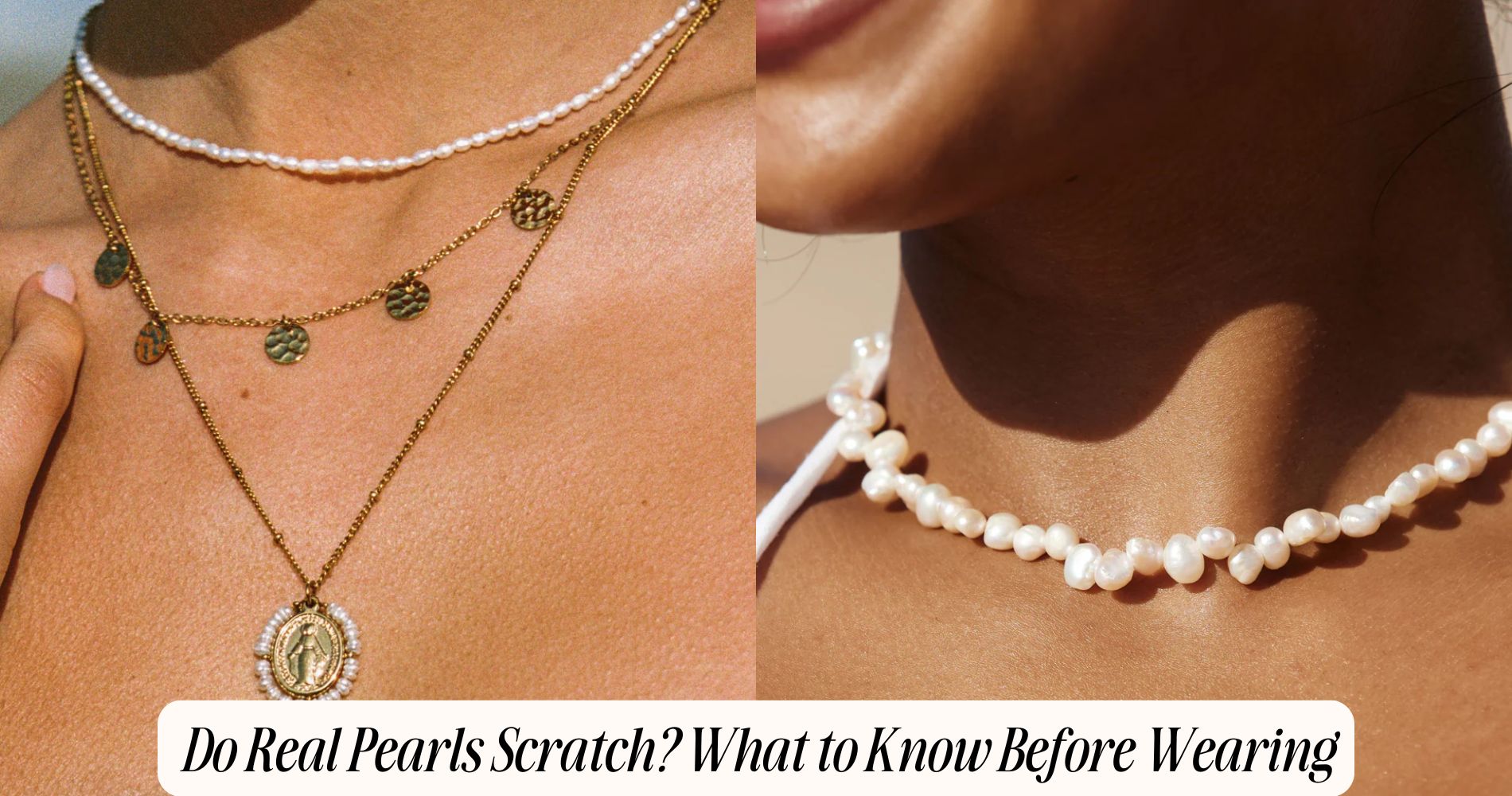
Do Real Pearls Scratch? What to Know Before Wearing
Do real pearls scratch? Yes—real pearls do scratch because they’re made of nacre: aragonite platelets bound by conchiolin, with a Mohs hardness of about 3.5–4. This means friction, grit, and contact with harder surfaces can cause micro-abrasions and dull luster over time. Acidity, salts, and low humidity accelerate wear at the platelet interfaces. You can spot genuine pearls through quick checks like the tooth test (slightly gritty feel), gentle rub test (fine nacre powder), layered drill holes, uneven luster, and natural growth marks. To protect pieces like Freshwater Pearls Jewelry, wipe pearls after wear, avoid chemicals, never use ultrasonic cleaners or soaking, and store them softly at 45–55% relative humidity. There’s more you can do to preserve both performance and beauty.
How Real Pearls Scratch and Why It Happens
Although nacre looks lustrous and smooth, real pearls can scratch because their microstructure is relatively soft and layered. You’re wearing a biomineral made of aragonite platelets bonded by an organic matrix (conchiolin).
This pearl composition forms a brick-and-mortar architecture that dissipates energy but trades hardness for toughness. On the Mohs scale, aragonite sits around 3.5–4, so asperities from harder materials, like quartz dust or steel, can abrade the surface.
When frictional contact occurs, shear stresses concentrate at platelet interfaces, initiating micro-abrasion and interlamellar delamination. Repetitive sliding produces ploughing grooves, matte burnish, and loss of luster.
Environmental chemistry matters: acidic sweat or low pH degrades the biopolymer, reducing scratch resistance; dehydration embrittles interfaces; high humidity softens them.
You improve durability by minimizing particulate contact, reducing sliding, and controlling exposure to aggressive chemistries.

Simple Tests to Tell Real Pearls From Imitations
Understanding how nacre abrades sets up practical field tests you can run without instruments.
Start with tooth testing: glide a pearl lightly across your incisors. True nacre feels microscopically gritty due to aragonite platelets; glass or plastic feels slick.
Next, perform the rub test—gently abrade two pearls together. Real pearls generate fine nacre powder; coatings on fakes may flake or reveal substrate.
Evaluate luster and orient under diffuse light. Authentic nacre shows depth and interference; uniform, paint-like shine signals typical imitation pearl characteristics.
Inspect drill holes: look for concentric nacre layers and clean separations; chipping, bubbling, or a glass bead core indicates a simulant.
Use magnification to assess surface topology. Natural growth marks beat perfectly regular textures—core pearl identification techniques.
Everyday Habits That Put Pearls at Risk
Because nacre is a bioceramic composite of aragonite platelets and conchiolin, everyday routines can accelerate micro-abrasion, dehydration, and chemical etching.
When you wear pearl jewelry during daily activities, you expose the nacreous surface to particulate abrasion from handbags, zippers, and desk edges, generating fine scratches along platelet boundaries.
Friction from collars and knit fabrics functions like low-grit lapping, dulling interference colors.
Household cleaners, fragrances, and hair spray introduce acids, alcohols, and surfactants that disrupt the organic matrix, promoting etching and loss of gloss.
Perspiration adds salts and lowers pH, enhancing dissolution at grain boundaries.
Dry, heated air dehydrates conchiolin, increasing brittleness and spall risk.
Fitness routines add impact and shear, while dishwashing and swimming combine thermal cycling with chloride-induced corrosion mechanisms.

Care and Cleaning Tips to Preserve Luster
While nacre tolerates gentle handling, you’ll preserve interference gloss by treating pearls as a hydrated, soft bioceramic composite with a vulnerable organic matrix.
Wipe them after wear with lint-free polishing cloths to remove sweat salts, skin lipids, and particulate grit that accelerate abrasion. Use only pH-neutral cleaning solutions—ideally deionized water with a drop of mild, unscented surfactant—to avoid denaturing the conchiolin binder or etching aragonite tablets.
Rinse briefly, then blot dry; don’t soak, since prolonged immersion can swell the protein matrix and weaken adhesion between nacre platelets.
Avoid ammonia, peroxide, alcohols, ultrasonic agitation, steam, and abrasive media; these induce micro-pitting and loss of constructive interference.
Inspect knot integrity while cleaning so strands don’t flex under wet load.
Finish with a gentle, straight-line wipe to minimize swirl-induced micro-scratches.
Safe Storage and Smart Wearing Practices
Even off the wrist or neck, pearls keep interacting with their environment, so control mechanics, chemistry, and humidity to limit nacre damage.
Use storage solutions that isolate each strand: a soft, nonabrasive pouch or a lined, compartmentalized box prevents pearl-to-pearl and metal contact. Avoid desiccants; nacre dehydrates and microcracks.
Maintain moderate relative humidity (~45–55%) and stable temperature to reduce thermal expansion mismatch between nacre tablets and organic matrix.
Adopt wearing precautions that minimize abrasive wear and acid exposure. Put pearls on last, after sunscreen, perfume, and hair spray have volatilized; remove them first to avoid zipper or clasp scuffing.
Keep them off during exercise—salt sweat lowers pH and increases chloride ion attack. Wipe with a damp, neutral cloth post-wear; fully dry before storage.

Frequently Asked Questions
Do Different Pearl Types Vary in Scratch Resistance?
Yes. Different pearl types exhibit varying scratch resistance due to microstructure. You’ll find Akoya and freshwater pearls softer; Tahitian similar; South Sea marginally tougher. Orientation of aragonite platelets, nacre thickness, crystallite cohesion, and surface finish govern abrasion behavior.
How Do Scratches Affect Pearl Value and Resale?
Scratches reduce value by disrupting nacre continuity, lowering pearl grading for luster, surface, and symmetry. You’ll see steeper discounts in the resale market, especially for matched strands, as defects impair optical interference, microtexture uniformity, and perceived durability.
Can a Jeweler Professionally Buff Out Pearl Scratches?
Yes—but only minimally. A jeweler can micro-polish nacre to blend fine abrasions, not deep gouges. You’ll prioritize pearl maintenance: humidity control, soft storage, gentle cleaning, restringing. For scratch prevention, avoid abrasives, ultrasonic cleaners, perfumes, and hard-surface friction during wear.
Are Pearl Coatings or Sealants Recommended?
No. You shouldn’t apply coatings or sealants; they can yellow, delaminate, and alter luster. Instead, practice pearl maintenance: gentle cleaning, soft storage, last-on/first-off wear. For pearl protection, minimize abrasion, acid, heat, and dehydration to preserve nacre integrity.
What Insurance Coverage Applies to Scratched Pearl Jewelry?
Your coverage typically falls under scheduled personal property in homeowners or renters insurance policies. You’ll need current jewelry appraisals, photos, and proof of loss. Exclusions may apply for wear abrasions; add riders covering accidental damage, mysterious disappearance, transit.
Conclusion
You now know pearls aren’t scratch-proof: nacre’s aragonite platelets and conchiolin matrix resist abrasion better than glass beads, yet they’re softer (Mohs ~2.5–4). Use tactile drag, luster depth, drill-hole inspection, and magnification to verify authenticity. Minimize micro-abrasion and acid attack by avoiding cosmetics, sweat, and rough fabrics. Clean with deionized water and mild surfactant; never ultrasonics. Store in humidity-stable, fabric-lined compartments, isolated from harder materials. Wear last, remove first—preserving nacre thickness, iridescence, and structural integrity.









Leave a comment
This site is protected by hCaptcha and the hCaptcha Privacy Policy and Terms of Service apply.