


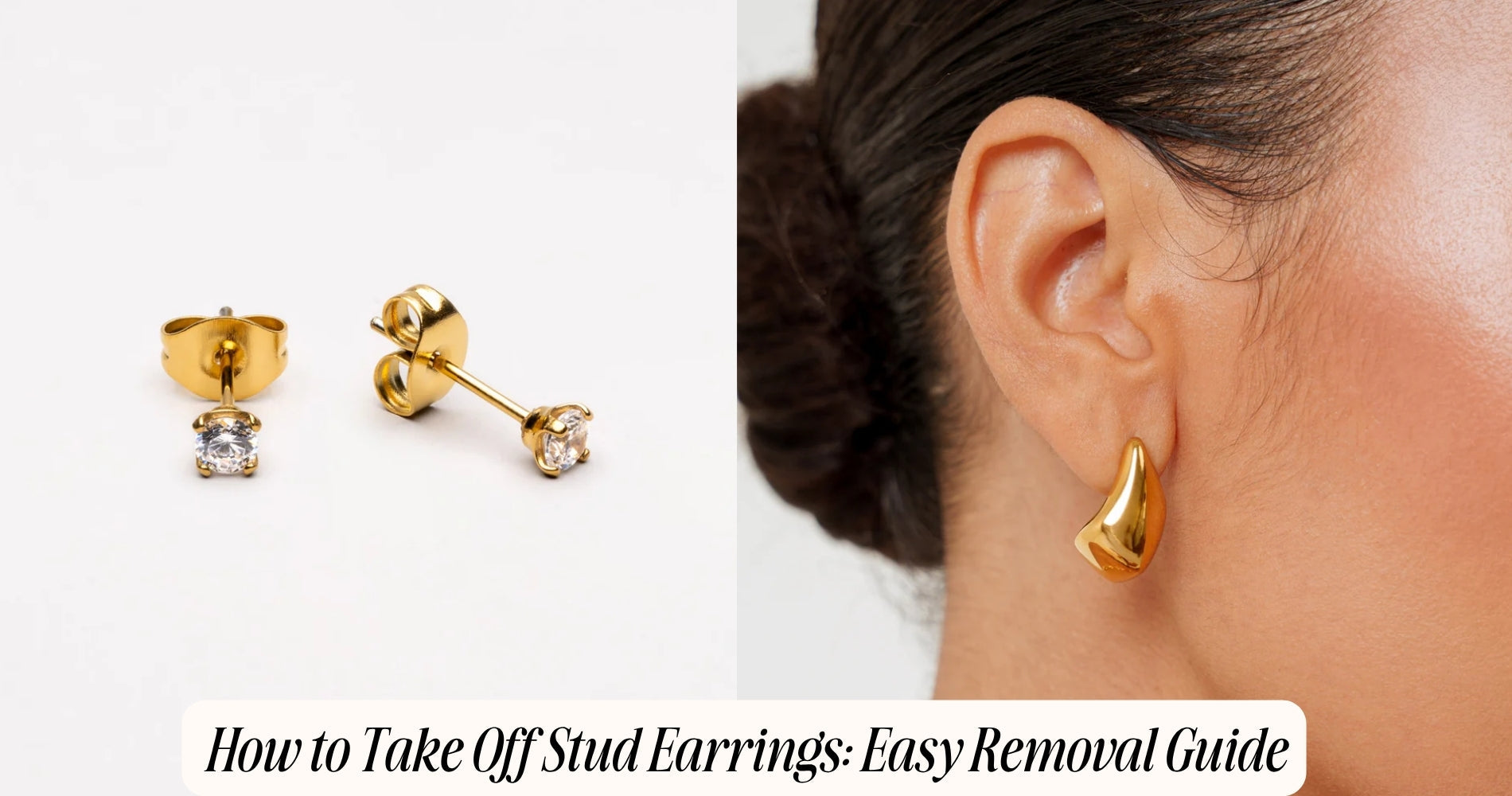
How to Take Off Stud Earrings: Easy Removal Guide
Stud earrings look simple, but the wrong removal technique on the wrong back type causes more discomfort and bent posts than most people realize. Knowing how to take off stud earrings correctly means matching your technique to the specific back mechanism, whether that is a standard butterfly, a screw back, or a flat back labret. Waterproof Earrings in flat back styles are among the pieces people most often ask how to remove correctly. This guide covers the correct removal method for every stud back type, how to handle a stud that will not budge, what to do differently for new piercings, one-handed removal technique, and safe removal for children.
Before You Start
A few basics apply regardless of back type. Wash your hands thoroughly before touching any earring or piercing to avoid transferring bacteria to the site. Work in front of a mirror with good lighting rather than by feel alone, since fumbling in low light is the most common cause of unintended pressure on the lobe. Keep your movements slow and steady rather than quick or forceful, since studs and their backs are small and any excess force tends to bend the post or pinch the skin rather than release the earring cleanly.

How to Take Off Stud Earrings: Butterfly Back
Butterfly backs, also called push backs or friction backs, are the most common stud closure and generally the easiest to remove correctly.
Hold the front of the earring face gently but securely between your thumb and index finger of one hand, which stabilizes the post and prevents it from bending during removal. With your other hand, pinch the butterfly back between your thumb and index finger and pull it straight backward along the same line as the post, rather than at an angle. If the back feels tight, a very small side-to-side wiggle while maintaining steady backward pressure usually releases it without needing extra force. Once the back is off, the stud slides forward and out of the piercing easily.
The most common mistake with butterfly backs is pulling downward or at an angle instead of straight back, which bends the post slightly and makes future insertions and removals progressively harder.
How to Take Off Stud Earrings: Screw Back
Screw backs thread onto the post and are common on higher-quality studs, particularly pieces with diamonds or other set stones, because they hold more securely than a standard friction back.
Hold the front of the earring steady with one hand to keep the post from spinning along with the back. With your other hand, grip the screw back and turn it counterclockwise, the same direction as loosening any standard screw. It will unwind gradually with a few rotations and slide off the post. If it feels stuck, double check that you are turning counterclockwise rather than clockwise, since turning the wrong way tightens the mechanism further rather than releasing it.

How to Take Off Stud Earrings: Flat Back (Threaded)
Threaded flat back studs use a front piece that screws onto a flat disc sitting behind the lobe.
Hold the flat back disc steady against the rear of your lobe with one hand. With your other hand, grip the decorative front piece and turn it counterclockwise. It unscrews and separates from the post after a few rotations. Once the front is off, the post and flat back disc slide out through the front of the piercing together.
Never attempt to push the flat disc through the front of the piercing without first removing the decorative front piece, since the disc is generally too wide to pass through the channel and forcing it will tear the piercing.
How to Take Off Stud Earrings: Flat Back (Threadless)
Threadless flat backs use a push-fit pin rather than a screw thread. The front piece stays in place through a slight bend in the pin that creates friction inside the post tube.
Hold the flat back disc steady with one hand. With your other hand, grip the front piece and pull it straight forward with one smooth, continuous motion rather than a series of small tugs. It will release with a small pop or click as the bent section of the pin clears the tube opening. Once the front piece is off, the post slides out through the front of the piercing.

What to Do With a Stud That Will Not Come Off
Studs get stuck for a few specific, identifiable reasons, and each has a different fix.
Swelling is the most common cause. A new or recently irritated piercing can swell enough to make the back feel embedded or unusually tight. Do not force removal. Apply a clean, cold compress to the area for five minutes to reduce swelling, then try again with gentle, steady pressure. If the back still will not budge, stop and consult a piercer rather than continuing to force it.
An overtightened screw back is the second common cause. If a screw back feels impossible to turn, confirm you are turning counterclockwise. A small piece of a clean rubber glove or a rubber jar-opening pad pressed against the back for extra grip often provides enough traction to start the turn on a very small or smooth screw back.
A corroded or tarnished post is a third possibility. A post made from a reactive metal can develop a rough, slightly sticky surface over time from corrosion, making removal harder and more uncomfortable than it should be. A small amount of a gentle, unscented oil applied around the front of the piercing before attempting removal can lubricate the channel enough to ease the stud out. Longer term, switching to a non-reactive post material prevents this from recurring.
An embedded back is the most serious possibility. If a back appears to have sunk into the skin rather than simply feeling tight, do not attempt home removal. This requires a professional piercer or healthcare provider to remove safely without causing tissue damage.

Removing Studs From New or Healing Piercings
For a genuinely new piercing, generally within the first six to eight weeks, avoid removing the original starter studs unless specifically instructed to by your piercer or unless there is a medical reason to do so. Healing piercings can begin to close within a matter of hours once jewelry is removed, and reinserting jewelry into a partially closed, still-healing channel risks irritation and can disrupt the healing process significantly.
If removal is medically necessary during this period, for an X-ray or MRI, for example, remove as gently as possible using the appropriate method above for the specific back type, and reinsert as soon as the procedure allows, ideally within a few hours.
One-Handed Removal Technique
For situations where only one hand is free, most stud types can still be removed with practice, though it requires more careful technique than the standard two-handed approach.
For butterfly backs, press the back gently against a flat surface, like the pad of your thumb resting against your palm, to create resistance while your fingers pinch and pull the back away from the post. For screw backs, brace the front of the earring against your fingertip while using your thumb and one other finger to rotate the back counterclockwise. This is slower and requires more patience than two-handed removal, so allow extra time rather than rushing, which increases the risk of dropping or losing a small piece.

Frequently Asked Questions
How do you take off a stud earring with a butterfly back?
Hold the front of the earring steady with one hand and pinch the butterfly back with your other hand, pulling it straight backward along the line of the post rather than at an angle. A gentle side-to-side wiggle helps release a back that feels tight. Once removed, the stud slides forward out of the piercing.
How do you remove a screw back earring that is stuck?
Confirm you are turning counterclockwise, since turning clockwise tightens the mechanism rather than releasing it. Hold the front of the earring steady to keep the post from spinning along with the back. If the back is too small or smooth to grip firmly, a piece of clean rubber glove pressed against it provides extra traction to start the turn.
Can you take off stud earrings with one hand?
Yes, with more careful technique than standard two-handed removal. For butterfly backs, brace the back against a flat surface like your palm while pinching and pulling with your fingers. For screw backs, brace the front against a fingertip while rotating the back counterclockwise with your thumb and another finger. Move slowly to avoid dropping small pieces.
Is it safe to remove stud earrings from a new piercing?
Generally, no, not within the first six to eight weeks unless instructed by your piercer or medically necessary. New piercings can begin closing within hours of jewelry removal, and reinserting into a partially closed channel risks irritation and disrupts healing. If removal is unavoidable during this period, reinsert as soon as possible afterward.
Why is my stud earring stuck and won't come out?
The most common reasons are swelling in a new or irritated piercing, an overtightened screw back, or a corroded post that has developed a rough surface making it harder to slide through the channel. Cold compress for swelling, confirming counterclockwise rotation for screw backs, and a small amount of gentle oil for a corroded post each address the specific cause. If a back feels embedded rather than simply tight, seek professional help rather than continuing to force it.
Removing Any Stud With Confidence
How to take off stud earrings correctly starts with identifying the back type, butterfly, screw, or flat back, and applying the specific technique that releases that mechanism rather than forcing it. Butterfly backs pull straight back. Screw backs turn counterclockwise. Flat backs unscrew or pull forward before the post slides out. For stuck studs, addressing the specific cause, swelling, an overtightened screw, or a corroded post, resolves the problem without risking damage to the earring or discomfort to the piercing.









Leave a comment
This site is protected by hCaptcha and the hCaptcha Privacy Policy and Terms of Service apply.