



What Are Pearls Used For in Jewelry
What are pearls used for? Pearls shape luster, movement, and silhouette across jewelry styles—think round studs and low-profile huggies for everyday wear, articulated drops and tassels for statement impact, solitaire pendants on fine chains, layered strands, snug chokers, and stackable or cuff bracelets with secure settings. For timeless minimalism, explore designs from our Single Pearl Necklaces collection, where simplicity highlights natural glow. Choose akoya, freshwater, South Sea, or Tahitian pearls by nacre thickness, overtone, and size. Baroque and keshi pearls add texture for casual styling, while high-orient rounds elevate formal looks. There’s more to optimize your selections ahead.
Pearl Studs and Everyday Earrings
Two essential profiles dominate everyday pearl earrings: classic round studs and low-profile huggies with pearl drops.
You’ll evaluate nacre thickness, orient, and luster first; thicker nacre yields deeper glow and better wear. For studs, opt for matched roundness (±0.1 mm), clean surfaces, and tension-secure friction backs or screw backs.
Huggies should feature hinged hoops with secure clicks and low swing to protect the gem’s soft aragonite.
Select pearl origins thoughtfully: Akoya for mirror luster in smaller diameters, freshwater for durability and value, South Sea for satin luster and larger calibers, Tahitian for natural greys and peacock overtones.
Prioritize pearl care: avoid acids, abrasives, and ultrasonic cleaners; wipe after wear; store in soft-lined compartments.
Choose 14k–18k gold or platinum findings to resist corrosion.

Statement Drop and Dangle Earrings
While studs stay close to the lobe, statement drops and dangles leverage length, articulation, and massing to dramatize a pearl’s orient and luster.
You can specify baroque, button, or teardrop pearls to control silhouette; larger nacre thickness amplifies iridescence under movement. Hinged links, chain tassels, or articulated frames create oscillation, increasing scintillation across micro-layered nacre.
Choose white, golden, or peacock Tahitian pearls for chroma; match overtones with metals—platinum for cool rosé, high-karat gold for warm champagne.
You’ll anchor weight with balanced findings: lever-backs for security, elongated French wires for graceful swing.
Consider gem pavé top elements to add counterweight and visual hierarchy in bold designs. Reference cultural significance through motifs—keshi cascades, South Sea graduates, or jhumka-inspired domes—while maintaining proper gauge, comfort, and biomechanical stability.
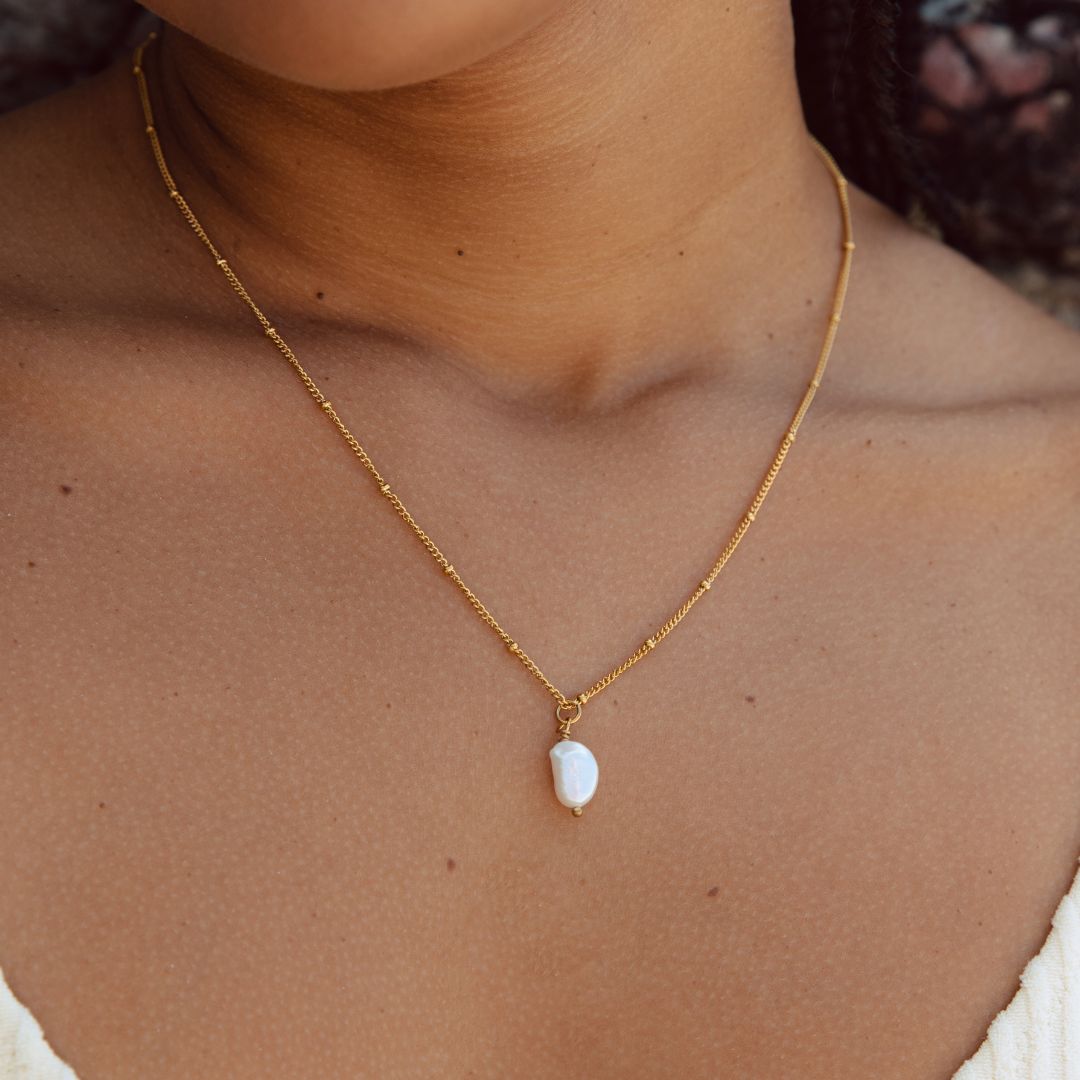
Delicate Pendants and Solitaire Necklaces
Something deceptively simple defines delicate pendants and solitaire necklaces: a single pearl engineered to read as weightless, centered, and luminous on the collarbone. You evaluate nacre thickness, surface luster, and symmetry, then select Akoya, South Sea, or freshwater pearls to match scale and undertone.
A fine cable or trace chain provides minimal visual interference, while a hidden bail or discrete peg setting stabilizes orientation and prevents spin. Choose 14k/18k gold or platinum for tensile strength and tarnish resistance; micro-jump rings and soldered endpoints add security.
You’ll fine-tune chain length for anatomical balance—typically 16–18 inches—and calibrate pearl diameter for proportionality. These pendants deliver timeless designs and seamless wear, integrating with elegant layering without visual noise.
Precision drilling, reinforced grommets, and friction-fit endcaps enhance durability and daily comfort.
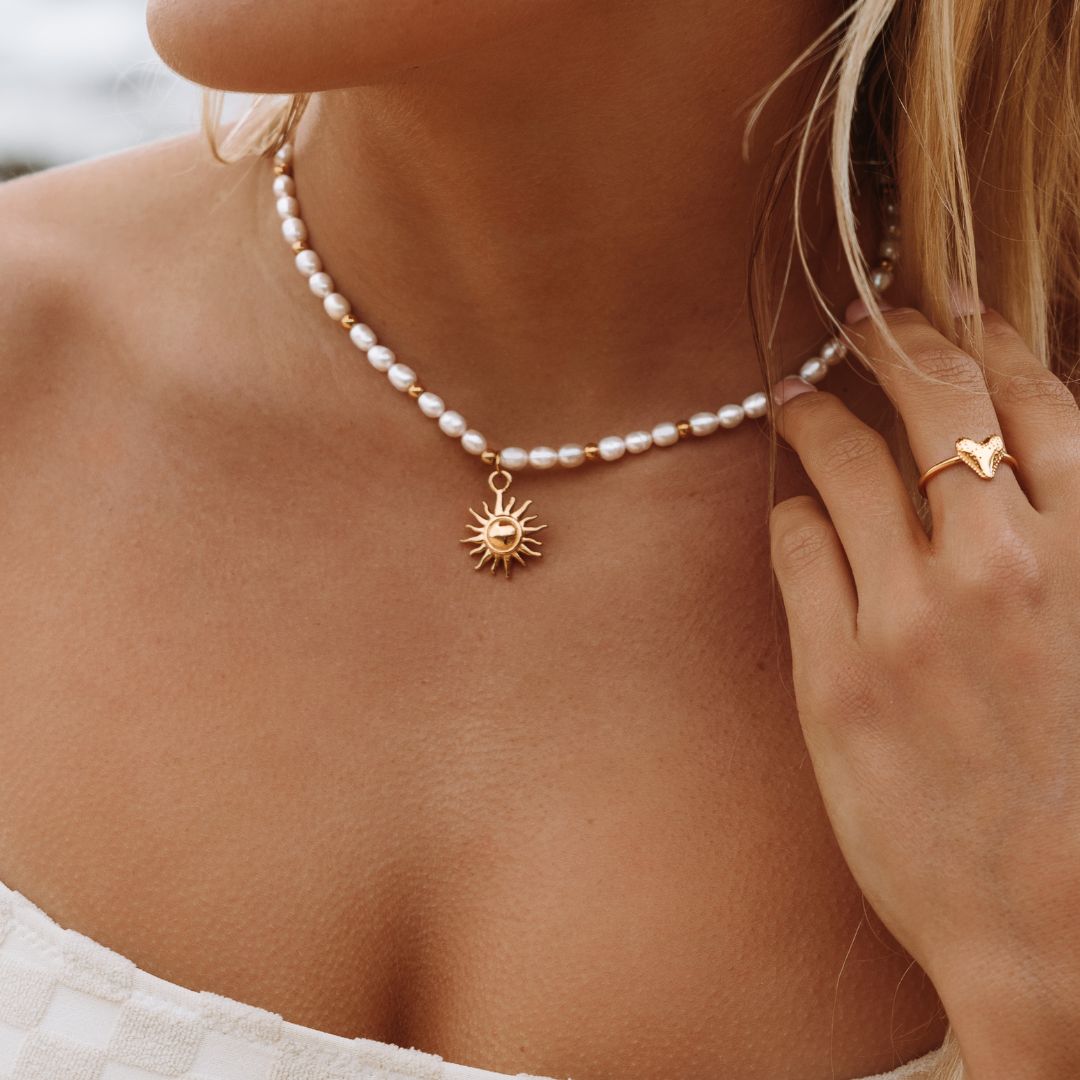
Layered Pearl Strands and Chokers
One disciplined approach to layered pearl strands and chokers treats length, millimeter size, and luster as interlocking variables that control proportion and rhythm across the neckline.
You calibrate strand hierarchy by alternating 6–7 mm near-gem rounds with 8–9 mm focal pearls, keeping nacre thickness high for mirror-like luster.
For choker styles, maintain a snug 14–15 inch inner line, then stage 16–20 inch drops to create graduated drape and controlled negative space.
Use matched overtones—rose, silver, or cream—to prevent chromatic discord.
You can vary drill orientation and knot spacing to fine-tune lay and articulation.
Select discreet clasps—box, fishhook, or bayonet—in matching alloys to preserve visual continuity.
These layered looks leverage symmetry, micro-graduation, and consistent surface quality for refined dimensionality.
Stackable and Cuff Bracelets With Pearl Accents
Choker discipline extends to the wrist, where stackable and cuff bracelets balance pearl scale, metal gauge, and spacing to control visual mass and tactility. You’ll tune nacre thickness, diameter uniformity, and luster grade so pearls read crisp against polished, brushed, or oxidized finishes.
In stackable designs, alternate micro pearls with spacer beads, low-profile links, or slim bangles to modulate height and prevent abrasion. Use flexible beading wire or articulated bars to maintain drape and mitigate torque.
For cuff styles, specify spring-tempered alloys, precise opening tolerances, and endcaps that cradle pearls without point loading. Seat pearls on posts with adhesive plus mechanical capture; align them along the neutral axis to reduce shear.
Mix white, golden, or black pearls to adjust color temperature while preserving ergonomic balance.
Classic and Modern Pearl Rings
Although traditions anchor the category, pearl rings now span bezel-set classics to sculptural, open-shank architectures that showcase the gem’s volume and surface optics.
You evaluate nacre thickness, luster grade, and surface clarity, then select settings that protect while presenting the pearl’s sphericity.
For a vintage pearl look, you might choose milgrain bezels, split-shank filigree, or halo frames using Old European–style pavé to amplify orient without overloading metal weight.
In contemporary designs, you’ll see tension-inspired mounts, knife-edge shanks, and negative-space galleries that float South Sea or Akoya pearls above the finger.
Pairing pearls with baguette or step-cut side stones adds linear contrast to the gem’s radial sheen.
Opt for low-profile cups, reinforced posts, and subtle silicone or cork buffers to mitigate abrasion.

Bridal and Special-Occasion Pearl Jewelry
Building on ring architecture and pearl performance, bridal and gala pieces prioritize harmony between nacre quality and formality cues.
For ceremony wear, you’ll favor high-luster, blemish-minimal pearls with tight overtone control—rose or silver for cool palettes, cream for warmth. Uniformity in millimeter diameter signals refinement; 7–9 mm suits minimalists, while 9–11 mm reads stately for aisle optics and flash photography.
Necklines drive stringing strategy: choker or collar lengths stabilize symmetry; opera lengths elongate silhouette. Choose knotting with silk and protected French wire for longevity.
Earrings benefit from balanced mass—studs with secure friction backs or omega clips; drops need calibrated cup-and-peg settings. In bridal trends and special occasions, prioritize matched overtone sets across necklace, earrings, and bracelet to maintain colorimetric consistency under varying light.
Mixed-Metal and Gemstone Pairings With Pearls
While pearl nacre reads neutral, its overtone and bodycolor dictate ideal metal alloys and gemstone chroma for disciplined pairings. You’ll assess pearl color first: cool Akoya with rose or silver overtone favors platinum, palladium, or rhodium-finished white gold for maximum metal compatibility and optical coherence.
Warm golden South Sea sings with high-carat yellow gold; champagne hues tolerate bronze accents. Tahitian peacock or pistachio tones thrive against black rhodium or darkened sterling for contrast without chromatic clash.
Select gemstones by complementary wavelength and saturation. Diamonds, white sapphire, or moissanite add scintillation without color shift. For hue harmony, match overtone: pink spinel with rosé Akoya, demantoid with pistachio Tahitian, mandarin garnet with golden South Sea.
Avoid abrasives near nacre; use bezel or halo architectures that buffer contact and mitigate Mohs-scale disparities.
Unique Shapes: Baroque, Keshi, and Beyond
Three non-round pearl morphologies—baroque, keshi, and free-form hybrids—expand your design vocabulary beyond calibrated rounds.
You’ll leverage baroque characteristics like asymmetry, lobes, and tailing to create directional flow and negative-space interplay. High-nacre thickness amplifies iridescence and orient, while ridges catch specular highlights.
Keshi variations, formed without a bead nucleus, deliver solid-nacre bodies, sharper luster, and micro-faceted surfaces that read almost metallic under point light. Choose drill orientation—side, top, or diagonal—to exploit silhouette and balance.
Free-form hybrids, including flame, soufflé, and ripple types, invite sculptural bezel strategies, articulated links, and protective settings that respect delicate overtones.
Evaluate surface cleanliness, nacre integrity, and thickness with a loupe; grade for matching by color temperature, overtone family, and approximate volumetric mass rather than diameter.

Styling Tips for Casual to Formal Pearl Looks
Curiously, you can calibrate pearl form, size, and overtone to the dress code by treating them like materials with specific visual outputs.
For casual styling, prioritize baroque or keshi pearls with matte to satin luster; their irregular morphology reads relaxed. Choose smaller diameters (5–7 mm), shorter chain lengths, and mixed-metal findings to reduce visual mass. Use station necklaces, seed-pearl hoops, or threader earrings for low-profile kinetics.
For business smart, move to near-round akoya or freshwater, 7–8.5 mm, medium luster, neutral overtones (rose, silver). A single-strand collar or studs deliver controlled reflectance and clean silhouettes.
For formal styling, scale up: round South Sea or Tahitian, 9–12 mm+, high orient and mirror luster. Opt for graduated strands, torsades, or rivière layouts with discreet platinum or gold mountings.
Frequently Asked Questions
How Do Cultured Pearls Differ From Natural Pearls in Jewelry?
You distinguish them by origin and structure: cultured pearl characteristics include induced nucleation, controlled growth, consistent luster, uniform nacre layering. Natural pearl rarity yields irregular shapes, variable nacre thickness, heterogeneous crystallography, unpredictable orient. You’ll verify via X-ray radiography and fluorescence, evaluating growth rings and nuclei.
What Factors Determine Pearl Quality and Grading Standards?
You evaluate pearl quality by luster characteristics, nacre thickness, surface blemishes, shape regularity, size (mm), color/overtone harmony, and matching. You apply grading systems (AAA–A, A–D), assess orient, symmetry, drill alignment, and species origin (Akoya, South Sea, Tahitian).
How Should Pearls Be Cleaned and Stored to Prevent Damage?
Use gentle cleaning techniques: wipe nacre with a damp, soft cloth, pH‑neutral soap, no ultrasonics or abrasives. Dry fully. For storage methods, keep pearls in breathable pouches, separate from metals, moderate humidity, avoid heat, acids, cosmetics, and dehydration.
Are Pearls Ethical and Sustainably Sourced in Modern Jewelry?
Yes—if you verify ethical sourcing and sustainable practices. You assess farm certification (RJC, MSC), biodiversity safeguards, water-quality monitoring, hatchery provenance, worker welfare audits, traceability chain-of-custody, and low-impact harvesting. You prioritize recycled metals, transparent suppliers, and third-party-verified lifecycle assessments.
Can Pearls Be Resized, Restrung, or Repaired Over Time?
Yes. You can’t do pearl resizing, but you can restring and perform pearl repair. A jeweler reknots with silk or poly thread, replaces clasps, resets pearls with epoxy, re-drills cautiously, polishes nacre lightly, and stabilizes compromised drill holes.
Conclusion
You’ve seen how pearls elevate everything from studs to chokers with nacre luster, orient, and surface grade driving impact. Use baroque and keshi for organic asymmetry, or round Akoya for precision symmetry. Pair with 14k gold, platinum, or oxidized silver; contrast with diamonds, sapphires, or enamel in bezel, prong, or pavé settings. Layer strands by millimeter size and length; stack cuffs with micro-pearl accents. For bridal or black-tie, prioritize matched overtone, high luster, and secure findings.











Leave a comment
This site is protected by hCaptcha and the hCaptcha Privacy Policy and Terms of Service apply.